Your group’s ready to play, but the Dungeon Master bailed, and AI Dungeon’s co-op still glitches. We spent six weeks testing today’s AI-GM tools and scored nine standouts on multiplayer depth, onboarding speed, creative freedom, value, and community buzz. Use our rubric to pick the platform that keeps your Friday night rolling.
How we ranked every platform
Before we dive into platform #9, here’s what we measured and why it matters.
When we say “multiplayer,” we mean any setup where two or more players shape one story in real time, turn by turn, or through a shared persistent world. That covers online lobbies, local pass-and-play on a single tablet, and worlds you build today then hand off tomorrow. Purely solo tools didn’t qualify.
We scored each product on five weighted factors:
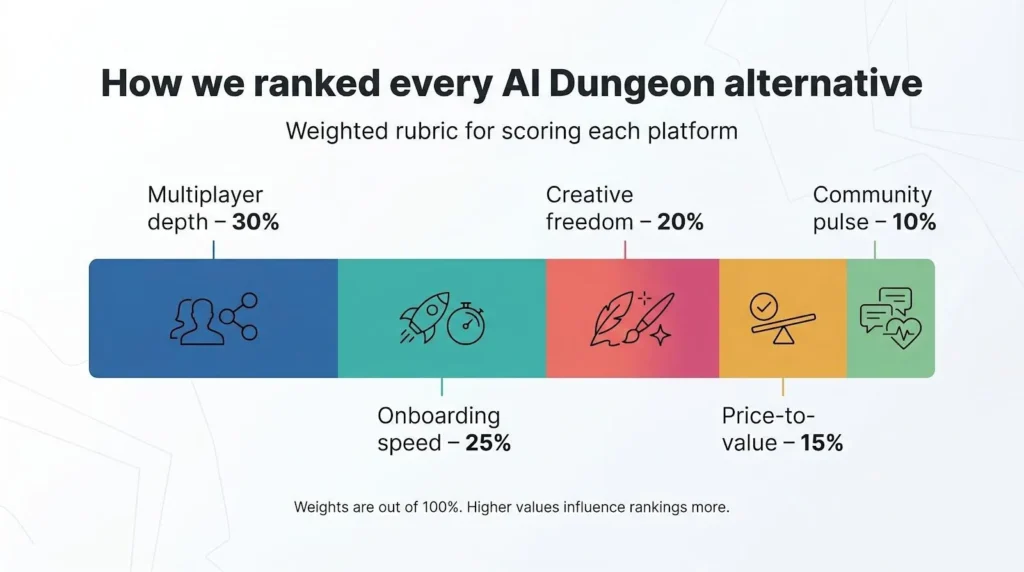
Multiplayer depth 30%
Onboarding speed 25%
Creative freedom 20%
Price-to-value 15%
Community pulse 10%
These weights keep comparisons fair and stop a flashy feature from tilting the list.
Each review follows the same four-step pattern: quick context, key strengths, honest drawbacks, and ideal use case. The rhythm helps you skim while giving Google clear, snippet-ready chunks.
We also cut any platform that 1) hides multiplayer behind a vague paywall, 2) offers no free trial, or 3) merely copies another tool. What remains is a focused lineup that saves you time and money.
For example, DreamGen’s Pro tier lists a 30,000 token context window and unlimited access to premium AI models, according to its pricing page, which nearly maxes out our Creative freedom metric.
Those deep dive setup options also add a couple of minutes to first-session onboarding, so DreamGen still needed solid scores in the other three areas to reach number one. The example shows how our weighting keeps one standout feature from deciding the whole race.
Ground rules set, let’s meet contender number nine.
9 The Infinite DM: next-gen ambition, beta reality
The Infinite DM brims with potential. On paper it offers real-time co-op powered by Google Gemini, cinematic art on demand, and an “infinite context” engine that claims to remember plot threads from a year ago. If every promise ships intact, the tool could jump to the front of the market.
In practice, the project is still taxiing. Access sits behind a small closed beta, pricing is undisclosed, and public demos are short, edited clips rather than full sessions. That uncertainty is a roadblock when your group needs a dependable platform for Friday night.
What we can verify looks solid. Dev blog posts show tight compliance with 5e math, with HP, DCs, and advantage rolls handled silently so players stay in the story. Interface mock-ups pair chat, art, and a live initiative tracker. Built-in voice narration is also unique among our contenders.
Those perks cannot outweigh one fact: most groups cannot play it today. Community chatter is faint because few people have access. Until the waitlist moves and pricing becomes clear, The Infinite DM is more preview than product.
Best for
Early adopters who enjoy pushing fresh AI tools, even if that means logging bugs between sessions.
Watch out for
Limited seats, unknown cost, and the chance that large-model hosting will push monthly fees well above a standard RPG budget.
For now, consider The Infinite DM tomorrow’s headline act. Eight proven platforms still give you a faster path to fun tonight.
8 AI Game Master: pocket-sized DM for couch co-op
Picture a Saturday when the only tabletop is the coffee table and the only screen is the phone lost in the cushions. That relaxed moment is where AI Game Master shines.
The app loads fast, hands you a ready-made fantasy hook, and invites up to four friends to pass the device like a digital story baton. No accounts to juggle, no rulebooks to browse. One tap and the AI paints a tavern scene, complete with on-the-fly images of a brooding barkeep and the suspicious door he guards.
Local play is its super-power. The free-text combat system lets each player describe any stunt—“I vault the table, splash ale in the goblin’s face, and swing low.” The AI narrates crisp outcomes and tracks hit points behind the curtain. The flow feels loose and cinematic, perfect for mixed-experience groups who avoid crunchy mechanics.
Tokens are the cost of entry. New accounts start with a small stash, and free refills arrive every few hours, enough for a short scene. Frequent sessions call for a subscription: fifteen to twenty-five dollars a month, depending on how often your party plays. Choose the unlimited tier and you can dungeon-crawl all evening without watching a meter.
The design trade-offs appear quickly. Because everything lives on one device, pacing relies on polite turn-taking. Over-eager players shout actions, the typist scrambles, and the story line can tangle. Remote friends cannot join except through a video call.
Memory has limits as well. After about an hour the AI may forget a minor NPC and reintroduce them as a stranger. Acceptable in one-shots, less charming in a four-session arc.
Even with those quirks, when the pizza arrives and you crave an instant quest, AI Game Master delivers. No laptops, no latency, just a pocket DM who never declines to host and can spin up a dragon at a campsite with zero bars of cell service.
Use it for spur-of-the-moment fun tonight. Move to a full online platform when the campaign earns a cloud-backed chapter two.
Also Read: Stream2Watch Alternatives
7 TextGame.ai: social deduction meets AI narration
Some nights your group skips grand campaigns for quick tension, secret roles, and the thrill of persuasion. TextGame.ai suits that mood, serving as an impartial moderator for Werewolf, Mafia, and other party classics.
Open a browser lobby, share the code, and the AI manages each phase. It whispers night actions in private chats, narrates dawn reveals, and keeps the vote clock honest. No human host forgets a rule or tips a role by accident, so everyone stays immersed.
Because the rules live inside the engine, first-timers learn the flow in minutes. The AI still adds flavor, describing how the “village elder’s lantern flickers” when a player is eliminated, making the round feel like more than a chat log.
Pricing stays simple. New accounts receive free credits, plenty for a spontaneous game night. Frequent players can subscribe for extra rounds; published plans start at five dollars a month.
Depth is purposefully limited. Sessions end with a winner, not a long narrative arc. If your crew loves deep character stories, you will outgrow TextGame.ai after dessert. And since the AI enforces structure, you trade open-ended creativity for streamlined play.
When friends are scattered across time zones and need a 30-minute social deduction fix, TextGame.ai delivers zero-prep fun with no rule disputes. Treat it as the quick-play deck on your virtual shelf.
6 Deep Realms: a sandbox for world-builders
Some tools hand you a story. Deep Realms hands you the clay, the kiln, and a shelf of pigments, then steps aside so you can sculpt an entire universe.
Open the editor and you’re greeted by fields for lore chunks, branching flags, and an instruction box that works like a director’s note to the AI. Pick the language model—GPT-4o mini for speed or Claude 3.7 Sonnet for lyrical prose—and watch the engine weave your inputs into a living setting. It feels part writing studio, part improv partner.
Real-time multiplayer is missing. Instead, Deep Realms relies on an asynchronous share-and-play loop. Build a world on Thursday night, post the link, and by Monday your friends report back on the surprising detours the AI found. Think book club, but everyone reads a slightly different edition and compares endings.
That creative freedom comes with a learning curve. New users can drown in sliders and context windows, wondering why the tavern barkeep keeps losing his accent. The free tier lets you experiment, but to gain access to GPT-4 or share more than a few adventures, you’ll subscribe at eight, fifteen, or twenty-five dollars a month, depending on tokens and storage slots.
The payoff is full creative control. No forced content filters, no rigid rule sets. If your group enjoys designing settings as much as exploring them, Deep Realms feels like home. If you prefer to click “New Game” and roll initiative, keep climbing the list; faster thrills wait ahead.
5 Infinite Worlds: solo epics you pass around
Infinite Worlds feels like an indie passion project that over-delivers. One click and the AI crafts a bespoke adventure, then illustrates each twist with a new Stable Diffusion image. The pictures are not gallery pieces, yet they spark table chatter whenever a dragon appears in questionable armor.
Gameplay follows a hybrid model. At every beat you can pick one of three AI suggestions or type your own move. This light structure keeps the plot coherent after fifty turns, something early AI Dungeon struggled to achieve. Behind the curtain, GPT-4 stores long-term memory, so the village you saved on turn five still praises you three chapters later.
Multiplayer is asynchronous. Build a world on Friday, share the link, and friends play solo during the weekend. Every run earns both players bonus credits, a viral loop that funds future sessions. While it is not real-time co-op, it creates a shared water-cooler moment when everyone compares endings on Monday.
The free credit pool covers a couple of short campaigns. After that you can buy a pack or keep earning through shares. Heavy image generation drains credits quickly, so plan on about five dollars for an evening of illustrated storytelling. Turn art off to stretch the budget.
Infinite Worlds suits writers who enjoy designing scenarios as much as playing them. If your crew trades one-shot adventures and debates whose twist landed best, this is your playground. If you need simultaneous turns and live banter, move to the next contender; it handles real-time play.
4 Old Greg’s Tavern: zero-prep, high-energy one-shots
Old Greg’s Tavern feels like someone bottled the spark of a late-night improv set. Open a browser, pick a genre, and within seconds an AI barkeep launches an adventure that races forward like a runaway cart. Share the link with up to five friends, all typing in real time while the AI juggles NPCs, twists, and sly jokes.
No rulebooks linger in the background. The engine relies on loose logic, so your wizard can bribe a dragon with poetry as easily as cast a fireball. That freedom keeps the pace brisk and the tone playful, though sessions lean cinematic rather than tactical—ideal when everyone wants laughs over loot tables.
The first hour is free for every player, plenty of time to storm a castle or swipe a cursed fiddle. After that, the host buys credit packs. Plan on about five dollars for several more hours, a price that shrinks when the group splits the tab. Watch for promo codes; the devs post them often.
Memory is both ally and foe. Short arcs feel tight, but pause for a week and the AI may forget the queen’s secret or recycle an NPC name. Veterans treat OGT like a mini-series: finish in one sitting, applaud, then spin a new pilot next time.
For casual crews who crave instant thrills, Old Greg’s Tavern delivers. Bring snacks, set a two-hour timer, and let the AI spin a tale that ends in applause or comedic disaster. Either way, you will retell the story long after the credits roll.
Read More: Vi Music Alternatives
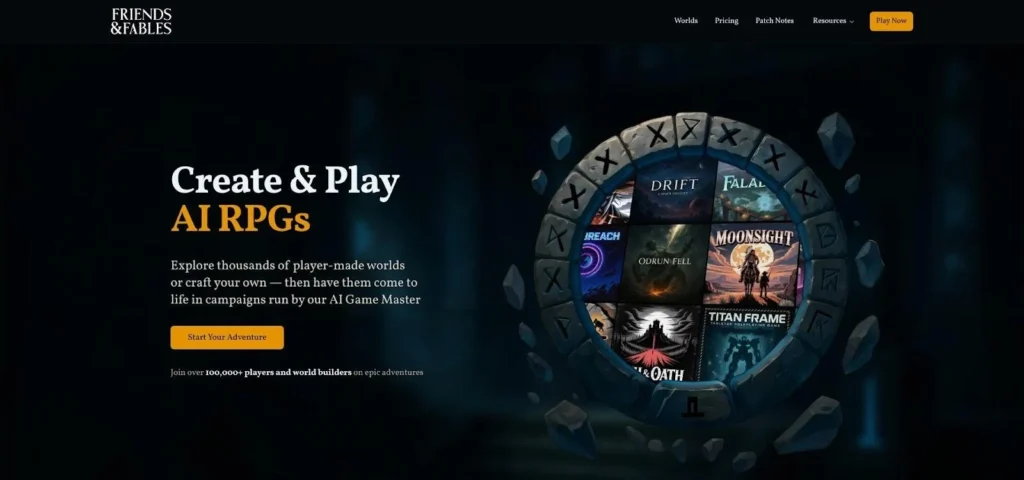
3 Friends & Fables: a full D&D table in your browser
Friends & Fables doesn’t dabble in tabletop flavor; it offers the whole feast. Start a session and the AI Dungeon Master, nicknamed “Franz,” runs 5e rules with near-clerical precision. Initiative is tracked, dice are virtual yet fair, and every condition from poisoned to petrified appears at the right moment. You feel the familiar beat of real D&D without prep time or rule-lawyering.
Invite links keep setup simple. Only the host needs a subscription, so one generous GM provides unlimited turns for up to six players. That “unlimited” word matters: no message cap cuts a boss fight short, a sore point with token-metered rivals. Session continuity is solid as well. Return a month later and Franz still remembers who lost an arm to a gelatinous cube and which NPC owes the party fifty gold.
Visual aids deepen immersion. Drop minis on an auto-generated battle map, zoom the camera, and watch the grid update while the AI narrates each move. Need a villain portrait? Type a prompt; the image studio supplies art good enough for most VTT streams.
These strengths come with a learning curve. If someone at the table misses how advantage works, the AI still enforces it. Storytellers who love wide-open improvisation may feel boxed in. A three-player trial tier exists, but meaningful play begins at nineteen dollars a month, higher than the tools still to come.
For groups who crave crunchy combat, character sheets, and the joy of landing a critical hit in real time, Friends & Fables stands apart. It turns distant friends into a steady adventuring party and proves an AI can sit behind the screen without breaking the magic.
2 Everweave: D&D in your pocket, solo today and group play tomorrow
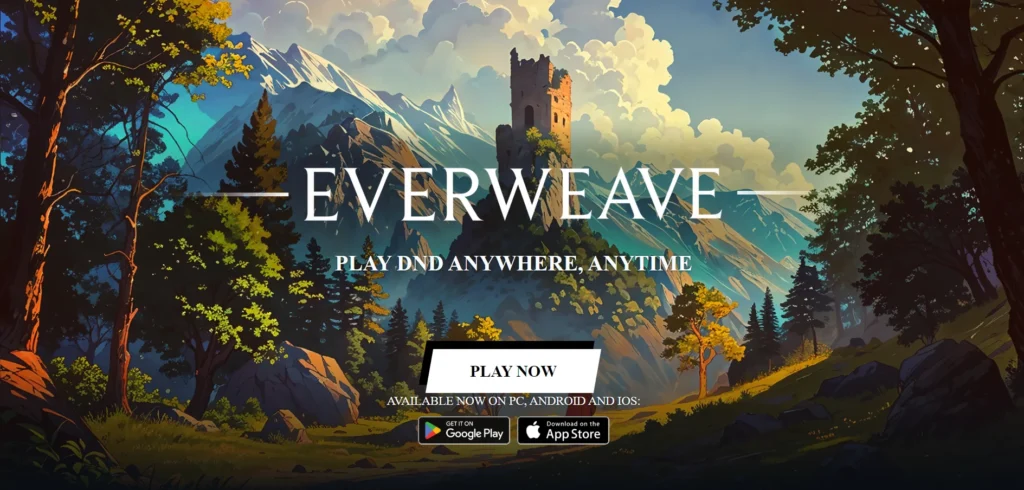
Everweave feels purpose-built for commute sessions. Download the mobile app, roll a character, and within minutes you are knee-deep in a classic fantasy crawl directed by an AI Dungeon Master that fits in your hand. The interface is polished, touch-first, and scrolls like a chat thread, perfect for sofa play or bus rides.
The AI leans on narrative beats instead of granular rules. It tracks quests, remembers that you rescued a child three chapters back, and lets you recruit AI companions who banter and fight without prompting. That persistence keeps solo players hooked, yet it is also the feature long-time fans want to share with friends.
Here is the catch: real multiplayer still sits on the roadmap. For now, “group play” means passing the phone around or sharing transcripts in Discord. The developers tease online co-op in beta notes, but until it ships, Everweave stops just shy of the throne.
Pricing follows a freemium pattern. You receive about sixty messages each month for free—enough for a short dungeon. Serious adventurers can pick the Adventurer or Pathfinder plans at six and eighteen dollars a month, buying 300 or 1,000 messages. Hit the cap mid-boss fight and you will feel it; Reddit critics note this message ceiling as the app’s biggest gripe.
Even so, Everweave’s pocket-ready design and cinematic flair make it the quickest way to scratch a D&D itch when your group cannot meet. If the promised multiplayer arrives this year, it could challenge our top pick. Until then, treat Everweave as your private rehearsal space, ideal for testing story hooks before revealing them to the party.
1 DreamGen: unfiltered creativity for groups who write together
DreamGen tops our list because it delivers what few rivals attempt: complete narrative freedom. Fire it up and you will find no content filters to skew the plot, no hidden dice logic to question. The AI listens, writes, and remembers up to thirty thousand tokens on the Pro tier, so sprawling epics stay coherent long after smaller models forget the villain’s name.
Technically it is single-user, yet it shines in a living-room setting where friends shout commands while one “typist DM” runs the interface. That pass-and-play flow sounds old school, but in practice it keeps everyone focused on story beats rather than browser tabs. The AI juggles multiple NPCs, so each player still hears their character’s voice in every scene.
Customization is DreamGen’s real edge. World lore fields, character sheets, and generation settings are yours to adjust. Want a low-fantasy tone with zero comic relief? Tweak repetition penalties and set the style guide. Need the orc warlord to speak only in haiku? One instruction handles it.
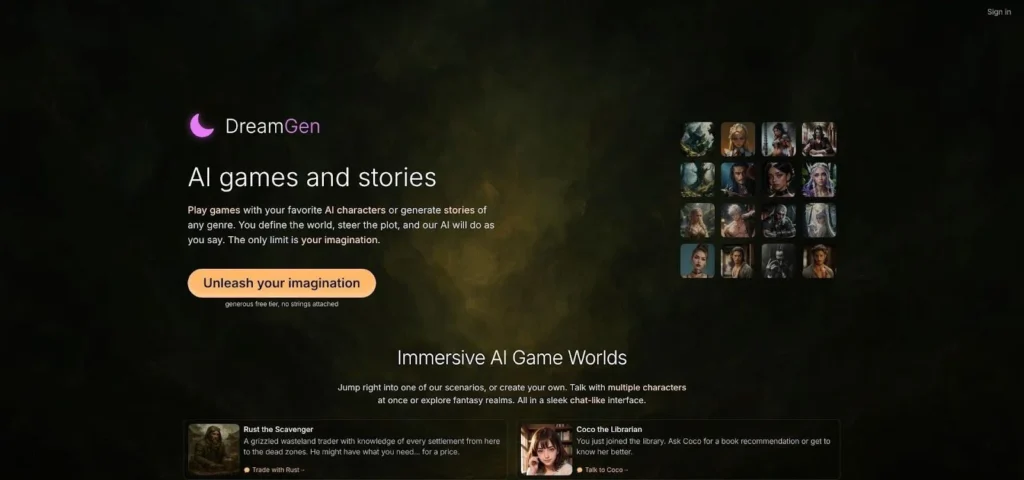
Money matters, and here DreamGen scores again. For another angle on the market, DreamGen’s own blog stacks eleven engines side-by-side—flagging rule support, content filters, and whether a free tier exists. Skim their chart of the best AI Dungeon alternatives before your group locks in a subscription. The free tier allows unlimited runs on a 13-billion-parameter model, enough for casual nights. Paid plans begin at eight dollars a month and rise to forty-eight for Llama-3 power. Every tier removes hard length caps, so the campaign ends when you decide, not when tokens expire.
No tool is perfect. DreamGen lacks native online multiplayer and built-in combat rules. New users may feel lost among sliders and text boxes. Yet for groups who prize imaginative control over convenience, nothing else comes close. In a hobby defined by stories, giving storytellers the widest canvas earns the gold.
Compare the contenders at a glance
Picking a platform often means flipping between rulebooks, pricing pages, and Reddit threads. The grid below spares the tab shuffle. Mode shows how players connect, cost lists what the host pays each month, and the Best for column sets the session’s vibe.
| Platform | Mode | Max players | Rules & mechanics | Free tier? | Typical monthly cost | Best for |
| DreamGen | Pass-and-play local | Unlimited (one typist) | None; pure narrative | Yes | $8–$48 | Writers who want total control |
| Friends & Fables | Online real time | 6 | Full D&D 5e | Trial (turn capped) | $20–$40 | Structured campaigns |
| Old Greg’s Tavern | Online real time | 6 | Light cinematic logic | First hour free | Credit packs (~$5+) | Spontaneous one-shots |
| Everweave | Solo mobile | 1 (AI companions) | Story-driven D&D-lite | 60 messages | $6–$18 | Pocket solo quests |
| Infinite Worlds | Solo shareable | 1 | Choice + GPT-4 memory | Credit drip | Pay as you go | Illustrated solo epics |
| Deep Realms | Solo shareable | 1 | Creator defined | Yes | $8–$25 | World-building sandboxes |
| TextGame.ai | Online real time | 12 | Party-game rules | Yes | Free starting credits | Social deduction nights |
| AI Game Master | Local pass around | 4 | Light stats + images | Token refill | $15–$25 | Couch co-op sessions |
| The Infinite DM | Online real time (beta) | 6+ | Streamlined 5e | Waitlist | TBA | Early adopters chasing Gemini |
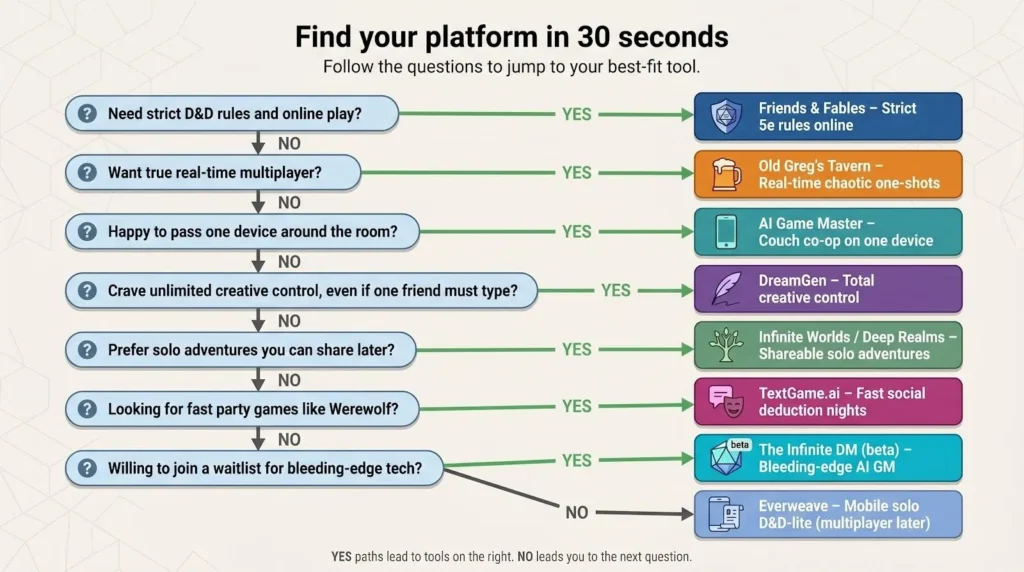
Find your platform in 30 seconds
Start at the top question and follow the arrows. When you reach “yes,” jump to the tool on the right.
Conclusion
Mind the blind spots before you subscribe. Rankings are helpful, yet no review stays current forever. Three shifting factors can change the winner overnight.
First, pricing changes quickly. Old Greg’s credit bundles and Deep Realms’ GPT-4 token rates have already changed twice in 2026. Before you commit, open each billing page and match the numbers to your budget.
Second, player caps can move. TextGame.ai supports twelve players in games such as Who’s Most Likely, but limits vary by title. If your group is large, confirm the latest cap.
Third, roadmaps add future value. Everweave’s multiplayer update and The Infinite DM’s public launch could arrive any month. If those features matter more than playing tonight, set a reminder and check again when they ship.
Stay curious, follow patch notes, and you will always choose from the front of the field.