The electrical contracting business is more complex than ever. Today, electrical contractors do much more than basic wiring—they also install renewable energy systems, EV charging stations, smart home technology, and advanced electrical systems for commercial buildings. As the industry grows, it brings new opportunities, but also creates major challenges in scheduling, estimating, compliance, and customer communication. Managing these tasks manually or using disconnected tools often leads to delays, higher costs, and frustrated clients.
The solution is Electrical Contractor Software, also known as Field Service Management (FSM) software, built specifically for electrical businesses. In this guide, you’ll learn how to choose the right electrical contractor platform to streamline operations and grow your business in 2026.
What Is Electrical Contractor Software?
Electrical contractor platform is an electronic solution that deals with the entire life cycle of a job for an electrical contractor. It collects leads, generates estimates, schedules jobs, sends out the techs, and processes invoicing and payments. The software links the field teams and the office in real time, meaning that the technicians can receive information and updates about the job from their tablets or mobile phones, while the office monitors progress, parts, and costs.
It streamlines the process by consolidating customer data, job history, and communication, thereby eliminating paperwork, improving response times, and ensuring timely job completion and timely payments for contractors.
Why Electrical Contractors Need Specialized Software in 2026
In today’s world of an electrical contracting business, you need to balance service calls, various projects, code compliance, and organizing your crew in one day. These tasks are all combined into a seamless process with specialized software, which saves time, reduces errors, and allows you to expand your operations without hassle.
The following are essential reasons that electrical contractors must consider having special software:
- A Faster Job Completion: By automating scheduling and dispatching, digital job management tools enable electricians to close 28% more service calls per week.
- Fewer Billing Mistakes: Automated invoicing and integrated payment processing cuts billing errors up to 45%, and helps you get paid quicker.
- Real-Time Project Visibility: Live information on schedules, costs, documents, and field updates from anywhere can be accessed from one unified platform.
- Code Compliance & Safety: Integrated checklists and compliance monitoring complete your inspection needs while keeping you up to date with the latest electrical codes and preventing expensive fines.
- Smart Material & Inventory Management: Manage job site materials, equipment, and wire in real time to avoid shortage and waste problems.
- Better Customer Experience: Customers are more satisfied, and satisfied customers are more likely to return, having been reminded of the service by the automation, given professional estimates, and seamless invoicing.
- AI-Powered Efficiency: AI-powered dispatching, estimating, and scheduling make you more productive and allow you to take on more jobs without hiring more people. Many modern platforms also include customer support tools, which help manage customer queries, service requests, and real-time updates, further improving response time and overall customer satisfaction.
Key Features to Look for In Electrical Contractor Software
The following key features to look for in Electrical Contractor Software:
- Job Scheduling & Dispatching: scheduling the best tech for the job, location, and availability. Have a calendar with drag and drop functionality; receive real-time updates and assignments update automatically when plans change.
- Estimating & Bidding Tools: Make quick and accurate material and labor estimates. Automatic take-off and pre-built electrical item databases (wires and conduit, panels, breakers) reduce the time spent on bids, allowing you to secure more projects.
- Invoicing & Payments: Generate invoices in the field and accept credit and digital payments on the spot. This helps speed up payment and enhances cash flow.
- Mobile App for Field Technicians: Technicians view job details, customer information, directions, and track time and upload photos all from their mobile phone. This is a call to and from the office (up and down).
- CRM & Customer Management: Keep customer records, send automated reminders, and follow-up messages to customers for repeat business. Great for repeat and referral work, particularly for residential contractors.
- QuickBooks & Accounting Integration: Automate timesheet, invoice, and expense sync with QuickBooks or other accounting tools . This eliminates double typing of data and reduces bookkeeping mistakes.
- Reporting & Analytics: Track revenue per technician, close rates, and job profitability with Reporting & Analytics. Clear reports enable you to make informed decisions, rather than educated guesses.
- AI & Automation: Automates, qualifies leads 24/7, and handles calls. This new benchmark will save staff time, lower response times, and increase business activity outside of office hours.
List Of 10 Best Electrical Contractor Software in 2026
1. Jobber

website: https://www.getjobber.com
Jobber is an all-in-one solution designed specifically for electrical contractors to quote, schedule, dispatch, invoice, accept payments, and communicate with customers from a single platform. It enables electricians to stay organized with client information, job history, notes, and attachments, allowing teams to work more quickly and professionally with customers. The software is created to function with small to mid-sized service businesses and is suitable for both one-man and expanding teams of service businesses.
Its electrical CRM pages offer very significant features for day-to-day operations: job tracking, estimate creation, technician scheduling, and invoice management. Jobber also focuses on mobile access for field techs so that work information remains on-site. It comes with automation capabilities that minimize manual administrative workload and enhance follow-ups. It is particularly helpful for businesses that desire a simple setup and easy-to-use interface.
best for: small to mid-sized electrical contractors that want simple scheduling, invoicing, and client management.
Key features
- Client management.
- Scheduling and dispatching.
- Estimates and quotes.
- Invoicing and payments.
- Mobile app access.
- Work order tracking.
Pros
- Easy to use.
- Good mobile app.
- Fast setup.
- Strong scheduling tools.
Cons
- Limited advanced reporting.
- No built-in inventory
- Basic marketing automation.
- Can become expensive when the teams increase.
Pricing
- Grow: $109/mo
- Connect: $73/mo
- Core: $22/mo
2. Housecall Pro

Website: housecallpro.com/
Housecall Pro is electrical contractor software designed for companies that want to complete jobs faster and keep their teams connected—both in the office and out in the field. Online booking helps contractors schedule more work, while built-in CRM tools make it easy to manage customer details, create accurate estimates, and send invoices from one centralized platform. It also includes a mobile workflow that allows technicians to access work orders, update job statuses, and manage tasks while on the road.
In addition to its electrical toolkit features, Housecall Pro includes specialized calculators built for electricians, such as voltage drop, wire sizing, conduit fill, and residential load calculations. It also supports PDF sharing, making it easy to send documents to clients or inspectors. Overall, it’s designed to simplify day-to-day operations for small to mid-sized electrical contractors looking for a clean and easy-to-use system.
Best for: Ideal for smaller to medium-sized electrical contractors looking for an easy, mobile-first, all-in-one job management software solution.
Key features
- Scheduling and dispatch.
- Estimates and invoicing.
- Online booking.
- Electrician CRM.
- Mobile app support.
- Electrical Toolkit calculators.
Pros
- Easy to use.
- Strong mobile workflow.
- Good payment handling.
- Ideal for the expansion of contractors.
Cons
- Limited customization.
- There may be additional add-ons that cost more.
- Advanced user basic reporting.
- Inventory tools are not very deep.
Pricing
- Basic: $59/mo
- Essentials: $149/mo
- MAX: $299/mo
3. ServiceTitan

Website: https://www.servicetitan.com
ServiceTitis an all‑in‑one field service management platform tailored for electrical contractors and other home‑service businesses. It brings together scheduling, dispatching, invoicing, CRM, and marketing into a single application that allows contractors to take charge of the jobs from the initial call to the final payment. It enables electricians to manage service history, equipment, inventory, and recurring maintenance deals, and also offers mobile forms, electronic signatures, and payment processing on-site for electricians in the field.
Service also features powerful reporting dashboards, with revenue, job costing, tech performance, and marketing ROI. It’s suitable for call centers, multiple-location management, and integration with accounting software like QuickBooks, in larger operations. Overall, its goal is to simplify operations, enhance customer interaction, and grow with electrical enterprises.
best for: Best for medium-sized to large electrical and home-service contractors
key features
- Centralized job scheduling
- GPS tracking dispatching
- Comprehensive customer management
- On-site payment processing
- Performance metrics analytics
- Full-featured mobile app
Pros
- Electrical industry-specific
- Field productivity enhancement
- Regular feature updates
- Well-integrated accounting and telephony solutions.
Cons
- It is costly, particularly for small businesses.
- High learning curve and lengthy onboarding.
- Usually works on multi‑year contracts.
- It may be too extensive for very basic tasks.
Pricing
- Custom pricing
- starting: $398 per month,
4. FieldPulse

website: https://www.fieldpulse.com/
FieldPulse is field service software that has been created to meet the needs of electrical contractors and allows office and field staff to operate in a single system. It also facilitates work order management, crew dispatching, scheduling jobs, and keeping the communication organized with customers in one place. This platform also includes estimates, invoices, project management, and mobile options for quick on-site updates for electricians.
It’s meant for expanding electrical organizations that are searching for more control over operations and less record-keeping. For faster customer service and follow-up, FieldPulse also provides electrician CRM functionality to keep customer history, job information, and conversations. According to its electrical page, it helps with urgent service work, repair, installation, and smart infrastructure jobs. The company describes it as a software solution that helps contractors make money and eliminate chaos.
Best for: Ideal for small to medium electrical contracting firms and expanding service providers.
Key features
- Scheduling and dispatching.
- Work order management
- Estimates and invoices.
- Mobile app.
- QuickBooks sync.
- Customer history and CRM.
Pros
- Strong all-in-one workflow.
- Ideal for expanding teams.
- Field crews are mobile-friendly.
- Customizable and scalable.
Cons
- The pricing is not clear.
- Higher tiers or add-ons may be needed for advanced needs.
- Some reviews mention that the UI is somewhat old-fashioned.
- Not a free-trial type of setup, demo first.
Pricing
- Custom pricing
5. Workiz

website::https://www.workiz.com
Workiz is a cloud-based, AI-powered field service management software solution, uniquely built for electrical contractors to expand and scale their operations throughout the year. It merges scheduling, dispatching, invoicing, estimates, and client administration into a single platform, eliminating the need to juggle with several various tools. By leveraging an AI-powered Genius Suite, the software enables electricians to save 20+ hours per week by automating job scheduling, lead generation, and customer communications.
Workiz keeps an eye on safety certifications and equipment servicing history so that electrical contractors can stay compliant with industry standards and communicate in real-time within the team. The mobile-first approach makes it easier for technicians on the go to get job information and provide updates. Workiz businesses experience an average of 23% growth within their first 3 months and 3X the number of jobs.
Best for: Small to mid-sized electrical contracting businesses want to automate operations and scale efficiently.
Key Features:
- Drag and drop job scheduling & dispatch.
- AI-powered answering & lead conversion.
- Instant invoicing & payment processing
- Real-time inventory management
- Safety certification tracking
- Mobile-first technician app
Pros:
- Saves 20+ hours weekly
- All-in-one platform
- AI automation included
- 23% avg. 3-month growth
Cons:
- For very small teams, the price could be high.
- Primarily US-focused
- More difficult learning curve for non-technical users
Pricing:
- Kickstart: $225/month
- Standard: $275/month
- Pro: $325/month
6. Service Fusion
Website: https://www.servicefusion.com/
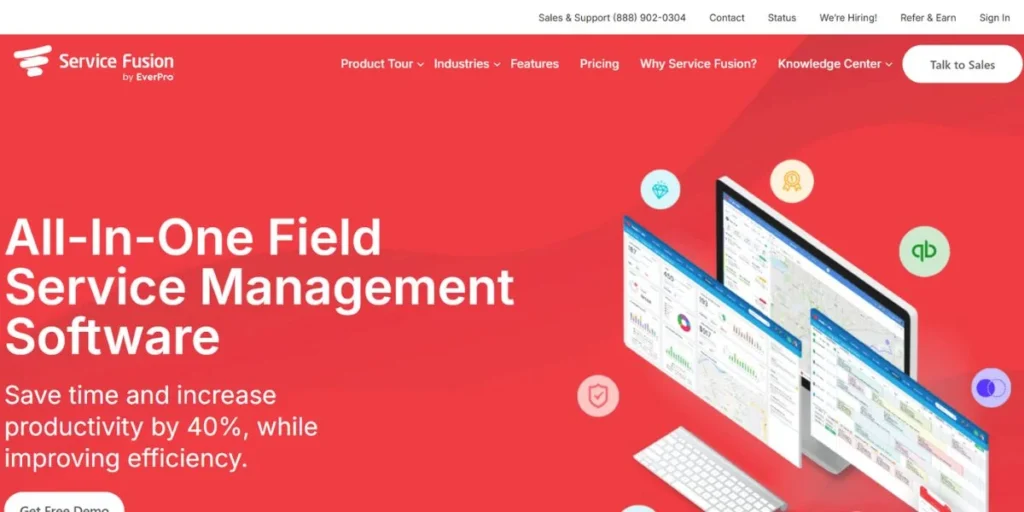
Service Fusion is an electrical contractor-specific service field management software designed for all the needs of electrical contractors. It allows companies to oversee the whole job process from accurate estimates to scheduling job dispatches, to invoicing and payment, all from a single cloud platform.
The software is user-friendly, allows unlimited users, and works for easy accounting with QuickBooks. Job details, photos, and eSignatures can be accessed by the technicians using their mobile application, and the customers are notified with text and/or voice messages automatically. By integrating operations seamlessly, improving customer relationship management, and tracking jobs in real-time, Service Fusion can optimize the operations of electrical contractors, making them more productive and efficient.
Best For: Small to mid-size electrical contractors and field service businesses.
Key Features:
- CRM and customer management.
- Estimates & job creation
- Scheduling & dispatching
- QuickBooks integration
- Mobile technichean app
- Integrated payments & invoicing
Pros:
- No restriction on the number of users per plan.
- eSigning agreements with contactless eSignatures.
- QuickBooks sync (online & desktop)
- No contract requirements
Cons:
- Limited report customization
- Only sync one QuickBooks income account.
- There are reports of support problems
Pricing:
- Starter:$208/mo(billed annualy)
- pro:$533/mo(billed annually)
7. McCormick Systems
Website: https://www.mccormicksys.com
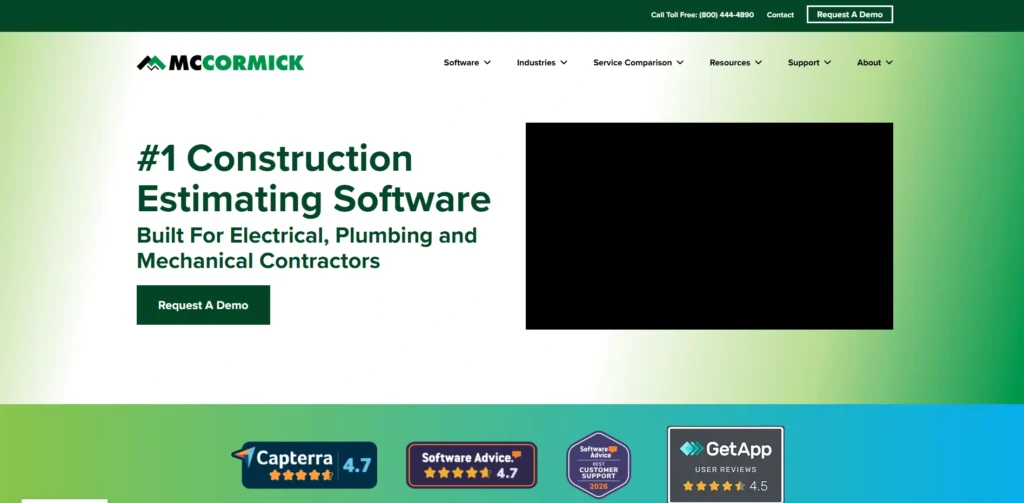
The leading construction estimating and digital takeoff software designed for electrical, plumbing, and mechanical contractors in the United States and Canada is McCormick Systems Electrical Contractor Software. It offers a streamlined system in which you can perform everything from digital takeoff to final bid proposal, all within one system, instead of multiple tools.
It has a large electrical database of more than 55,000 electrical items and a large number of pre-built assemblies optimised for residential, commercial, industrial, low voltage, and high voltage projects. Incorporates patented Auto Home Run and auto count functions to instantly draw and measure runs for instant knowledge of supply needs, cost, and best path. Contractors can keep their material pricing up-to-date and in real-time right from the major pricing services or their own supply houses.
Best for: Small to medium electrical contractors who are bidding on commercial, industrial, and residential projects often.
Key Features:
- Auto-count and patented
- Get real-time prices from suppliers
- 55,000+ items and 25,000 prebuilt assemblies
- A single program for integrated takeoff and estimating.
- A NECA labor unit of three levels has been included.
- Generate professional bids automatically.
Pros:
- Quick and accurate electrical estimates.
- All-in-one takeoff + estimating
- US & Canada databases were included.
- 45+ years of trade expertise
Cons:
- Only applies to specialty trades.
- The more difficult learning curve for novices
Pricing:
- contact for a custom quote
8. Trimble Accubid Anywhere

Website: https://www.trimble.com/en
Trimble Accubid Anywhere is a full, cloud-based estimating solution built to address the needs of electrical contractors and industrial mechanical contractors. It offers sophisticated spec-driven estimating and graphical take-off features in a flexible subscription that is available around the clock, on any device. The platform allows any number of estimators to work at the same time on one project, using the same item, assembly, and pricing databases.
It features advanced supplier pricing capabilities in Supplier Xchange, change order management, submittal management, document collaboration in Trimble Connect, and powerful bid output reporting capabilities. This solution is the contemporary version of the previous desktop solution, AccuBid Classic, that integrates estimating and bidding processes into a single solution.
Best For: Medium to large-sized electrical contractors based in several locations.
Key Features:
- Estimating using assembly selection and specifying.
- Graphic Takeoff with LiveCount
- Supplier Xchange offers live prices for suppliers.
- Replace order management using templates.
- The ability to submit and track documents.
- Cloud collaboration with multiple users.
Pros:
- Library of catalogs that can be customized for items/assemblies
- Integrating real-time supplier pricing
- Works anywhere on mobile devices.
- Simultaneous multi-user collaboration
Cons:
- Steep learning curve for new users
- A consultation call is required for pricing.
- No free trial available
Pricing:
- custom pricing
9. Conest IntelliBid

Website: https://conest.com/
ConEst IntelliBid is the most complete electrical estimating software, especially for electrical contractors, low voltage contractors, datacom contractors, and solar contractors. It offers a streamlined estimating process, including comprehensive assemblies, labor units, and historical cost information to help firms win more bids and become more accurate.
It includes built-in reports, bid and job estimate tracking, change order management, and a seamless export to accounting applications and MS Office. This solution can be on-premises or cloud-based, and can be integrated with Conest’s takeoff and reporting tools, SureCount. Conest Software has more than 30 years of experience and provides outstanding technical support and trusted solutions to the top electrical contracting companies.
Best for: All sizes of electrical, low voltage, datacom, and solar contractors.
Key Features:
- Largest database available with 125,000+ items & assemblies
- Auto-labor factoring and automatic price updates
- Four-level phase breakdown on takeoff
- Built-in reports and bid tracking.
- Change order management
- Export to accounting software & MS Office.
Pros:
- Complete electrical estimating database available.
- Quick and precise estimation with auto-updates.
- Cloud or on-premises options available
- Excellent technical support
Cons:
- Increased price for larger businesses
- Implementing the measures may be expensive
- A greater learning curve for novices
- If you need this to be customized, you will need to pay extra.
Pricing:
- Subscription: starts at $150/user/month
10. Knowify

website: https://knowify.com
Knowify is an online job costing and project management solution for electrical contractors and other trade contractors. It provides teams with an accurate idea of the cost of a job, the ability to write bids, monitor labor and material costs, and bill invoices from a single location. Its software is designed to make everyday tasks easier by integrating estimating, scheduling, time tracking, billing, and project management in a single workflow. It is also tightly coupled with QuickBooks, aiding in minimizing duplicate accounting tasks and enhancing financial reporting.
Electrical Contractors find it particularly helpful with contract jobs, organizing service work, and profitability tracking for projects. Knowify is generally designed for contractors who wish to have more control over their finances, time, and cash flow. It is suitable for commercial and residential applications, so it can be used in various electrical contracting configurations. It is also a web app and mobile app, so your field and office teams can stay connected.
Best for: electrical contractors and small to medium-sized trade businesses that require estimating, job costing, scheduling, and invoicing in one system.
Key features
- Estimating and budgeting.
- Scheduling and dispatching.
- Job costing and profitability tracking.
- Invoicing and pay apps.
- QuickBooks two-way sync.
- Mobile app for field updates
Pros
- Easy budgeting.
- Strong QuickBooks integration.
- Good job tracking.
- Useful mobile access.
Cons
- For really small teams, the price can seem steep.
- There can be some advanced tools that require learning time.
- Best value is primarily geared towards contractors, not general businesses.
Pricing
- core:$99/month
- Advanced:$249/month
Electrical Contractor Software Comparison Table
How Much Does Electrical Contractor Software Cost?
Electrical Contractor Software Pricing Levels
Electrical contractor software typically comes in three levels – Basic, Intermediate and Premium/Enterprise. The following is a practical breakdown in tiers based on the price ranges for electrician and electrical contractor software today.
Basic Tier
- Average cost: $33 to $120 per user, per month.
- Ideal for single electricians or small teams.
- Typically involves scheduling, dispatching, estimating, and basic invoicing.
Mid-range Tier
- Average price range: $120 to $167 per user/month, or $400 to $1,800 per month for mid-sized teams.
- Ideal for growing contractors who have multiple technicians.
- Typically includes billing, mobile access, custom branding, and enhanced workflow options.
Premium Tier
- The typical cost is $167 per user per month, or $500+ per technician per month for add-ons and scale.
- Ideal for a large or complex electrical business.
- Typically has higher-level reporting and accounting features, e-signature, payment integration, and enhanced project management capabilities.
Other Pricing Models
Some vendors even offer project pricing or team pricing, or a one-time license, rather than a monthly subscription. One example mentioned for the market is a one-time license scheme for some estimating tools, costing approximately $1,295.
What Affects Price
The top cost factors are the number of users, the depth of the features, the level of support, integrations, and add-ons. The monthly equivalent cost can be decreased with annual billing as well.
How to Choose the Right Electrical Contractor Software For Your Business
Below are some tips for choosing software that will actually benefit your electrical business and not be a burden:
- Ensure that it is user-friendly: Look for software that is easy to master, even for new employees and for electricians who are not tech-savvy. If it doesn’t make sense, you won’t use it.
- A single solution for all the features you require: Find an integrated system that can quote, schedule, dispatch, invoice, and track job costs. Having to use different applications for different tasks is inefficient and confusing.
- See if it is available as a mobile/field-friendly version: You need to use software that operates on mobile devices, as your electricians work on jobsites. They are expected to be able to update jobs, send out invoices, and view schedules in the field.
- Ensure that it provides current and accurate information: The best software will provide you with real-time data on jobs, costs, and profits, enabling you to make informed decisions promptly.
- Check for excellent customer service and training:Choose a provider that provides the support and training needed, and includes data analytics tools to help you track performance and make better decisions. There will be times when you need assistance, and there will be times after you have begun that you will need assistance.
- Take your budget and pricing into account: Buy software that is in line with financial resources. Be aware of any hidden fees and ensure that the cost (monthly/yearly) is suitable for your business size.
- Look for compatibility with other applications you use: It should seamlessly integrate with the systems and applications you already have in place, such as accounting software, email applications, or payment systems, to avoid the hassle of transferring data from one application to another.
- Check out what other electrical contractors have to say: Read other electricians’ reviews on the software. Real user reviews provide insight into whether it truly performs well for electrical companies, just as you are.
Benefits of Using Electrical Contractor Software
So here are the primary advantages of electrical contractor software:
- Saves time and minimises manual effort: The software reduces manual workload, such as estimates, invoicing, scheduling, and reports, allowing your team to focus more on jobs and less on paperwork.
- Supports you in making quicker and more precise estimates: Built-in databases and tools enable you to calculate materials, labor, and pricing accurately and efficiently, resulting in improved bids and fewer unforeseen costs.
- Improves project management: All jobs are tracked, tasks are assigned, progress can be monitored, and change orders can be managed in one place – and nothing gets missed and projects stay on time and on budget.
- Improves professionalism with clients: Proposals, invoices, and communication are all neat and delivered on time, demonstrating that you’re running a modern and organized business, and this helps you to gain trust and secure more work.
- Enhances cash flow and invoicing: Automated reminders, faster invoicing, and easy payment processing help you get paid faster and minimize cash flow delays.
- Makes scheduling and dispatching easier: Technicians can be assigned, assignments tracked, and changes made to assignments at the last minute — all from one dashboard — resulting in faster, more efficient job completion.
- Enhances stock and materials management: The software keeps a record of materials you have, what you are consuming and what you need to order to ensure you avoid material shortages or wastage.
- Improves efficiency and decreases mistakes: Your team works more smoothly, and fewer costly mistakes are made with less double entry, fewer missed deadlines, and real-time updates.
- Resists growth and supports good decision-making: Reports and dashboards give you insight into the most profitable jobs, what’s successful, and where to improve, so you can plan smarter business growth.
Common Mistakes to Avoid When Choosing Electrical Software
Common mistakes to avoid when selecting your electrical software
- Not assessing your actual requirements first.
- Selecting software that’s too difficult to navigate.
- Choosing a tool with too many unnecessary features.
- Not verifying its compatibility with your other tools.
- Not considering whether your team can learn it adequately.
- Not checking for training and support.
- Not requesting a demo before making any purchase.
- Not doing reviews or listening to other users.
Final Verdict
The best software for electrical contractors depends on your team’s size and how simple or complex your operation is. If you want something simple, Jobber or Housecall Pro are great for small to medium teams. If you’re growing and need workflow, automation, and better tracking, FieldPulse or Workiz are all good choices.
For larger operations that need advanced reporting, scheduling, and full-service management, Service Titan is a winner. McCormick’s systems, Trimble Accubid and Conest intellibid are, however, great choices for estimating and bidding. In short, pile on those tools that save you time, make you get paid a lot faster, and are easy to actually use for your team every day.