The food service segment of the Indian economy is on fire. Valued at over $90 billion in 2026, it is racing towards $144–152 billion by 2030 at a CAGR of nearly 10–11%. If you are seriously considering entering this space, one name keeps coming up in every investor conversation — Haldiram’s.
This is why understanding the Haldiram Franchise Cost is the very first step for any serious investor. Haldiram’s is not just a snack brand — it is a food empire recognised globally, with 400+ products sold across 60+ countries and a brand valuation of $10 billion following the Temasek investment in 2025.
The Indian snack market alone was estimated at $22.78 billion in 2024 and is projected to cross $33.48 billion by 2030. With snack food volume growth projected at 4.8% in 2026, the timing to invest under the Haldiram name has rarely looked this compelling.
Who This Guide Is For: This article is written for first-time franchise investors, experienced food business entrepreneurs, and anyone researching the Haldiram Franchise Cost before approaching the brand directly. All figures are sourced from publicly available franchise disclosures, industry reports, and Haldiram’s own official franchise portal as of 2026. Always verify final terms directly with Haldiram’s franchise team before making financial commitments.
What Is Haldiram’s? A Quick Brand Overview
Before jumping to costs and contracts, it is worth understanding exactly what you are buying into — because the Haldiram Franchise Cost makes far more sense when you see the scale of the brand behind it.
What began as a small bhujia shop in Bikaner, Rajasthan in 1937 is now a multi-billion dollar global food company. The Haldiram family built their reputation over decades of consistent product quality and a deep connection with Indian taste preferences — not through aggressive marketing, but through product trust.
Today, Haldiram commands close to 40% of the organised snack market in India. In March 2025, Singapore’s sovereign wealth fund Temasek acquired a 10% stake for approximately $1 billion, valuing the brand at $10 billion — a clear signal of institutional-grade investor confidence. The company operates manufacturing centres in Delhi, Nagpur, and Kolkata, supplying products to retailers, e-commerce platforms, and its franchise network simultaneously.
Key Brand Numbers at a Glance (2026) Founded: 1937 in Bikaner, Rajasthan Brand Valuation: $10 billion (post-Temasek 2025 deal) Products: 400+ SKUs across namkeens, sweets, beverages, ready meals Global Reach: 80+ countries including US, UK, Canada, Australia, Middle East Market Share (Organised Snacks, India): ~40% Manufacturing Hubs: Delhi, Nagpur, Kolkata
Haldiram Franchise Models Available in 2026
Haldiram currently offers three distinct franchise models. The right one for you depends on your budget, available space, and long-term business vision. Here is what each one looks like in practice.
1. Casual Dining Restaurant Model
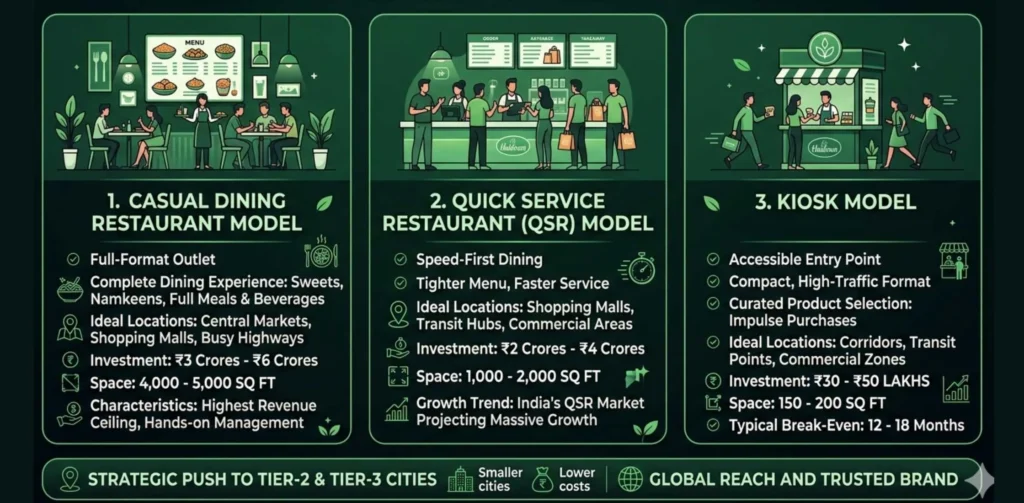
This is Haldiram’s full-format outlet — the version most people associate with the brand in large cities. It offers a complete dining experience covering everything from traditional sweets and namkeens to full meals and beverages. Think high-footfall city locations: central markets, shopping malls, and busy highway stops.
The Haldiram Franchise Cost for this model sits between ₹3 crore and ₹6 crore, with a space requirement of 4,000–5,000 sq ft. This format has the highest revenue ceiling of the three, but it also demands the most hands-on operational management. If you are looking for maximum brand presence and have the capital and experience to back it up, this is the format to aim for.
2. Quick Service Restaurant (QSR) Model
The QSR model is Haldiram’s answer to speed-first dining. It runs on a tighter menu, moves customers faster, and requires significantly less space than the full dining format. It is well-suited to shopping malls, transit hubs, and busy commercial areas where customer dwell time is limited.
Total investment for the QSR format typically ranges between ₹2 crore and ₹4 crore, with a space footprint of 1,000–2,000 sq ft. India’s QSR market is projected to surpass $30.37 billion by 2026 — and operating a Haldiram QSR puts you right at the centre of that growth.
3. Kiosk Model
The kiosk is the most accessible entry point into the Haldiram franchise system. It is a compact, high-traffic format that offers a curated product selection and works best in corridors, transit points, and crowded commercial zones where impulse purchases drive revenue.
At ₹30–50 lakhs for a 150–200 sq ft unit, this is clearly designed for first-time investors who want to test the brand before committing to a larger format. Kiosk owners who choose high-footfall locations typically report break-even within 12–18 months.
Haldiram has made a pointed strategic push to expand kiosk and QSR presence in Tier-2 and Tier-3 cities through 2026, where real estate costs are significantly lower — which means first movers in smaller cities have a genuine advantage right now.
Haldiram Franchise Cost Breakdown 2026
The table below summarises all major cost components across the three models. Use this as your planning baseline — actual costs will vary by city, specific location, and local real estate rates.
| Cost Component | Kiosk Model | QSR Model | Casual Dining |
| Franchise Fee | ₹3 lakhs + GST | ₹5 lakhs + GST | ₹7–10 lakhs + GST |
| Setup & Interior | ₹10–15 lakhs | ₹50–80 lakhs | ₹1–2 crore |
| Kitchen Equipment | ₹5–8 lakhs | ₹40–70 lakhs | ₹80 lakhs–1.5 crore |
| Initial Inventory | ₹3–5 lakhs | ₹15–25 lakhs | ₹30–50 lakhs |
| Working Capital | ₹5–10 lakhs | ₹20–30 lakhs | ₹50–80 lakhs |
| Total Investment | ₹30–50 lakhs | ₹2–4 crore | ₹3–6 crore |
| Royalty Fee | 2.5% of annual sales | 2.5% of annual sales | 2.5% of annual sales |
| Agreement Duration | 9 years | 9 years | 9 years |
| Space Required | 150–200 sq ft | 1,000–2,000 sq ft | 4,000–5,000 sq ft |
| ROI Timeline | 12–18 months | 18–24 months | 24–36 months |
| Total investment | ₹30–50 lakhs | ₹2–4 crore | ₹3–6 crore |
Note: All figures are estimates based on publicly available franchise data as of 2026. Confirm exact figures directly with Haldiram’s franchise team before finalising any investment decision.
The Hidden Cost Most Investors Overlook: Location Premium
One thing the headline investment numbers do not always capture is the location premium — the additional cost that separates a mediocre outlet from a highly profitable one.
A kiosk in a high-footfall mall in Mumbai or Delhi commands significantly higher rent than the same footprint in a Tier-2 city market. Monthly rentals for prime Tier-1 kiosk spots can range from ₹80,000 to ₹2,50,000 per month — a cost that compounds significantly over a 9-year franchise term.
On the other hand, Tier-2 and Tier-3 cities often offer monthly rents between ₹15,000 and ₹60,000 for equivalent footfall, which dramatically improves your margins and shortens the ROI timeline. Haldiram’s 2026 expansion strategy explicitly targets these markets — making this a timely window for investors who are flexible on geography.
Practical Tip: Calculate Your Total Location Cost Before locking in a site, calculate the total rental outgo over your entire franchise term. For a 9-year kiosk agreement, the difference between a ₹50,000/month and ₹1,50,000/month rental site is ₹1.08 crore in rent alone — which more than doubles your effective investment. A slightly lower-footfall location with significantly lower rent often outperforms a premium spot on pure ROI.
Haldiram Franchise Profit Margin & ROI
The most important question before committing to the Haldiram Franchise Cost is straightforward: will the investment pay off, and how fast?
Haldiram franchisees typically report net profit margins of 14–20% on gross sales. During peak festive periods — Diwali, Holi, Eid, Raksha Bandhan — margins can push towards 25% as gifting demand drives both volume and average transaction value significantly higher.
Here is how the ROI timeline breaks down by model under efficient management:
- Kiosk Model: Break-even in 12–18 months at high-footfall locations
- QSR Model: Break-even in 18–24 months in well-chosen commercial zones
- Casual Dining Model: Break-even in 24–36 months, with higher absolute profit potential
Three factors make these margins better than most food franchises in India. First, the strong brand pull reduces your customer acquisition cost to near zero — people already want Haldiram’s before they walk in. Second, the royalty is only 2.5% of annual sales, compared to 6–8% charged by many competitors. Third, the 9-year agreement period gives you enough runway to build genuine local loyalty and recover your initial investment comfortably.
Maximising Profits: Festive Season Strategy
This is a content gap most Haldiram franchise guides skip entirely — and it is one of the most practically useful things to understand before you open.
Haldiram’s product portfolio is structurally built for Indian festivals. The brand’s sweet boxes, mithai assortments, and gift packs see 3–5x volume spikes during Diwali alone. Franchisees who plan their inventory, staffing, and display space around the festival calendar consistently outperform those who treat it as a standard month.
The key festivals to plan for include Diwali (October–November), Holi (March), Raksha Bandhan (August), Dussehra, and Navratri. In regions with strong regional festival culture — like Durga Puja in West Bengal or Baisakhi in Punjab — local demand spikes can be equally significant.
Working with your Haldiram supply chain manager to pre-order festive inventory 6–8 weeks in advance is not optional — it is a competitive necessity. Franchisees who underestimate demand during Diwali frequently report stock-outs that directly cost them 15–25% of potential peak-season revenue.
Haldiram Franchise Eligibility: What You Need
Haldiram does not have a publicly stated minimum net worth requirement, but in practice the franchise team evaluates applicants on a combination of financial capacity, location quality, and relevant experience. Here is what matters most.
Financial Capacity
You need to demonstrate that you can fund the full investment from your own resources or through verified financing — Haldiram does not offer in-house financing. Bank statements for the past 6 months and income tax returns for the past 2–3 years are standard requirements. Showing a comfortable buffer above the investment amount (typically 20–30%) strengthens your application significantly.
Location Quality
Haldiram’s team evaluates every proposed location independently before granting approval. They look specifically at daily footfall, visibility from the street or corridor, parking access, proximity to your target demographic (office complexes, colleges, residential clusters), and competition density. A strong location proposal can compensate for limited F&B experience on the applicant side.
Prior Experience
F&B or retail experience is not mandatory, but it is a material advantage. If you have managed a food business, retail outlet, or QSR franchise previously, highlight it in your application. Haldiram has publicly indicated a preference for franchisees with some operational background as the brand scales aggressively through 2026 and beyond.
Documents Required
The standard document checklist for a Haldiram franchise application includes:
- Aadhaar card and PAN card (identity proof)
- Address proof
- Bank statements — last 6 months
- Income tax returns — last 2–3 years
- Property documents or signed lease agreement for the outlet space
- GST registration certificate
- Passport-size photographs
- Business plan (optional but strongly recommended for faster approval)
How to Apply for Haldiram Franchise: Step-by-Step
As of 2026, Haldiram operates under a unified franchise entity for both its Delhi and Nagpur divisions, which has streamlined the application and approval pathway considerably. The full process from inquiry to launch typically takes 3–6 months.
- Research: Visit the official Haldiram franchise portal to review current models, investment ranges, and eligibility criteria before making contact.
- Inquiry Form: Complete the official franchise enquiry form with your personal details, preferred model, target city, and estimated investment capacity. Be specific — vague inquiries take longer to progress.
- Location Proposal: Submit your shortlisted site details — available area in sq ft, daily footfall estimates, lease terms, and nearby landmarks. A professionally prepared location proposal significantly accelerates this stage.
- Evaluation Meeting: Haldiram’s franchise team will schedule an in-person or virtual meeting to review your profile, financial standing, and proposed outlet location. Be prepared to discuss your business plan and operational readiness.
- Agreement & Setup: Once approved, sign the 9-year franchise agreement, pay applicable fees, and begin the fit-out phase. This includes interior design, equipment procurement, inventory stocking, and mandatory staff training before your official launch date.
IMPORTANT: Avoid Franchise Scams With Haldiram’s valuation at $10 billion and investor interest at an all-time high, fraudulent franchise agents have become a real problem in 2026. Never pay any fees to third-party agents who claim they can fast-track your approval or offer discounted franchise terms. There is no authorised middleman in the Haldiram franchise process. Always contact Haldiram directly through their official portal or registered corporate offices in Delhi and Nagpur.
Haldiram vs Competitors: How Does It Stack Up?
If you are evaluating the Haldiram Franchise Cost against alternatives, here is an honest side-by-side comparison with the two other major players in the Indian ethnic snack and sweets franchise space — Bikanervala and Bikaji.
| Parameter | Haldiram | Bikanervala | Bikaji |
| Min. Investment | ₹30–50 lakhs (kiosk) | ₹1.25–2.75 crore | ₹10–25 lakhs (distributor) |
| Max. Investment | ₹3–6 crore | ₹2–5 crore | ₹50 lakhs–1 crore |
| Royalty Fee | ~2.5% of annual sales | 6–8% of monthly revenue | N/A (distributor model) |
| Profit Margin | 14–20% | 12–22% | 15–20% |
| ROI Timeline | 12–36 months | 2.5–4 years | 2–4 years |
| Countries | 80+ | 10+ | Growing |
| Product Range | 400+ SKUs | Sweets, snacks, meals | Namkeens, sweets, papad |
| Agreement Term | 9 years | 5 years | Distributor-based |
| Brand Valuation | $10 billion (2025) | ~₹1,300 crore | Listed (NSE/BSE) |
Haldiram vs Bikanervala
Both brands share Bikaner heritage, but the comparison ends there in terms of scale. Haldiram is present in 80+ countries versus Bikanervala’s 10+. The royalty difference is perhaps the starkest contrast: Haldiram charges 2.5% of annual sales, while Bikanervala charges 6–8% of monthly revenue — a structural disadvantage that compresses your margins significantly over a multi-year term.
For investors who want international brand recognition with a lower ongoing royalty burden, Haldiram wins this comparison clearly.
Haldiram vs Bikaji
Bikaji operates primarily on a distributor model rather than a dine-in franchise model, so a direct comparison is not entirely apples-to-apples. Bikaji’s entry cost of ₹10–25 lakhs is more accessible, but the business model is fundamentally different — you are distributing products, not running a branded experience with full control over the customer environment.
If you want a full-service, high-visibility food outlet with multiple revenue streams (dine-in, takeaway, online delivery), Haldiram’s franchise model offers something Bikaji’s distributor setup simply cannot replicate.
What Nobody Tells You: Operational Realities of Running a Haldiram Franchise
Most franchise guides stop at investment and ROI figures. This section covers the practical operational realities that experienced Haldiram franchisees frequently mention — things that directly affect your profitability.
Staff Training Is Non-Negotiable
Haldiram requires all outlet staff to complete mandatory training before opening. This is not a formality — it is how the brand protects its service consistency across hundreds of outlets. Budget for at least 2–3 weeks of pre-opening staff training time, plus ongoing refreshers. Understaffing or undertrained staff at a Haldiram outlet shows immediately in customer satisfaction scores.
Supply Chain Reliability Is a Strength
One of the less-discussed advantages of the Haldiram franchise model is the supply chain reliability that comes from its manufacturing scale in Delhi, Nagpur, and Kolkata. Unlike smaller franchise brands where supply disruptions are common, Haldiram franchisees generally report consistent product availability — which directly supports the reliability of your daily revenue.
Online Delivery Integration
By 2026, a significant share of Haldiram franchise revenue comes from aggregator platforms like Swiggy and Zomato, particularly for QSR and kiosk formats. If you are not integrating delivery from day one, you are leaving money on the table. Factor in the 18–25% aggregator commission when calculating your delivery-channel margins — these need to be priced into your unit economics from the start.
The Festive Season Staffing Surge
During October–November (Diwali season), Haldiram outlets often require 40–60% more staff than their usual headcount to handle the volume surge in both walk-in customers and delivery orders. Planning and budgeting for this seasonal staffing requirement is critical — outlets that are understaffed during Diwali consistently under-perform their potential.
Explore details about wow momo franchise cost.
Final Verdict: Is the Haldiram Franchise Cost Worth It in 2026?
The numbers make a compelling case. A trusted brand with 40% market share in organised Indian snacks. A $10 billion valuation backed by institutional capital. A royalty of just 2.5% versus 6–8% from competitors. A 9-year franchise agreement that gives you real time to build and recover. And a market — the Indian snack segment — that is growing towards $33.48 billion by 2030.
Whether you come in at ₹30–50 lakhs with a kiosk or ₹3–6 crore with a full casual dining outlet, you are backing a brand with genuine, proven national and international demand. The Haldiram Franchise Cost is, fundamentally, the price of entry into one of India’s most trusted food businesses.
What turns a good investment into a great one is: choosing the right location, planning your festive season strategy from day one, integrating delivery channels early, and operating with the kind of consistency that keeps customers loyal over a 9-year franchise term.
Get those right, and the Haldiram franchise is not just a food business — it is a genuinely durable, scalable enterprise for 2026 and well beyond.
Explore:
FAQs: Haldiram Franchise Cost
What is the total cost of a Haldiram franchise in 2026?
It depends on the format. A kiosk starts at ₹30–50 lakhs, a QSR outlet requires ₹2–4 crore, and a full casual dining restaurant requires ₹3–6 crore. These are all-in estimates covering franchise fees, setup, equipment, initial inventory, and working capital. City-specific real estate costs are additional.
Is the Haldiram franchise profitable?
Yes — franchisees typically report net profit margins of 14–20% on gross sales, rising to around 25% during peak festive seasons. A well-located kiosk can break even in 12–18 months, making it one of the stronger ROI propositions in Indian food franchising.
How do I apply for a Haldiram franchise?
Visit the official franchise inquiry page at haldiramsfranchisee.com or www.haldirams.com, complete the inquiry form with your details and preferred model, and submit a location proposal. The process from inquiry to launch typically takes 3–6 months. Do not engage third-party agents who claim to represent Haldiram — the brand does not use authorised franchise middlemen.
What is the franchise fee for Haldiram?
The one-time franchise fee ranges from ₹3 lakhs (kiosk) to ₹7–10 lakhs (casual dining), plus applicable GST. A royalty of 2.5% of annual sales applies throughout the 9-year agreement term.
How long does it take to recover the investment?
Kiosk investors at high-footfall locations typically break even in 12–18 months. QSR formats average 18–24 months. Larger casual dining outlets typically require 24–36 months to recover initial investment under efficient management.
Can I own multiple Haldiram franchise outlets?
Haldiram’s franchise agreements are per-outlet, but there is no stated restriction on owning multiple locations. Multi-outlet ownership is common among experienced franchisees and is generally viewed positively by the brand during the application process.
Does Haldiram provide financing?
No — Haldiram does not offer in-house franchise financing. You will need to fund the investment independently, whether through personal capital, bank loans, or investor partnerships. Showing financial self-sufficiency during the application process strengthens your approval chances.
Disclaimer: All investment figures and market data in this article are based on publicly available information and industry reports as of 2026. They are intended as general guidance only. Verify all terms, fees, and conditions directly with Haldiram’s official franchise team before making any investment decision.