The traditional, spreadsheet-driven HR department is officially a thing of the past. Managing a modern workforce where remote, hybrid, and “phygital” setups are standard baseline expectations requires shifting away from fragmented tools that cause “app sprawl” and data silos. Today, HR teams are moving toward consolidated, intelligent ecosystems that serve as a single source of truth for payroll, recruitment, talent retention, and compliance.
The urgency to modernize is backed by striking industry data. Recent market research indicates that the global SaaS-based HR software market is projected to reach $434 billion this year, driven by a massive corporate push for automated operations. Furthermore, a staggering 80% of HR leaders plan to integrate advanced, AI-driven tools into their talent management pipelines by the end of the year. This shift is not just about keeping up with trends; industry data shows that organizations utilizing advanced analytics to guide people strategies and pay equity see an average 15% boost in overall workforce productivity.
However, selecting the ideal system is easier said than done. With nearly 60% of employers admitting they currently underutilize their existing HRIS platforms, picking a software that fits your organizational scale and workflows is critical. To cut through the noise, we have thoroughly analyzed the market to bring you the top 15 HR management software that are redefining workforce operations this year, helping you choose the perfect match for your business.
What Is HR Management Software?
At its core, Human Resources Management Software (HRMS) is an integrated digital platform designed to centralize, automate, and optimize an organization’s daily workforce operations. Instead of forcing HR teams to juggle disconnected spreadsheets, manual paperwork, and fragmented tools, it merges essential functions such as payroll processing, time and attendance tracking, recruitment, benefits administration, and performance reviews into a single, unified database. By serving as the central nervous system for company data, it streamlines everything from onboarding a new hire to managing employee offboarding, ensuring consistency and accuracy across the entire employee lifecycle.
Beyond just digitalizing routine administrative tasks, modern HR software and AI tools for business act as strategic engines for business growth. By automating high-volume, repetitive processes like compliance reporting and leave approvals, it frees HR professionals from burdensome paperwork, allowing them to focus on high-impact initiatives like culture building, talent retention, and strategic workforce planning. Furthermore, equipped with built-in analytics, these platforms provide leadership teams with real-time, data-driven insights into key workforce metrics such as turnover trends, labor costs, and engagement levels enabling faster, more informed decision-making that aligns people strategies directly with business goals.
Why Businesses Need HR Management Software
Relying on manual workflows and disjointed spreadsheets to manage a workforce creates costly bottlenecks and data silos. Implementing an integrated HR platform eliminates administrative friction, allowing your team to shift from reactive firefighting to proactive, data-driven workforce strategy.
- Eliminates Administrative Drain: Automates high-volume, repetitive tasks like leave tracking, expense approvals, and document management, saving HR teams hours of manual effort every week.
- Guarantees Payroll and Compliance Accuracy: Minimizes human error by syncing time-tracking data directly with payroll processing, while automatically updating tax calculations and regional labor law requirements to keep you audit-ready.
- Improves the Employee Experience: Empower your workforce with self-service portals where they can independently request time off, access payslips, and update personal details without clogging HR inboxes.
- Centralizes Data for Better Decisions: Consolidates workforce metrics into unified dashboards, giving leadership instant visibility into turnover trends, hiring costs, and employee performance.
- Scales Seamlessly with Company Growth: Whether you are expanding locally or onboarding international remote talent, a flexible cloud ecosystem adapts to your growing headcount without breaking your existing workflows.
Top Benefits Of Using HR Management Software
While having an HR system keeps your business organized, the day-to-day advantages completely change how your team operates. It makes life easier for both your HR staff and your regular employees by removing friction from daily tasks.
- Saves Significant Money: Automating everyday tasks means your business spends less on administrative overhead and doesn’t have to pay for multiple separate apps that only do one job.
- Keeps Employee Data Safe: Instead of storing sensitive information like bank details and home addresses in loose files or emails, everything is kept in one locked-down digital folder that only authorized managers can see.
- Fills Job Openings Faster: The software helps you post jobs, sort through applications, and schedule interviews through AI recruitment software in one place. So you can hire the right people before they take an offer elsewhere.
- Makes Reviews More Meaningful: Instead of waiting for a stressful once-a-year review, managers and employees can easily set clear goals and share quick feedback throughout the year.
- Prevents Costly Legal Mistakes: The system automatically keeps an organized record of signed contracts, training, and policy updates, so you never have to panic during a legal check or audit.
List Of Top 15+HR Management Software
1. Rippling
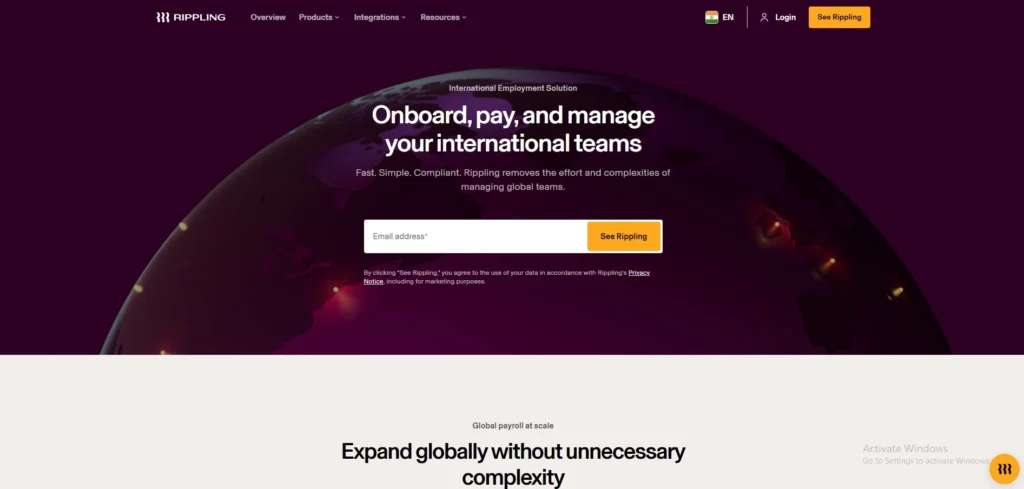
Rippling stands out because it connects your HR operations directly with your company’s IT and finance systems. This means when you hire someone new, the software doesn’t just add them to payroll; it can also automatically ship them a laptop and set up their company email, Slack, and software accounts in seconds. It is a highly customizable platform built for businesses that want to automate manual workflows across multiple departments from a single dashboard.
Key features
- Unifies HR, IT hardware management, and finance apps in one portal.
- Fully automated onboarding and offboarding workflows.
- Global payroll system capable of paying employees and contractors across 130+ countries.
- Custom automation builder using simple “if/then” rules.
Pros
- Saves hours of manual work by handling app provisioning and tech setups instantly.
- Exceptional global compliance and multi-currency payroll support.
- Flexible modular setup allows you to buy only the specific features you need.
Cons
- The final cost can add up quickly as you purchase separate add-on modules.
- Setting up the advanced multi-department automations requires a learning curve.
Pricing Available on request
2. BambooHR
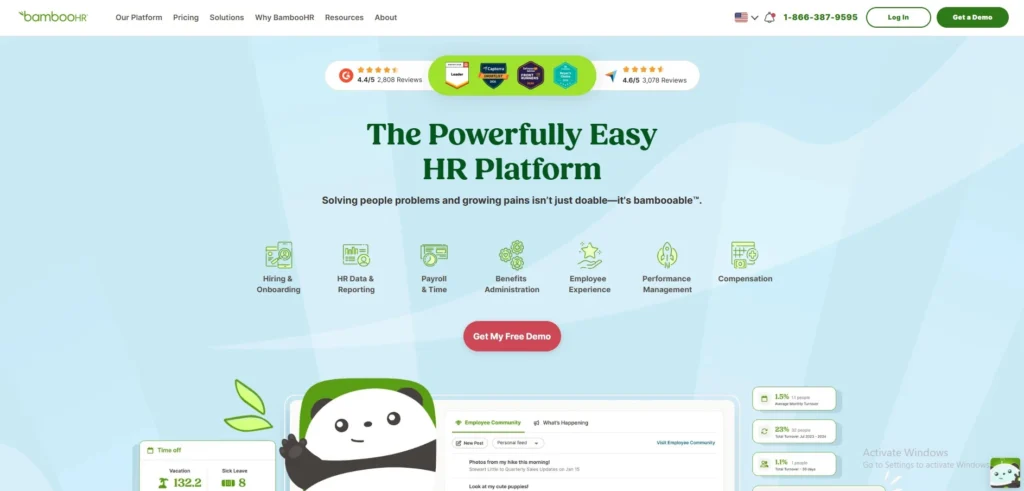
BambooHR is tailored specifically for small to mid-sized businesses looking for a clean, approachable way to move away from spreadsheets. The platform prioritizes the human side of HR, offering an exceptionally clear user interface that employees and managers can navigate with zero training. It acts as a central home for your team’s data, making it incredibly easy to manage employee records, track time-off balances, and gather team feedback.
Key features
- Simple employee self-service portal and intuitive mobile app.
- Built-in applicant tracking system (ATS) to manage hiring pipelines.
- Automatic employee wellness and engagement surveys (eNPS).
- Centralized digital document storage with built-in e-signatures.
Pros
- Extremely friendly user experience that employees actually enjoy using.
- Fast, straightforward implementation process compared to larger enterprise tools.
- Strong reporting features that let you build visual HR dashboards in a few clicks.
Cons
- Lacks advanced global payroll and international compliance features.
- Tracking time and attendance costs extra as a separate add-on.
Pricing Available on request
3. Leapsome
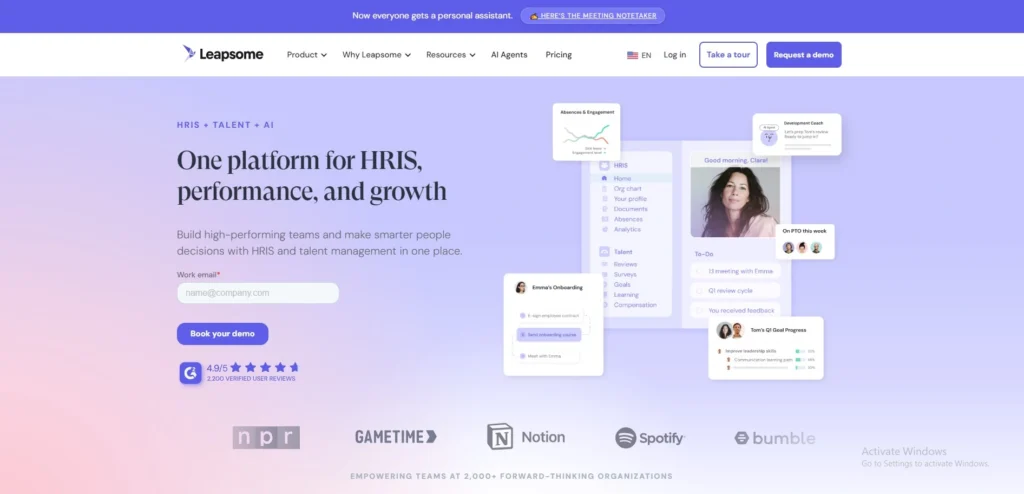
Leapsome is one of the leading people enablement and performance management platforms. It centralizes key HR functions such as performance reviews, goal-setting, employee engagement, and learning—making it easier for organizations to build a strong, continuous improvement culture. Its analytics and real-time insights give HR teams and leaders a data-driven foundation for better decision-making.
The platform’s intuitive interface makes it a great fit for companies that want structured processes without complexity. Leapsome is designed to boost engagement, improve manager–employee communication, and support long-term professional development across the organization.
Key Features:
- Performance reviews and 360° feedback
- OKR & goal management
- Employee engagement surveys
- Real-time feedback and praise
- Learning paths and competency frameworks
- People analytics
Pros:
- Clean, user-friendly interface
- Highly customizable for different teams and workflows
- Strong focus on continuous feedback and development
- Excellent for improving engagement and performance culture
Pricing: Custom pricing based on modules and number of employees.
4. Gusto
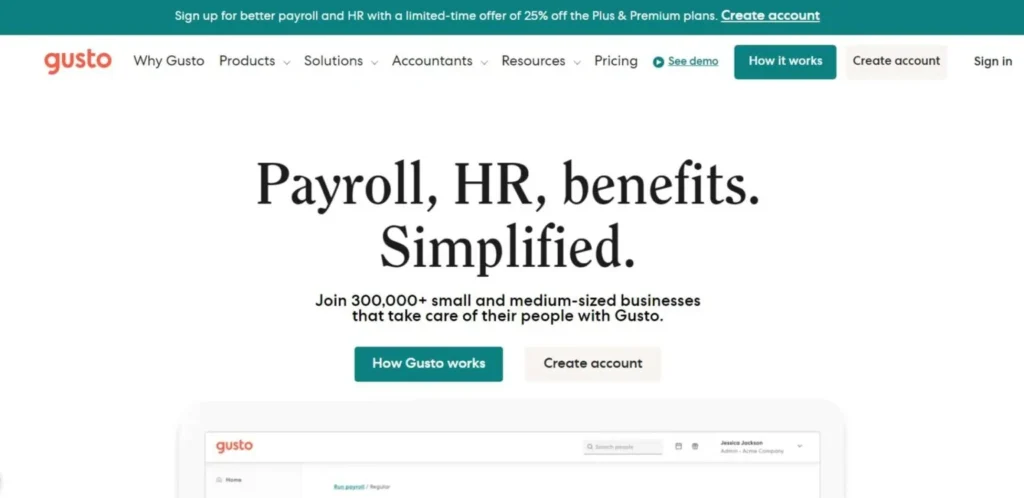
Gusto built its reputation as a payroll-first platform designed specifically for startups and growing small businesses. It takes the stress out of tax season by automatically calculating, paying, and filing local, state, and federal payroll taxes on your behalf. Beyond payroll, it integrates health insurance administration, financial wellness tools, and simple onboarding checklists into a very clean, easy-to-understand layout.
Key features
- Automated payroll processing with built-in, error-free tax filing.
- Integrated health insurance brokerage spanning medical, dental, and vision.
- Smart worker classification tools for managing both regular employees and contract workers.
- Direct employee self-onboarding and lifetime digital access to pay stubs.
Pros
- Incredibly easy to set up and run payroll, even with zero accounting background.
- Health benefits administration is included natively across all primary tiers.
- Transparent, upfront pricing models with no hidden fees.
Cons
- Advanced HR features like performance tracking and time-clocks require upgrading to the highest tier.
- Not designed to support large enterprise structures or highly complex shifting schedules.
Pricing:
| Simple | Plus | Premium |
| $49/mo | $80/mo | $180/mo |
5. HiBob (Bob)
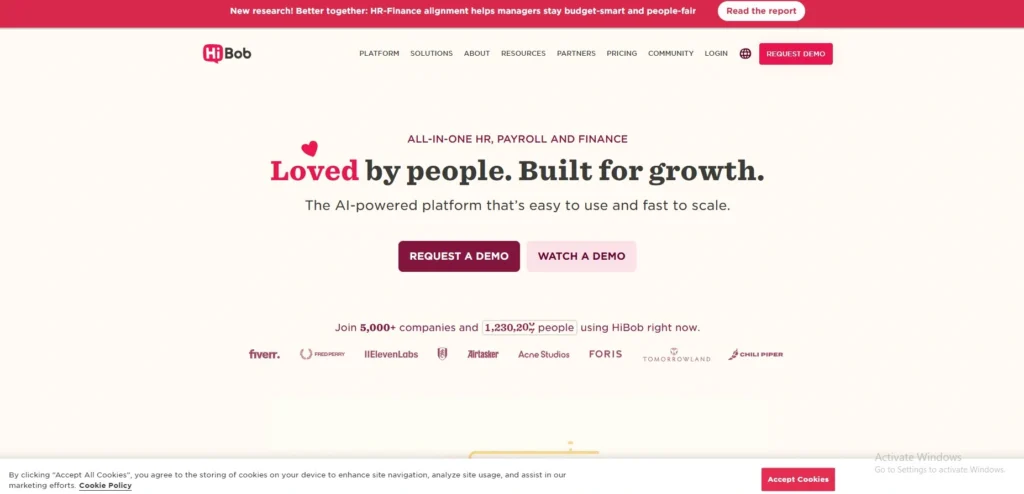
HiBob approaches HR management by styling its platform like a modern social media network rather than a dry database. Popular among fast-growing tech companies and mid-market teams, “Bob” places a heavy emphasis on company culture, peer recognition, and modern hybrid workplace management. It balances this fun, collaborative layout with incredibly powerful people analytics, touchbase alternatives, and flexible workforce planning tools.
Key features
- Social-style company homepage featuring peer shout-outs, hobbies, and announcements.
- Dynamic hybrid work planner to manage office desk bookings and remote schedules.
- Advanced custom analytics dashboards tracking turnover risks and growth trends.
- Flexible performance management supporting 360-degree reviews.
Pros
- High employee adoption rates due to the interactive, social user interface.
- Excellent flexibility for companies transitioning between remote and in-office setups.
- Highly customizable workflows that adapt smoothly as your headcount grows.
Cons
- The high level of custom settings can feel overwhelming to configure initially.
- Public pricing details are hidden, making budget planning difficult without a formal sales call.
Pricing: Custom pricing provided by the sales team upon request based on your specific organizational size and feature selection.
6. greytHR
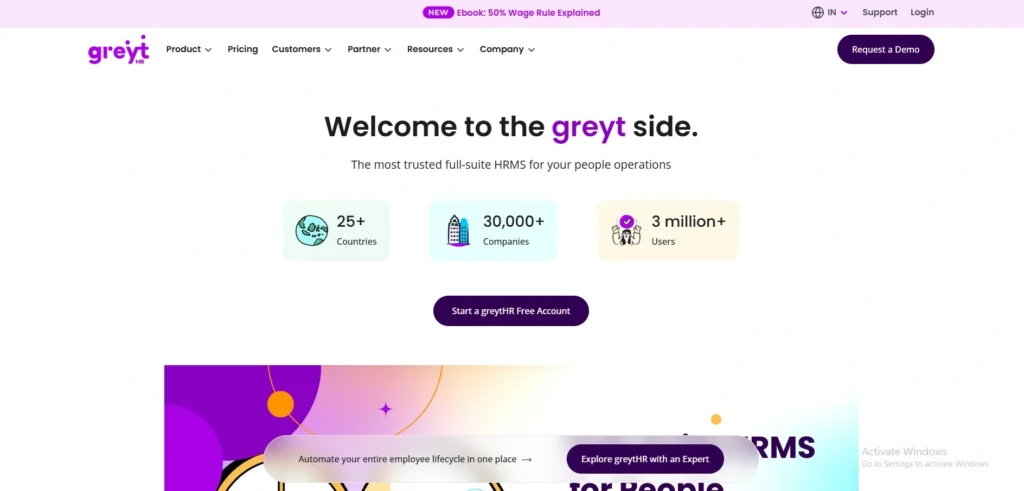
For businesses operating primarily in India and the Middle East, greytHR is one of the most reliable and trusted choices available. It is purpose-built to handle complex regional statutory compliance natively, meaning it takes care of Provident Fund (PF), Employee State Insurance (ESI), Professional Tax (PT), and Tax Deducted at Source (TDS) automatically. It is highly valued by payroll-heavy small to mid-sized enterprises that cannot afford compliance calculation errors.
Key features
- Comprehensive payroll automation aligned completely with regional labor laws.
- Native processing for Indian statutory compliance (PF, ESI, PT, TDS).
- Robust geo-fenced attendance tracking and shift management via mobile app.
- Structured employee self-service portal for downloading form 16 and payslips.
Pros
- Flawless accuracy when handling local tax laws and complex salary structures.
- Budget-friendly option specifically scaled for Indian small businesses and startups.
- Highly functional mobile application for frontline and field employees.
Cons
- The user interface looks and feels more traditional and less modern compared to global competitors.
- Features for advanced talent development and creative recruitment are limited.
Pricing:
| Essential | Growth | Premium |
| $26.20/mo | $47.20/mo | Available on request |
7. Deel
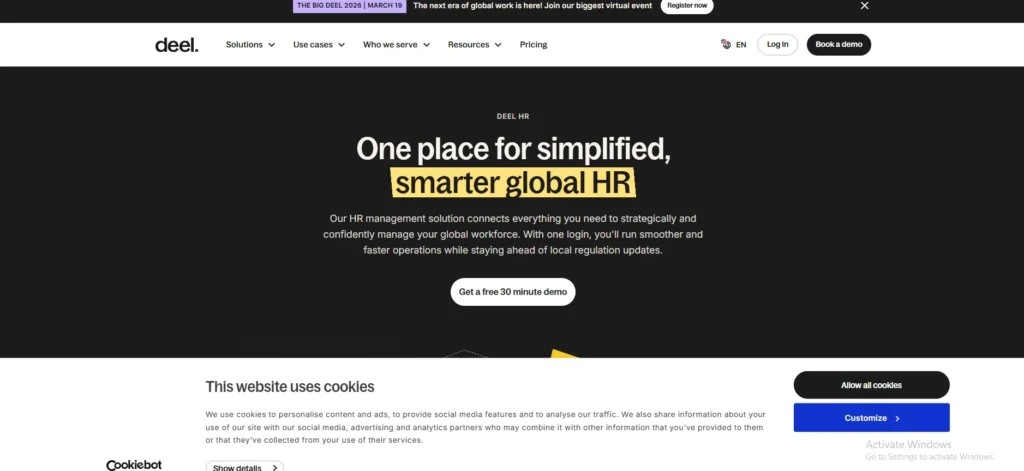
Deel is built specifically for companies that hire international teams and remote workers across borders. It simplifies global expansion by allowing businesses to legally hire, onboard, and pay full-time employees and independent contractors in over 150 countries without setting up local legal entities. The platform handles localized contracts, background checks, regional tax compliance, and automated multi-currency payments from a single unified hub.
Key features
- Automated global contract creation that complies with local country laws.
- Localized payroll management and tax filings in over 100 countries.
- Direct immigration support and visa sponsorship handling.
- Flexible multi-currency payment options, including direct bank transfers and digital wallets.
Pros
- Eliminates the massive legal and financial hurdles of international hiring.
- Excellent, responsive customer support familiar with international labor laws.
- Smooth self-onboarding and text recruiting workflows for global contractors.
Cons
- Higher base costs for full-time employee management compared to local HR platforms.
- Features for traditional, in-office attendance tracking are limited.
Pricing:
| Standard | Enterprise |
| $599/employee/mo | $899/employee/mo |
8. ZoHo People
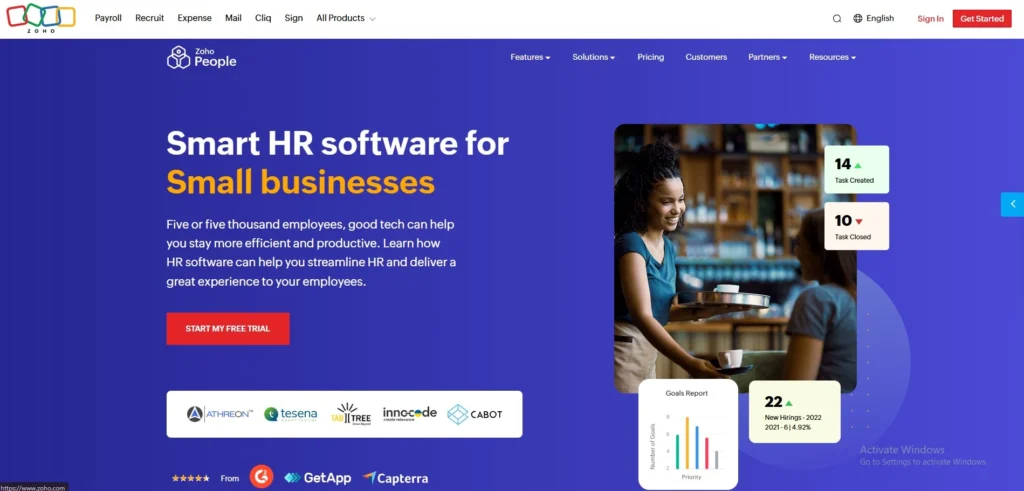
ZoHo People is a highly adaptable, cloud-based HR system that works incredibly well for small to mid-sized businesses looking for deep customization on a budget. It covers the entire employee lifecycle, from onboarding and attendance tracking to performance reviews and corporate training. Because it is part of the massive ZoHo ecosystem, it integrates seamlessly with companion tools for accounting, desk management, and recruitment, allowing you to build an interconnected back office.
Key features
- Built-in time tracker, shift planner, and attendance recorder.
- Highly customizable forms and data fields for personalized workflows.
- Comprehensive performance appraisal management with multi-rater feedback.
- Employee self-service dashboard for handling leave requests and tracking goals.
Pros
- Highly affordable pricing tiers that offer incredible value for money.
- Extreme flexibility, allowing you to modify fields and workflows without coding.
- Flawless integration with other popular ZoHo business applications.
Cons
- The initial setup and customization process can take quite a bit of time.
- The mobile application interface can sometimes feel cluttered.
Pricing:
| Essential | Professional | Premium | Enterprise |
| $0.50/user/mo | $1.01/mo | $1.51/mo | $2.02/mo |
9. Namely
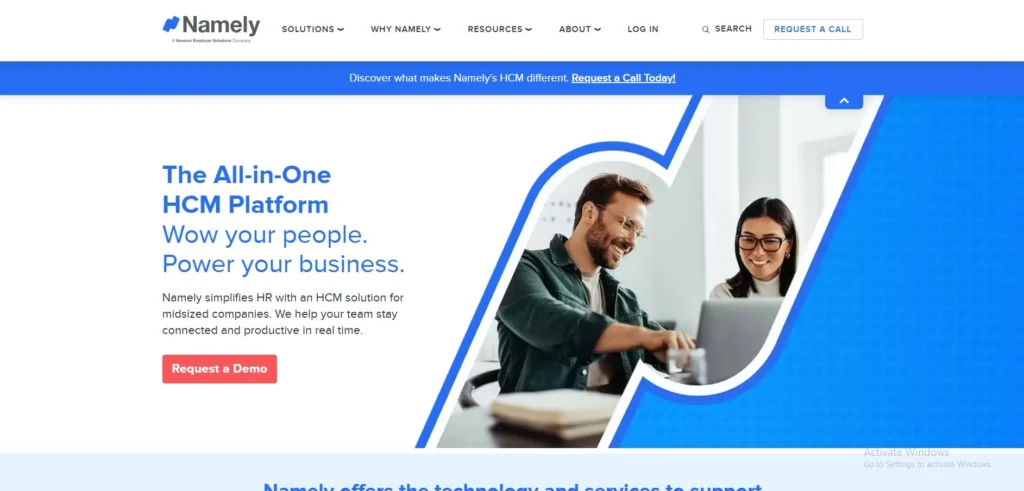
Focuses on midsized companies, which seek to simplify the HR tasks such as payroll, benefits, time tracking, and performance management. It pays most attention to making employees engaged through the benefits tools whereby employees can manage their own benefits, submit time-off requests, and access other important HR information.
The platform Namely uses to enact its services is user-friendly and contains the feature of a social feed, hence empowering the employees to interact and keep in touch with each other, thus providing an avenue for a more collaborative work environment.
Key Features:
- Payroll and benefits management
- Employee self-service portal
- Time tracking and attendance
- Performance management
- Compliance tools
Pros:
- User-friendly interface
- Features for employee engagement
- Powerful payroll and benefits management
- Good for mid-sized businesses
Pricing: $12/employee/month or $30/hr/employee, depending on the package
10. Workday HCM
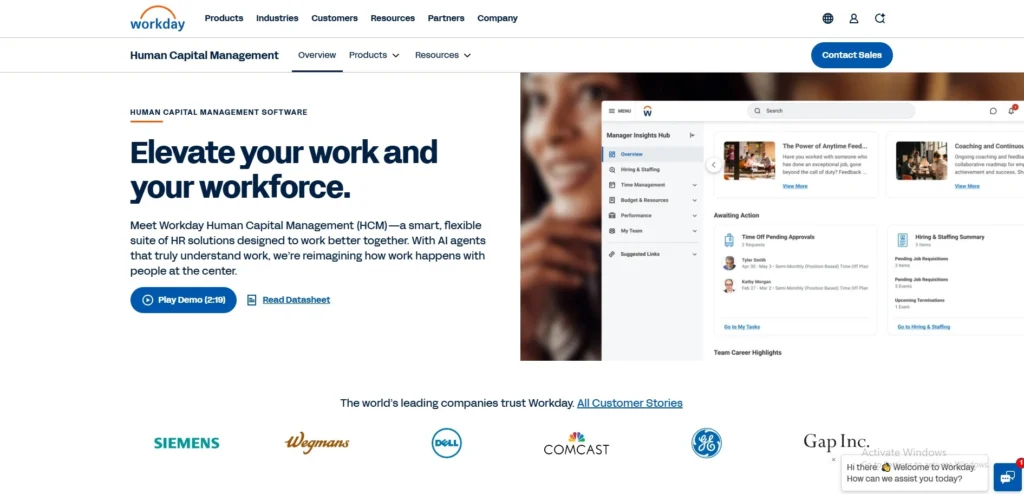
Workday is a heavy-duty, enterprise-grade human capital management system designed for large corporations and global enterprises. It combines HR operations, talent strategy, workforce planning, and financial analytics into one massive, highly secure cloud database. It is best suited for organizations that need deep machine learning insights to manage thousands of employees across multiple global offices and complex regulatory environments.
Key features
- AI-driven talent insights to predict employee retention and skill gaps.
- Global workforce analytics and real-time organizational chart planning.
- Highly secure, global compliance framework for payroll and benefits administration.
- Advanced career path mapping and continuous learning management systems.
Pros
- Practically unmatched processing power and scalability for giant corporations.
- Incredibly deep reporting and data analytics capabilities.
- Unified finance and HR database avoids data mismatches between departments.
Cons
- The software is far too complex, slow to implement, and expensive for small businesses.
- Requires dedicated, trained internal administrators to manage and maintain daily configurations.
Pricing: Custom enterprise pricing only, requiring a detailed consultation and multi-year contract commitment with their sales team.
11. Monday.com (HR Cloud)
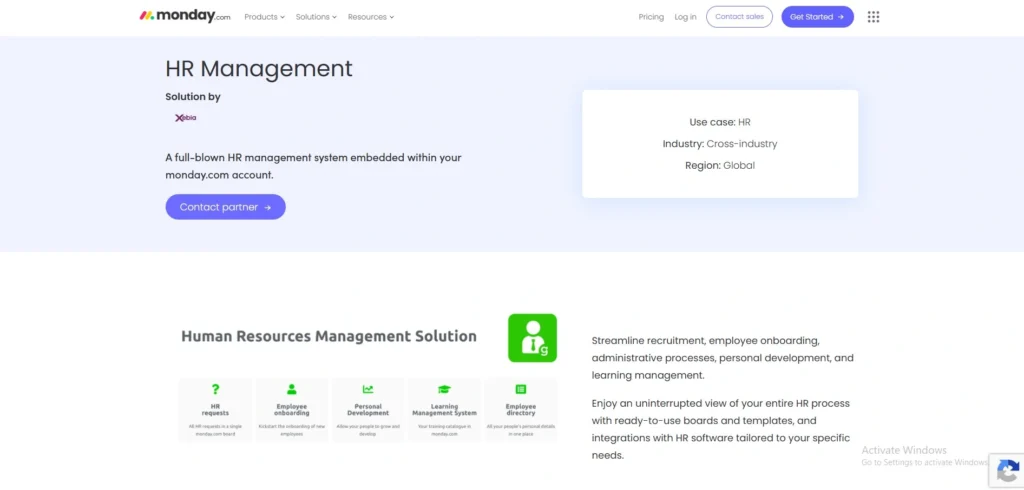
Monday.com approaches HR management through a highly visual, building-block style project management platform. Instead of forcing you into a rigid, pre-made HR layout, it provides completely customizable boards to track recruitment pipelines, manage employee onboarding checklists, and organize annual performance reviews. It is an exceptional tool for collaborative teams that prioritize visual clarity and project-based workflows over complex payroll calculations.
Key features
- Visual pipeline boards to track candidate hiring stages.
- Drag-and-drop workflow automation to trigger internal notifications.
- Centralized dashboard for tracking team goals, deadlines, and resource allocation.
- Collaborative feedback workspaces for internal team check-ins.
Pros
- Highly visual, beautiful interface that is incredibly easy to learn and modify.
- Seamlessly doubles as a company-wide project and task management tool.
- Excellent automation options that save teams from manual repetitive status updates.
Cons
- Lacks native payroll processing, tax filing, and benefits administration features.
- Requires third-party integrations to function as a complete, traditional HRIS database.
Pricing
| Standard | Pro | Enterprise |
| $31/seat/mo | $45/seat/mo | Available on request |
12. Zenefits
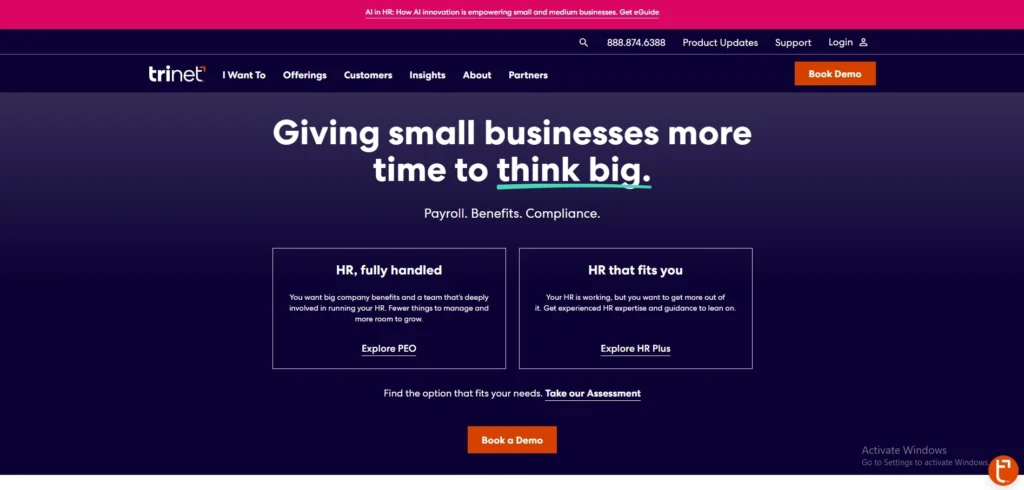
Zenefits focuses heavily on streamlining health insurance, retirement plans, and basic HR administration for growing small to medium-sized businesses. It acts as an easy-to-use bridge connecting your company payroll with major insurance providers, taking the confusion out of open enrollment and benefits deductions. The platform pairs this benefits focus with clean time-tracking, onboarding, and compliance reporting tools.
Key features
- Digital health benefits selection and open enrollment portal for employees.
- Automatic sync between employee benefit selections and monthly payroll.
- Geo-tagged mobile time-clock and automated PTO approval workflows.
- Built-in contractor payment handling and compliance document signing.
Pros
- Makes onboarding and choosing healthcare options very clear and simple for employees.
- Clean, minimalist design that requires very little training to navigate.
- Strong digital document signing and automated tax onboarding workflow.
Cons
- Customer support responses can be slow during peak open-enrollment seasons.
- Now heavily integrated into TriNet, which has altered some standalone purchasing options.
Pricing
| Essential | Growth | Zen |
| $10/mo | $27/mo | $31/mo |
13. Keka
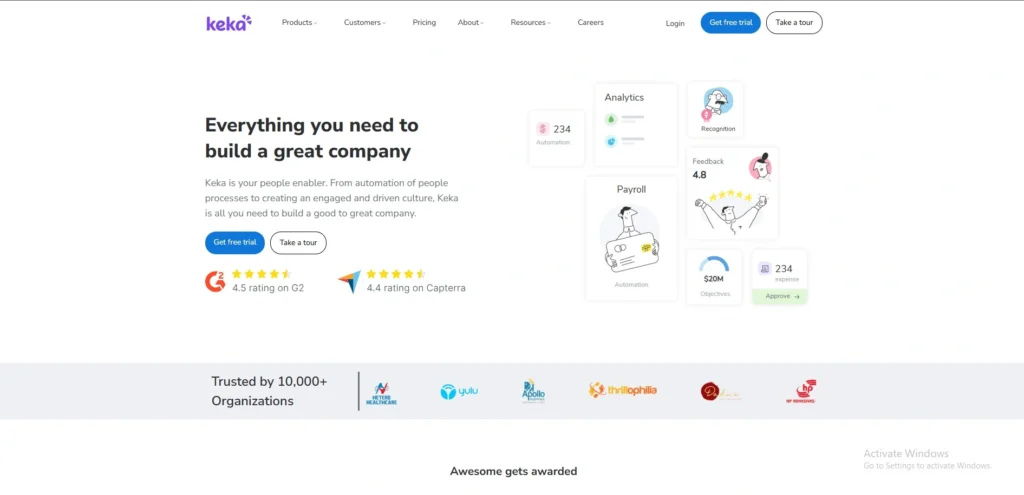
Keka is a highly popular, employee-centric HR and payroll platform designed primarily for growing businesses in India and South Asia. It specializes in untangling complex, frustrating workflows like attendance tracking and multi-tier shift management. Keka stands out because it focuses heavily on user experience, offering a modern, clean interface that integrates smoothly with existing workplace biometric devices and office setups.
Key features
- Simplified 6-step payroll wizard with automated local statutory tax filings.
- Advanced shift rotation planners and automated biometric attendance syncing.
- Goal management dashboards using structured OKR frameworks.
- Dynamic employee helpdesk system to resolve internal ticketing queries.
Pros
- Exceptionally clean, intuitive user interface that reduces employee confusion.
- Excellent handling of complex local salary structures and loan advances.
- Robust project timesheet tracking for client billing.
Cons
- Customizing complex, non-standard approval chains can be a bit tedious.
- The reporting engine can feel sluggish when exporting massive datasets.
Pricing: Available on request
14. factoHR
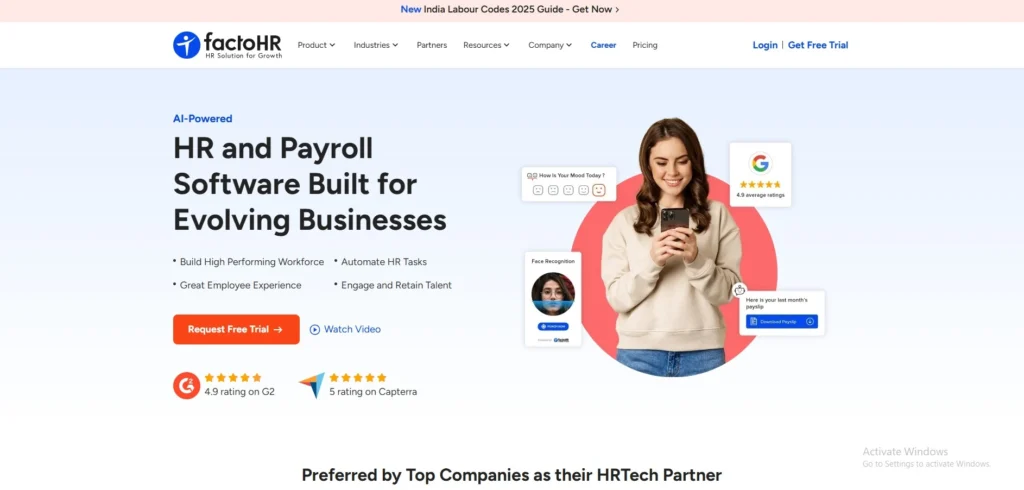
factoHR is built to streamline HR processes and automate payroll easily, helping businesses save time and reduce manual work. From recruitment and onboarding to attendance, performance, and compliance, factoHR brings every aspect of workforce management into one simple, unified platform. It’s designed to take the pressure off HR teams so they can focus more on people and less on paperwork.
With mobile access, real-time data insights, and smooth integration with existing systems, factoHR adapts to your business, whether you’re just starting out or scaling fast. It’s the all-in-one solution that grows with you and makes HR operations more efficient every step of the way.
Key Features:
- Payroll Automation
- Recruitment & Onboarding
- Attendance & Time Tracking
- Leave Management
- Employee Self-Service Portal
Pros:
- Fast and accurate payroll processing
- Reduces manual HR tasks
- Strong compliance support
- Scalable for all business sizes
- Mobile-friendly access
Pricing: Contact The Vendor
15. Personio
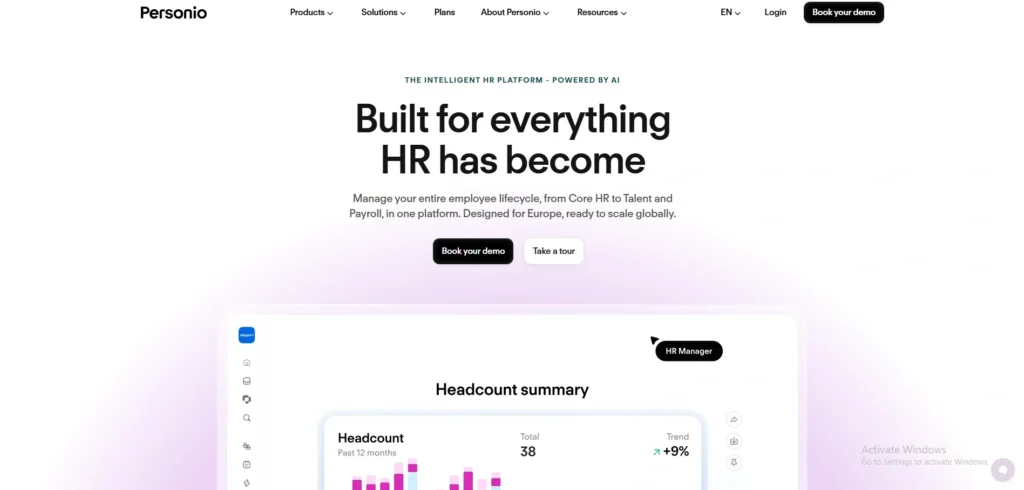
Personio serves as the default HR operating system for small to mid-sized businesses across Europe. It acts as a single, highly structured vault for all employee data, tailored specifically to handle European privacy laws, cross-border compliance, and complex multi-national absence types. It balances basic administrative tasks like payroll data validation with modern tools for recruitment and strategic workforce metrics.
Key features
- Automated absence and holiday management compliant with European labor laws.
- Unified recruitment hub with bulk resume parsing and applicant tracking.
- Centralized digital personnel files featuring secure electronic signature flows.
- Automated reminder triggers for upcoming contract renewals or probation ends.
Pros
- Simplifies compliance with strict General Data Protection Regulation (GDPR) privacy rules.
- Clean, non-distracting dashboard that focuses purely on core administrative work.
- Highly responsive customer support team tailored for growing businesses.
Cons
- Lacks deep, native payroll processing outside of its primary European markets.
- Advanced employee development features require paying for extra add-on modules.
Pricing: Pricing is hidden and requires a sales quote
16. Paycor
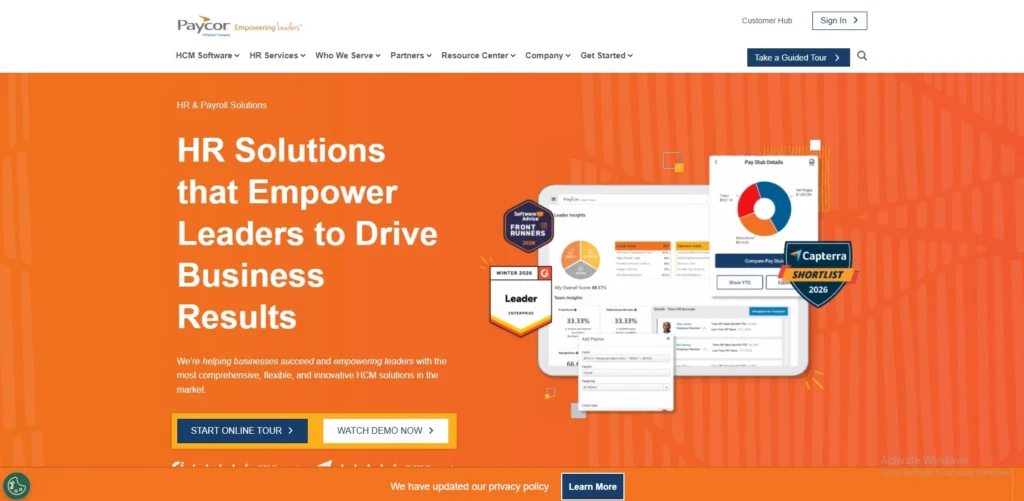
Paycor is a robust payroll and human capital management tool built explicitly for small to midsize businesses that need heavy-duty reporting. It excels at delivering deep workforce analytics, providing helpful visual charts that show leadership how their labor costs and turnover rates compare to industry averages. It also features an AI assistant to answer simple administrative questions and speed up everyday tasks.
Key features
- Intelligent payroll processing with built-in proactive error warnings.
- Predictive analytics dashboards tracking employee retention and workforce diversity.
- Integrated health benefits administration with step-by-step open enrollment guides.
- Industry-specific compliance templates, particularly for healthcare and manufacturing.
Pros
- Provides outstanding, deep data insights that you rarely find in small-business tools.
- On-demand pay options allow employees to access earned wages before payday.
- Does not enforce strict minimum employee caps to get started.
Cons
- Public pricing structures are hidden, meaning you have to handle a sales call.
- Setting up the system and importing historical data can be quite expensive.
Pricing: Custom sales quotes only.
17. Paylocity
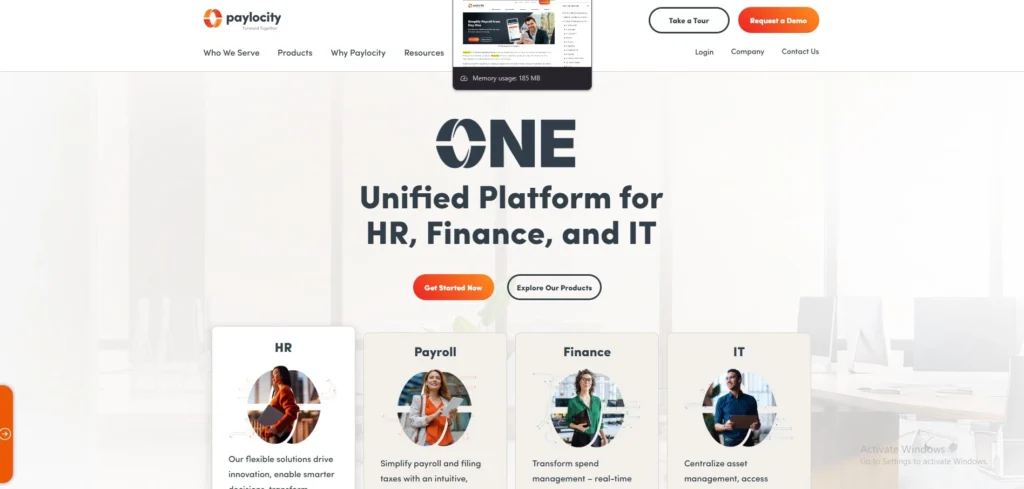
Paylocity is a modern, mid-market HR software system that places a massive focus on employee communication and community building. Recognizing that modern workforces are often split across multiple locations, it introduces community portals, video message hubs, and peer recognition boards directly into the software. This focus on engagement is backed by strong payroll, shift scheduling, and labor compliance tools.
Key features
- Integrated community hub featuring company newsfeeds and direct peer recognition.
- On-demand learning management platform to host internal training videos.
- Custom survey engine to gauge employee sentiment and workplace morale.
- Flexible, mobile-first scheduling and expense reimbursement tools.
Pros
- Outstanding mobile app functionality, making it highly accessible for on-the-go workers.
- Video integration allows leadership to attach personal welcome clips to onboarding steps.
- Strong, multi-layered security controls protect sensitive employee profiles.
Cons
- The wide variety of communication features can sometimes feel distracting or overwhelming.
- Navigating the custom report builder takes a significant amount of practice.
Pricing: Available on request
18. ADP RUN
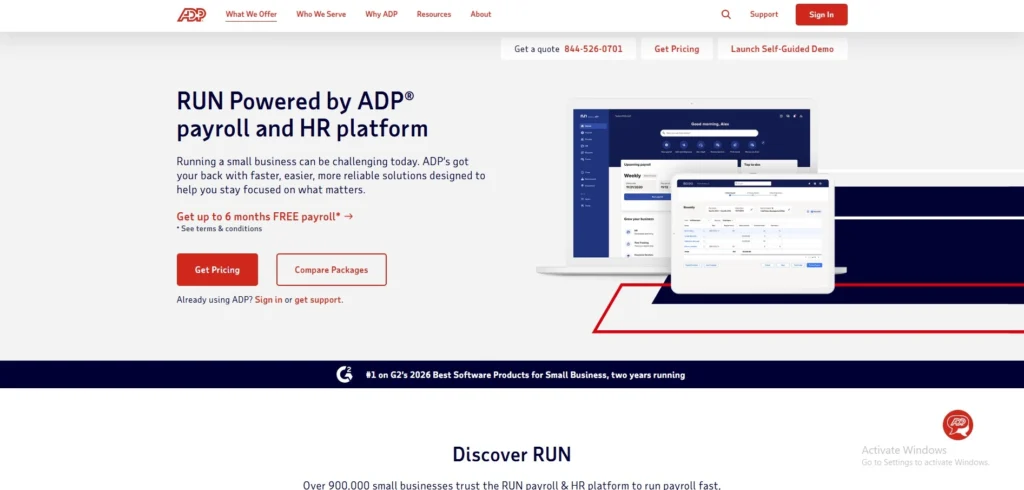
ADP RUN is a streamlined, web-based payroll and HR helper designed by one of the largest payroll processors in the world, specifically for small businesses with fewer than 50 employees. It strips away the heavy enterprise complexity of the main ADP platform to provide straightforward, highly secure paycheck processing and automated tax filing. It is an ideal pick for small shop owners who want zero-friction payroll backed by absolute legal accuracy.
Key features
- Ultra-fast payroll processing that can be completed in just a few clicks.
- Automatic local, state, and federal payroll tax calculations and submissions.
- Direct integration with major workers’ compensation insurance policies.
- Embedded HR support wizards offering step-by-step handbook builders.
Pros
- Backed by massive corporate infrastructure, guaranteeing total compliance accuracy.
- A simple, rock-solid mobile app allows you to run payroll directly from a phone.
- Excellent customer support with access to actual human payroll experts.
Cons
- Advanced talent tracking, performance metrics, and recruitment tools are absent.
- Can become significantly more expensive than newer SaaS competitors and adp payroll competitors as your team grows.
Pricing: It varies widely based on specific business setups, requiring a quick customized quote through their website.
Comparison Table
To help you quickly compare your choices, we have organized all fifteen platforms into a clean, easy-to-read summary. This side-by-side view highlights exactly what each software does best, along with its core features and pricing structures.
| Software | Best For | Key Features | Free Trial | Pricing |
| Rippling | Cross-department IT, HR, and finance automation | Unified HR & IT hub, global payroll, custom if/then automation rules | No | Available on request |
| BambooHR | Small to mid-sized teams wanting simple records management | Employee self-service, built-in ATS, wellness surveys (eNPS) | No | Available on request |
| Gusto | Startups needing easy payroll and health insurance matching | Automated tax filing, health brokerage, contractor classification tools | No | Simple ($49/mo), Plus ($80/mo), Premium ($180/mo) |
| HiBob (Bob) | Modern tech firms prioritizing culture and hybrid planning | Social company homepage, hybrid desk planner, 360-degree reviews | No | Custom pricing based on team size |
| greytHR | Businesses in India and the Middle East needing regional tax compliance | Statutory compliance (PF, ESI, TDS), geo-fenced mobile attendance | No | Essential ($26.20/mo), Growth ($47.20/mo), Premium (On request) |
| Deel | Hiring and paying international remote workers legally | Localized contract builder, multi-country compliance, visa support | No | Standard ($599/emp/mo), Enterprise ($899/emp/mo) |
| ZoHo People | Budget-conscious businesses wanting deep system adjustments | Shift planner, custom form designer, multi-rater performance appraisals | Yes (Limited Free Tier) | Essential ($0.50/user/mo) up to Enterprise ($2.02/user/mo) |
| Workday HCM | Large, global enterprise corporations with complex pipelines | AI talent predictions, global charts, consolidated finance database | No | Custom enterprise quotes only |
| Monday.com | Teams looking for highly visual pipeline tracking and task management | Visual candidate tracker, drag-and-drop notifications, task boards | No | Standard ($31/seat/mo), Pro ($45/seat/mo), Enterprise (On request) |
| Zenefits | Easy healthcare selection and basic document organization | Open enrollment system, payroll insurance sync, digital signing workflows | No | Essential ($10/mo), Growth ($27/mo), Zen ($31/mo) |
| Keka | South Asian companies handling biometric time clocks and complex shifts | 6-step payroll tool, biometric shift syncing, OKR framework tools | No | Available on request |
| Personio | European businesses scaling under strict regional privacy settings | European compliance filters, unified recruitment hub, renewal alerts | No | Hidden; requires direct sales quote |
| Paycor | Midsize teams demanding deep labor cost analytics | Proactive error alerts, retention charts, industry templates | No | Custom sales quotes only |
| Paylocity | Distributed, multi-location operations focusing on communication | Community message hub, native video onboarding, custom surveys | No | Available on request |
| ADP RUN | Small shops under 50 workers prioritizing error-free tax filing | Fast checkout payroll, automatic tax submissions, handbook templates | No | Varies; requires customized web quote |
Key Features Of HR Management Software
While different platforms focus on different business sizes, a great HR system always includes core tools that keep your company running smoothly. These key features work behind the scenes to replace manual paperwork with automated, reliable workflows.
- Central Employee Database: Acts as a single, secure digital vault for all worker records, emergency contacts, and job histories, eliminating messy paper files.
- Automated Payroll and Tax Filing: Calculates salaries, manages direct deposits, and automatically submits local and national taxes to ensure error-free paydays.
- Time and Attendance Tracking: Monitors working hours, shift schedules, and vacation requests while linking directly to payroll to ensure accurate hours.
- Employee Self-Service Portal: Gives your team a personal login to download payslips, check time-off balances, and update banking info without needing to email HR.
- Onboarding and Offboarding Tools: Automates checklists for new hires and exiting staff, making it easy to sign digital contracts, complete training, and collect equipment.
How To Choose The Right HR Management Software
Finding the perfect platform depends entirely on your specific team structure and workflows. To make the right choice, focus on how a platform matches your day-to-day operations rather than chasing unnecessary features.
- Assess Your Current Business Size and Scale: Look for software that matches your immediate headcount, and make sure it has the flexibility to scale up seamlessly without forcing you to rebuild your entire setup later.
- Identify Your Absolute Non-Negotiable Features: Pinpoint exactly where your team struggles most whether that is complex multi-shift scheduling, international payroll compliance, or just simple document storage—and filter out platforms that treat those features as expensive addons.
- Test the System’s User Friendliness: Take advantage of a product demo to evaluate how easily a regular employee or manager can navigate the interface with minimal training, ensuring high adoption rates across the company.
- Verify Regional Compliance and Tax Handling: Ensure the platform natively supports the exact statutory laws, tax brackets, and labor regulations of the specific regions or countries where your workforce actually operates.
- Evaluate Integration and Technical Support: Choose a system that connects smoothly with your existing everyday business applications, and confirm that the provider offers responsive customer support via chat, email, or phone when issues pop up.
Conclusion
In conclusion, choosing the right HR management software isn’t about picking the option with the most features; it is about finding the platform that actually fits your company’s day-to-day rhythm. Whether you are running a local small shop that just needs quick, accurate payroll, or leading a growing remote company spread across different countries, the right system will immediately take the stress out of your administrative work. By shifting from messy spreadsheets to a single organized dashboard, you save your business significant time and protect yourself from costly regulatory mistakes.
Ultimately, investing in a solid HR setup frees your team from grinding paperwork so you can focus on what actually drives your business forward your people. Take your time utilizing product demos, looking at transparent pricing plans, and involving your team in the selection process. Once you find a software platform that matches your workflow, you will turn your HR department from a stressful daily chore into a smooth, supportive asset that scales alongside your success.