Many people see a lot of visuals online. To grab their attention you need more than just plain text. Visual content is very important and infographics are one of the best types. Infographics mix data design and stories. They can make difficult information easier to understand and keep people interested. However creating a great infographic is only part of the job; sharing it with the right audience is just as important.
Infographic submission helps with this. For many years these platforms have allowed creators to show their work to more people. But in today’s world of SEO and digital marketing some people wonder if these sites still matter. Do they really exist?
This guide will take a close look at infographic submission sites. We will also look at what makes a good platform and how to submit your work step-by-step. Additionally we will share tips for making the most impact and discuss the benefits and downsides of free versus paid options. Finally we will provide best practices for getting your infographic seen beyond just submitting it to directories. Whether you are an experienced marketer or new to visual content this article will give you the tools you need to use infographic submission successfully.
What are Infographic Submission Sites?
Infographic submission websites are online platforms that act as directories or galleries specifically for infographics. Think of them as curated libraries where individuals, agencies, or brands can upload their visual content for others to discover, view, and even share.
These platforms primarily collect and organize infographics from various sources. Typically, they sort the content by topics, industries, or keywords, making it easier for users to find specific visual information all in one place.
Role of Infographic Directories in Content Discovery
Infographic submission sites can be proactive channels for content discovery and are very popular for researchers, students and marketers. In 2026, more than 65% of the information available online is visual, which makes directories more and more relevant.
These sites sort infographics by industry, keyword on a topic and by subject, ensuring when users search, they discover precisely what they are looking for. For creators, it implies that they don’t need to promote the video in order to get people to see it. Your infographic will be accessible in the correct directory and you’re putting it in front of an audience that is already in the “information” mindset, which brings reverent traffic back to your site.
Types of Infographic Submission Sites:
- General Sites: These platforms accept infographics covering a broad range of topics (e.g., Visual.ly, Daily Infographic), making them suitable for content across various industries.
- Niche Sites: These directories focus on specific fields such as finance, health, or technology. Submitting to relevant niche sites often results in more targeted traffic and higher-quality backlinks, especially for businesses aiming to reach specific audiences.
- Free Sites: Many infographic submission sites offer free submission options. However, these often come with no guarantees regarding approval or turnaround time.
- Paid Sites: On paid platforms, users pay a fee for expedited review and guaranteed placement. These submissions often receive priority visibility, enhanced positioning, and promotional opportunities.
- Curated Sites: These platforms accept only high-quality, research-driven infographics that meet strict editorial standards. Being featured on a curated site enhances credibility and can significantly increase content visibility.
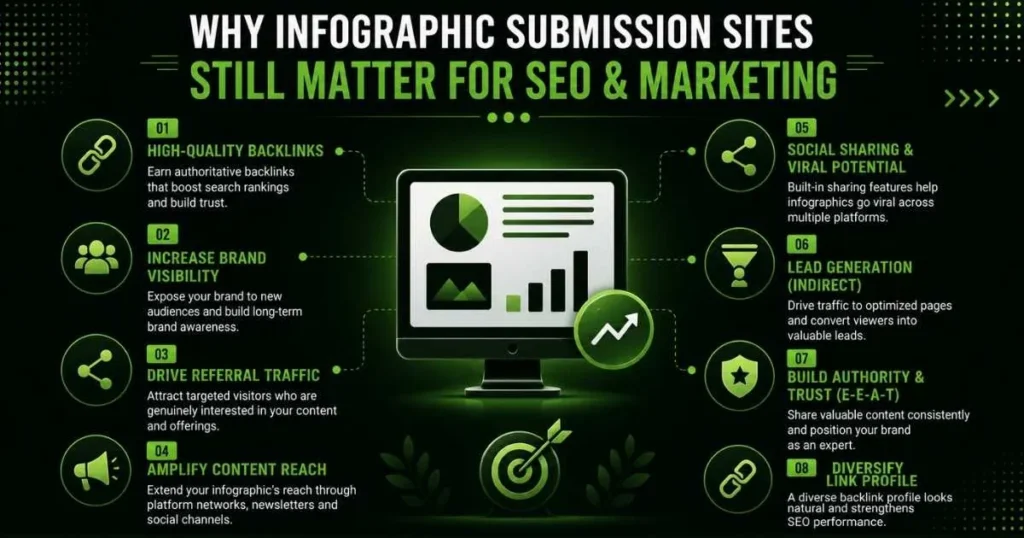
Why Infographic Submission Sites Still Matter for SEO & Marketing in 2026
In 2026, infographic submission sites are still a vital and effective tool for content marketing. There are 4.9 billion people using the internet every day and they are all consuming visual information, which has grown stronger the need of appropriate directories of infographics.
High-Quality Backlink Acquisition:
The acquisition of high-quality backlinks remains the main reason why people continue to use these services. Reputable infographic submission sites carry respectable Domain Authority or Domain Rating scores that still hold SEO weight. A link from such an authoritative site sends strong link signals to search engines, indicating your website contains trustworthy and valuable content.
Increased Brand Visibility and Awareness:
Placing your infographic across various submission platforms extends your branding and design style to new audience segments who might never have encountered your enterprise. Consistent use of cohesive brand visuals within your submissions helps cultivate brand awareness over time.
Referral Traffic Generation:
Visitors on infographic sites are there with clear intent—to find useful information. When your infographic delivers real value, it naturally attracts clicks. Viewers often follow the source link to read the original post or explore more of your site. This kind of referral traffic consists of genuinely interested users, turning passive viewers into potential future customers.
Content Amplification and Extended Reach:
Your website and social media have a limited audience reach. Submission platforms help amplify your infographic’s reach by distributing it through their networks. Beyond their native audiences, these platforms often push selected content via social media and email newsletters, expanding your exposure to new viewers and platforms.
Social Sharing and Virality Potential:
Infographic submission sites typically include built-in social sharing features on their content pages. These allow users to share infographics across various platforms easily. This sharing can spark a viral spread, helping your infographic travel beyond the initial submission site. While social signals don’t directly impact SEO rankings, they do reflect content popularity.
Lead Generation (Indirect):
The infographic process can serve as a lead generator when paired with optimized landing pages. Direct viewers to a page featuring your original infographic and include CTAs, downloadable lead magnets (like checklists or guides), or contact forms. This setup encourages users to connect further with your brand and offerings.
Demonstrating Authority and Expertise (E-E-A-T):
Your brand will emerge as a trusted leader in your industry through regular creation and distribution of valuable and educational infographics across suitable platforms. Your brand becomes more respected by users when they discover valuable visual information under your name which helps satisfy the E-E-A-T standards of Google.
Diversification of Link Profile:
Relying on a single method—like only guest posting—can make your backlink strategy appear unnatural. Incorporating links from reputable infographic submission directories helps diversify your link profile. This variety is usually seen as a positive signal by search engines and may contribute to stronger ranking stability.
Key Features to Look for in an Infographic Submission Site
- Domain Authority (DA) / Domain Rating (DR): The search engine ranking prediction metrics DA and DR from Moz and Ahrefs respectively come from analyzing website backlink profiles. A link originating from a high authority/domain rating site holds more weight for SEO than a link from a site with lower authority/domain rating.
- Relevance and Niche Focus: Your infographic should match both the fundamental content area and subcategories present on the target site. When you select a site related to your content you ensure your infographic gets in front of viewers who specifically want to see it. Search engines place greater importance on links that match your industry.
- Website Traffic Volume and Quality: The actual visitor volume of the website should be substantial. The current visitors match the profile of your target demographic groups. The probability of obtaining views along with shares and referral clicks becomes higher as site traffic expands.
- Clear Submission Guidelines: Users should find complete and specific guidelines regarding submission procedures that include file size parameters together with document type specifications and content requirements and link rules alongside categories for selection.
- Cost and Transparency (Free vs. Paid): The submission process requires payment or comes with free service. You should know both the price of payment status and the additional benefits included when paying such as expedited review times and prominent placements or followable links.
Top 75 Free Infographic Submission Sites List
How to Optimize Your Infographics for Maximum SEO Impact
The rule of thumb for infographic submission sites is that well-optimized infographics will garner three times as many backlinks as traditional blog posts will earn (in a span of 2026).
- Your first 60 characters of the title of the infographic should include your major Keyword to get you indexed.
- Write descriptive alt text on all infographic images; SE looks at this to determine context of information for images.
- You can reduce the size of an infographic up to 1MB without compromising on quality, which will certainly help with the crawlability and user experience.
- For all submission form on your infographic page, always include a dofollow link to your webpage within the URL field.
- Create a unique description (approximately 150-200 words) for each platform; it can have less value for SEO if the same description is used on multiple infographic distribution sites.
How to Submit Infographics on Submission Sites (Step-by-Step Guide)
The websites of infographic submission allow for higher rates of infographics being approved — simpler websites reporting 20% more approval for well-designed, correctly-formatted infographics in 2026.
Step 1: Finalize Your Infographic
Only begin the submission process once your infographic is fully completed and professionally polished. Ensure that all data is accurate, sources are properly cited (ideally placed subtly at the bottom), and the overall narrative flows clearly. Correct all typos and grammatical errors. Use high-quality graphics, maintain consistent branding (logo, color scheme), ensure readability through proper size contrasts, and present your design with a professional, engaging look.
Step 2: Research and Select the Relevant Site:
Avoid submitting blindly. Choose the most suitable platforms based on your infographic’s topic or industry. Use search terms like “infographic submission sites”, “submit infographic”, or “infographic directory” in combination with your specific niche or field. Explore recent blog posts listing credible submission sites—but always verify each platform yourself using the key evaluation criteria previously discussed.
Step 3: Read Submission Guidelines CAREFULLY
This is one of the most important steps. Each site has unique submission rules, and failing to follow them will likely lead to immediate rejection. Look for pages labeled “Submit,” “Add Infographic,” “Guidelines,” or “FAQ.” Note down the specific requirements of each site in a tracking spreadsheet for quick reference.
Step 4: Prepare Submission Assets
Gather all necessary materials and adjust them for each submission site. Ensure your image file is in the proper format and resolution. Write a compelling, clear title and a unique, well-written description for each platform. Naturally incorporate relevant keywords. You may need to slightly modify your content when submitting to different sites.
Step 6: Submit the Infographic
Go to the submission form on your chosen site. Fill in all required fields using your prepared assets. Upload the infographic file, paste your customized title and description, choose relevant categories, and add appropriate tags or keywords.
Step 7: Track Submissions and Results
Keep your spreadsheet updated with the progress of each submission. Log the submission date and change the status as needed: Submitted, Approved, Rejected, or Live URL. Once a submission is approved, record the live link of your infographic for reference.
Free Vs Paid: When to Consider Paid Options
You will find free and paid infographic submission sites while exploring such services. The effective use of your resources demands you must grasp both positive and negative aspects between free and paid submission methods at suitable times.
Free Infographic Submission Sites:
Pros:
- An essential advantage is that these options do not have any costs associated with them. Ideal for startups, small businesses, or marketers with limited resources.
- The entry criteria remain simple because every individual can easily access these submission sites.
- Different free submission options through various market niches provide ample space for users.
- Some popular websites with significant traffic provide their services for free although they support their operations through user ads and premium feature sales instead of submitters fees.
Cons:
- The high number of submissions combined with minimal reviewer capacities causes reviews to extend for several weeks or several months.
- Users submitting content receive no promise from any platform for their work to be accepted for publication. Your infographic will most likely get rejected from a site when it fails to meet quality criteria or when their server becomes overloaded.
- Numerous free submission sites experience lower Domain Authority/Domain Rating than both established paid and highly curated platforms do.
- Free sites mostly provide backlinks marked with nofollow attributes that prevent passing SEO value to your website.
- The large number of infographic submissions actively seeking visibility will create high competition levels.
- Poor moderation practices in free sites have the potential to produce excessive spam content that damages the optimal branding environment.
- Basic submission forms with limited promotional choices constitute the typical features of free submission platforms.
Paid Infographic Submission Sites:
Pros:
- The services offer quick review processes which combine fast approval times from 24-72 hours and publication guarantees provided authors maintain adequate standards. Some guarantee placement.
- Paid platforms which function as well-established entities host websites with higher authority along with substantial website visitors.
- The payment will increase your chances to obtain valuable dofollow backlinks from directories though you should confirm such claims before proceeding.
- May offer premium placement (e.g., homepage feature, category highlight) or additional promotion through their social channels or newsletters.
- The payment barrier sometimes results in lower competition on the platform because it excludes weaker submissions thus creating a more refined submission environment.
- Project submitters can find enhanced support services available from better support channels.
Cons:
- The business requires financial allocation along with submission fee costs which span from minimal dollars to heavy amounts per submission.
- Paying for inclusion does not ensure the return of substantial SEO advantages along with significant traffic. The site’s payment value depends on its genuine quality and visitor activity combined with its connection to specific terms.
- Paid sites could claim high fees even though their website features shallow visitor numbers together with low authority level. Thorough vetting is essential.
- The practice of paid links may produce negative effects in search engine perception when organizations fail to combine it properly with organic link building methods but legitimate directory listings remain acceptable to search engines.
Best Practices for Infographic Distribution and Promotion
Out of the box promotion to infographic submission websites ensures that your content is seen multiple times: Infographics outperform all other content types in social media sharing per week in 2026, by 3x.
- Stagger: Submitting on different days or weeks to create a natural link acquisition backlink strategy algorithm-friendly.
- Embed Code: For you to give attribute to your hosted infographic automatically on other websites: add a simple embed code below your hosted infographic.
- Reaching out: Personally reach out to niche bloggers and journalists via email — personalized outreach is 27% more likely to be responded to.
- Social Slicing: Divide your infographic into segments that will work well for all the social platforms with varying specifications, to boost interaction per platform.
- Repurpose: Repurpose infographic content to make short videos, carousels, or blog posts to reach wider audiences according to their preferred video consumption styles.
Common Mistakes to Avoid When Submitting Infographics
In 2026, more than 60% of rejected infographic submissions are because of incorrect image quality and duplicate information.More than 60% of the submissions to infographics in 2026 are simply rejected due to faulty photos and information.
- Duplicate Content: When the same description is pasted over all infographic submission sites, it leads to receiving a penalty from Google and low approval rates.
- Ignoring Guidelines: Not following the submission guidelines for your platform usually means that you will be rejected without being told.
- Low Resolution: Poor-quality infographics can lead to bad impression and flagged during quality checks by moderators.
- Not relevant niche: When there is no relevance, it decreases traffic quality; keep always in touch the theme of your infographic with the focus area of the site.
- Mass Submitting: It is a process of submitting articles to 30+ sites at a time, which may be considered a manipulative behavior by the search engines.
Measuring the ROI of Infographic Submission: Key Metrics to Track
It is crucial to track ROI from infographic submission websites — the content marketers who track their infographic performance regularly receive 12% of all their referrals from visuals.
- Backlinks: Track the amount of new linking domains collected after each submission, using link-explorers such as Ahrefs or Moz’s link Explorer.
- Referral Traffic: Sign in to Google Analytics to view session sources that direct traffic back to your site directly from each infographic submission site that you have participated in.
- Domain Authority: Track monthly growth in your site’s Domain Score & determine if efforts on high authority sites affect it.
- Engagement Rate: Monitor Bounce Rate and Time on page on traffic referred from other platforms – better traffic quality means increased LOTP & increased Conversion Rate.
- Share: Analyse the virality potential with the number of social shares of each infographic you submit – Which ones resonate the best?
Conclusion
These platforms are no instant formula to SEO success, but really an incredible addition to a broader, diversified method. By picking the right heir strategic relevance and good authority of sites, write information in the descriptions, to link to well-optimised source-page and from well-optimised source-pages to reach, markets assured relevant resources with invaluable linking, traffic and quality referrals say, of well-optimised SEO page sites, getting publicity online, hyperlink marketing too increase being search of the requisite, this is the benefits how selecting.
Through combining quality infographic submission and promotion as part of your complete content marketing strategy, you can effectively leverage the ability of visual storytelling in order to reach your SEO and marketing aims within the continuously changing digital environment.
FAQs
Have infographic submission sites done the trick for SEO?
Yes, strategically. Putting in high quality infographics to the respected submission sites with valid backlink (using dofollow) still have their use.
Do all infographic submit websites provide dofollow link?
No. There are numerous free sites that issue nofollow links which, whilst they don’t pass SEO “link juice”.
How many infographic submission sites I need to submit.
There’s no magic number. Be more interested in relevance and quality rather than size. Find a handpicked of the best sites, your particular infographic content and its audience (maybe 5-15 quality spots).
Is it legal to submit the same infographic to multiple websites?
Yes, in general it’s fine and customary to submit an infographic image to multiple directory sites that are related.