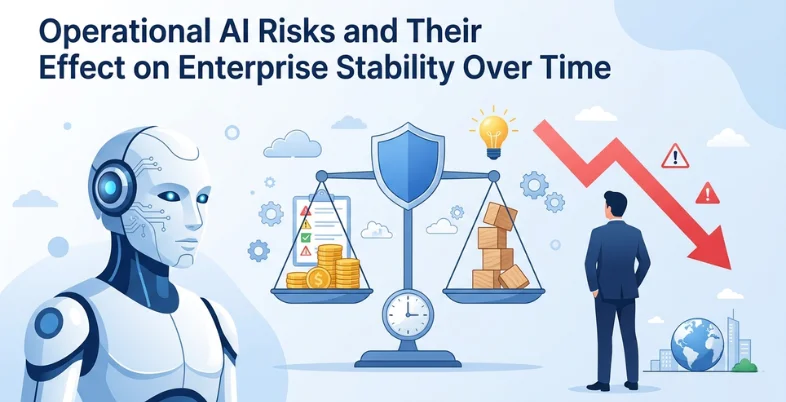
Artificial intelligence is no longer confined to experimental labs or innovation units. It is increasingly embedded within revenue operations, compliance workflows, customer analytics, fraud detection systems, underwriting models, logistics optimization engines, and executive decision frameworks.
Adoption velocity is accelerating across industries.
Governance maturity is not keeping pace.
For investors, board members, and capital allocators, this imbalance introduces a structural category of operational risk that extends beyond technical execution. It affects valuation durability, regulatory exposure, earnings predictability, and systemic enterprise resilience.
The opportunity narrative surrounding artificial intelligence remains powerful. Productivity gains, automation leverage, enhanced analytics, and cost optimization continue to attract substantial investment.
However, long term enterprise stability depends less on deployment speed and more on architectural discipline.
The core question for investors is no longer whether artificial intelligence will create competitive advantage. It is whether enterprises are implementing it in a manner that preserves structural integrity.
AI Adoption Is Advancing Faster Than Oversight
Global research continues to demonstrate rapid adoption.
McKinsey reports that a majority of organizations have implemented artificial intelligence in at least one business function. Many have integrated it across multiple operational domains, including customer onboarding and lifecycle management, where artificial intelligence is increasingly shaping how SaaS platforms engage users from the outset.
Deloitte findings indicate that only a limited percentage of enterprises classify themselves as mature in artificial intelligence governance, model oversight, and risk management practices.
Gartner has warned that organizations lacking formal artificial intelligence governance frameworks are materially more likely to encounter operational incidents linked to automated systems.
The pattern is consistent across studies.
Deployment decisions are accelerating at the executive level. Oversight and control frameworks frequently evolve in response to incidents rather than in anticipation of them.
This creates asymmetry.
Enterprises are expanding automated decision capacity without proportionally strengthening monitoring, auditability, and integration discipline.
Such asymmetry introduces latent risk that may not manifest immediately but becomes visible under stress conditions.
Understanding Operational Artificial Intelligence Risk

Operational artificial intelligence risk refers to vulnerabilities that arise when automated systems are embedded within enterprise infrastructure without adequate structural safeguards.
Unlike experimental risk, which is contained within isolated pilots, operational risk affects core processes.
It is multidimensional.
Model risk
Artificial intelligence models are inherently sensitive to data drift, environmental changes, and evolving market conditions. Without continuous validation and recalibration, model performance can degrade gradually. Decisions influenced by degraded models may appear statistically valid while producing economically flawed outcomes.
Data integrity risk
Artificial intelligence systems depend on complex data pipelines. Inconsistent inputs, incomplete datasets, and unmonitored data transformations introduce reliability concerns. When governance over data lineage is weak, accountability becomes diffuse.
Security exposure
Integration of artificial intelligence expands digital surface area. Additional endpoints, data interfaces, and automated workflows increase susceptibility to unauthorized access and adversarial manipulation. Security controls that are sufficient for traditional systems may not address the complexity of automated decision engines.
Bias and compliance risk
Regulators have increased scrutiny over algorithmic transparency and fairness. In sectors such as financial services and healthcare, insufficient explainability can trigger enforcement action. Bias embedded within training data or model logic can generate reputational and legal consequences.
Vendor dependency risk
Many enterprises rely on external providers for core artificial intelligence infrastructure. Concentration of dependency may reduce visibility into underlying models, training data, and operational safeguards. Limited transparency complicates oversight.
Infrastructure fragility
Artificial intelligence systems often operate within layered technology stacks that include cloud services, data warehouses, orchestration tools, and integration layers. Weak cohesion across these components increases the probability of cascading operational failure.
These dimensions interact.
Risk does not accumulate linearly. It compounds systemically.
The Hidden Impact on Enterprise Valuation
Operational artificial intelligence risk rarely produces immediate headline losses. Instead, it erodes structural predictability.
Predictability remains central to valuation durability.
The impact tends to emerge through indirect channels.
- Reputational impairment: Public incidents tied to automated system failures weaken stakeholder trust. Restoring credibility requires sustained governance reform and often extended disclosure cycles.
- Regulatory enforcement: Financial institutions and publicly traded companies have incurred fines and remediation costs linked to insufficient oversight of automated decision systems.
- Operational disruption: Model malfunction or infrastructure failure can interrupt revenue generating processes. Even temporary instability can introduce volatility in earnings performance.
- Cost unpredictability: Uncontrolled scaling of artificial intelligence infrastructure may elevate cloud expenditure and vendor costs beyond forecasted projections.
- Capital market sensitivity: Investors increasingly evaluate governance quality as part of enterprise risk assessment. Limited transparency around artificial intelligence oversight introduces uncertainty premiums that may influence valuation multiples.
The market does not penalize innovation. It penalizes unmanaged volatility.
Operational artificial intelligence risk is fundamentally a volatility question.
Architecture Determines Risk Exposure
Artificial intelligence does not operate independently.
It functions within enterprise architecture, data ecosystems, governance structures, and infrastructure frameworks.
Risk exposure is therefore architectural rather than purely algorithmic.
According to insights shared by Pratik Mistry at Radixweb, a leading custom software engineering firm, sustainable AI performance is driven less by advanced models and more by how deeply those systems are integrated into secure, observable, and governed enterprise environments.
When architectural discipline is present, artificial intelligence enhances operational intelligence.
When integration is ad hoc, artificial intelligence can amplify fragility.
The distinction is structural.
Well engineered systems incorporate monitoring checkpoints, failover mechanisms, traceability controls, and governance oversight. Poorly integrated systems lack visibility into failure points and decision pathways.
For investors, evaluating architectural maturity may provide greater insight into long term stability than evaluating model complexity.
What Investors and Boards Should Evaluate
Board level oversight of artificial intelligence requires structured inquiry that extends beyond capability narratives.
Key evaluation areas include:
- Presence of formal governance frameworks
- Clear accountability for model ownership and oversight
- Continuous monitoring and performance validation protocols
- Documented audit trails and traceability of automated decisions
- Stress testing under infrastructure load conditions
- Explainability mechanisms aligned with regulatory expectations
- Clarity regarding reliance on third party providers
- Integration maturity across enterprise systems
These considerations collectively indicate whether artificial intelligence functions as governed infrastructure or unmanaged experimentation.
Enterprises that treat artificial intelligence as embedded operational intelligence governed by defined policy frameworks exhibit stronger structural resilience.
Long Term Stability Requires Structural Control
Artificial intelligence is neither inherently stabilizing nor destabilizing.
Outcome is determined by implementation discipline.
Enterprises that embed automated systems within cohesive architectural frameworks are better positioned to convert innovation into durable performance. Those that prioritize rapid deployment without systemic integration introduce latent volatility that may not surface immediately but becomes material over time.
Long term stability is not achieved through technology adoption alone.
It is achieved through architectural control.
Architecture determines risk exposure.
Risk exposure influences predictability.
Predictability shapes valuation durability.
For capital allocators assessing enterprise resilience in an increasingly automated economy, operational artificial intelligence risk warrants structured and continuous evaluation.
Innovation drives growth.
Architecture preserves stability.
Both are required.