Businesses today are constantly searching for smarter ways to make decisions and stay ahead of the competition. Predictive Analytics Tools help organizations achieve this by analyzing historical data and identifying patterns that can forecast future outcomes. Using advanced technologies such as statistical modeling, artificial intelligence, and machine learning, these tools transform large volumes of raw data into meaningful insights that support better planning and strategy.
Predictive analytics software are widely used across industries, including finance, healthcare, retail, marketing, and manufacturing. Companies use them to predict customer behavior, forecast sales trends, identify potential risks, and improve operational efficiency. By understanding what is likely to happen next, businesses can take proactive actions rather than simply reacting to past events.
Modern predictive analytics platforms also provide user-friendly dashboards, automated data analysis, and real-time reporting, making them accessible to both technical and non-technical teams. As data continues to grow rapidly, predictive analytics software play a vital role in helping organizations make faster, smarter, and more confident business decisions.
What Are Predictive Analytics Tools?
Predictive analytics tools are software platforms that analyze historical data using statistical models, machine learning, and artificial intelligence to predict future outcomes. Instead of only showing what happened in the past, these tools identify patterns in data and estimate what is likely to happen next. Businesses use them to forecast trends, anticipate customer behavior, and make smarter decisions based on data rather than assumptions.
Organizations rely on predictive analytics software because modern businesses generate massive amounts of data every day. Without advanced tools, it becomes difficult to interpret this data and turn it into meaningful insights. Predictive analytics platforms help companies transform raw data into forecasts that guide planning, reduce risks, and improve performance.
Why Companies and Professionals Use Predictive Analytics Tools
1. Forecasting Future Trends
Businesses can predict sales demand, revenue growth, or market changes. This helps companies prepare for future opportunities and avoid sudden disruptions.
2. Understanding Customer Behavior
Predictive analytics helps identify which customers are likely to purchase, leave a service, or respond to marketing campaigns. This improves customer retention and marketing efficiency.
3. Risk Management
Financial institutions and insurance companies use predictive models to detect fraud, assess credit risk, and prevent financial losses before they occur.
4. Improving Operational Efficiency
Companies use predictive analytics to optimize supply chains, manage inventory, schedule staff, and reduce operational costs.
5. Data-Driven Decision Making
Executives and managers use predictive insights to make strategic decisions based on probabilities rather than guesswork.
Overall, predictive analytics tools help organizations move from reactive decision-making to proactive planning, allowing them to stay competitive in fast-changing markets.
List of Top 15 Predictive Analytics Tools
1. IBM SPSS
Website: https://www.ibm.com/products/spss
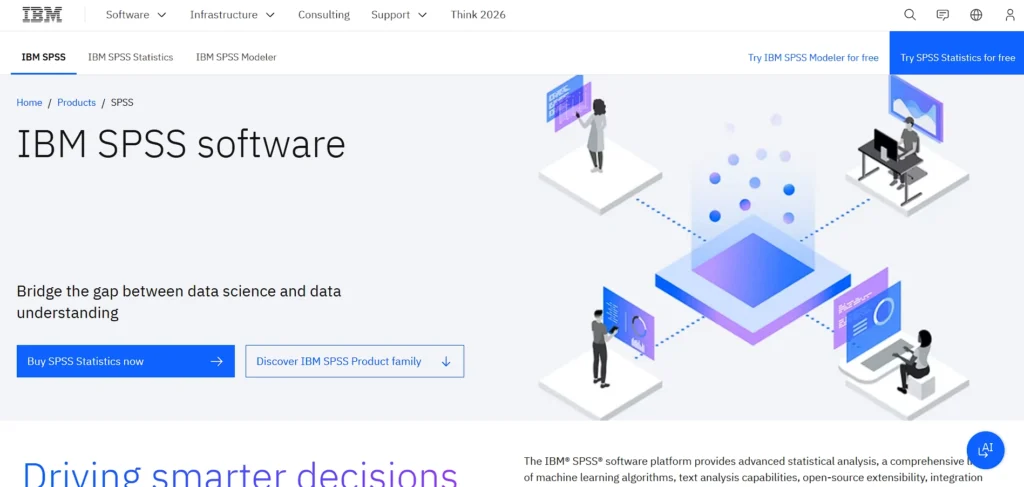
IBM SPSS is the most commonly used tool, most effective in cases of large and structured data sets. It possesses a graphical interface that allows the user to create multifaceted statistical frameworks and explore data without writing a great deal of code. It is popular among researchers, human resource departments, and even marketers because it is reliable. SPSS can transform big data into transparent predictions and display the behavior and future trends to enable companies to make smart decisions in 2026.
Key Features:
- Visual workflow builder
- Sophisticated statistical predictions.
- R & Python integration
Pros:
- Highly user-friendly
- Properly organized search.
Cons:
- Poor real‑time scaling
- Slightly dated interface
Suggested Read: Supply Chain Management Platforms
2. Alteryx
Website: https://www.alteryx.com/
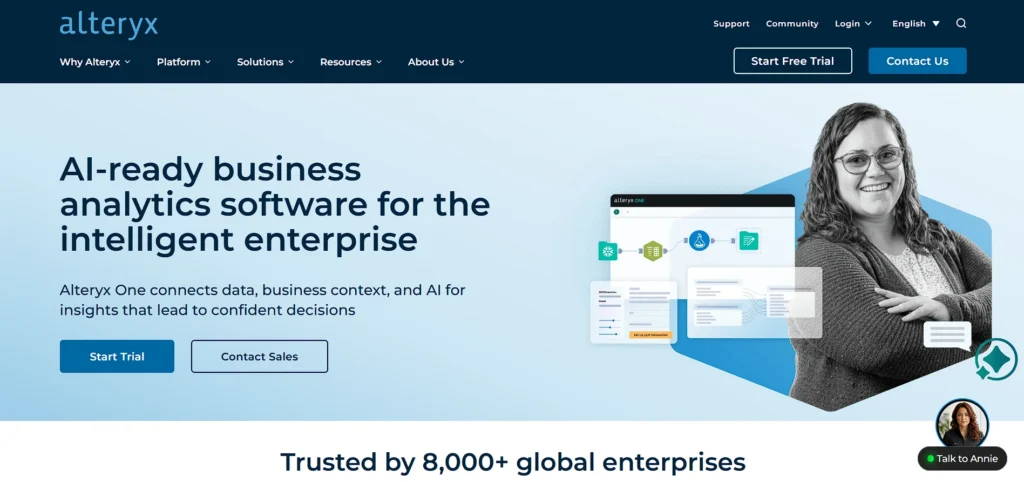
Alteryx assists users in blending, cleansing, and modeling information with little or no code using advanced predictive analytics tools. Connect to almost any source of data, clean up unruly data, and run predictive models entirely in a visual flowchart workspace. It combines raw data work and business knowledge. The data prep becomes quicker with the help of Alteryx, allowing any non-expert to develop models, identify the tendencies of the market, and embed predictions into daily business processes.
Key Features:
- Automated data prep
- Pre‑built predictive models
- Geospatial location intelligence.
Pros:
- Fast data prep
- Empowers science and researchers who are citizens.
Cons:
- Expensive for SMBs
- Lacks full MLOps
3. RapidMiner (by Altair)
Website: https://altair.com/altair-rapidminer
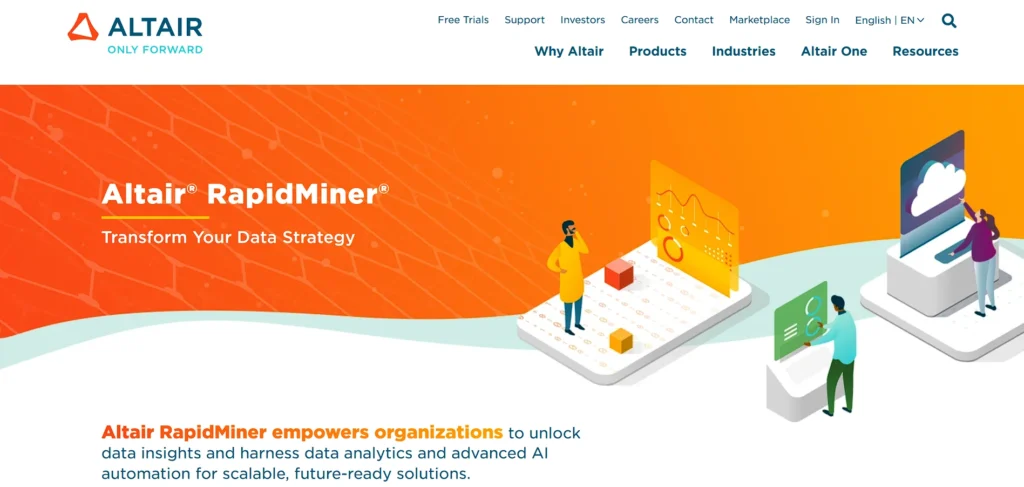
RapidMiner provides a fully operational, user-friendly, but powerful data science platform. It includes data cleansing process, model training and evaluation, and deployment. Teams of analysts to data scientists can collaborate in one place. Its AutoML and numerous ready-made algorithms will accelerate reasonable predictions, assisting the business in forecasting customer actions, enhance supply chains, and reduce the risk within a short time frame.
Key Features:
- Visual workflow builder
- Rapid AutoML capabilities
- Wide-ranging pre-existing algorithms.
Pros:
- Strikes the right correspondence between light and heavy.
- Strong community support
Cons:
- Frustrates pure coders
- Complex pricing structures
4. DataRobot
Website: https://www.datarobot.com/
DataRobot is a business-centric model of AI that specializes in automated machine learning (AutoML) to simplify the process of building, testing, and deploying predictive models. As one of the leading predictive analytics tools, it automates feature engineering as well as model selection to help firms convert raw data into actionable financial forecasts within record time. It also provides transparent explanations of AI decisions and strong governance features, making the results reliable for business leaders. This is why it is a strong choice in industries where regulation, reliability, and predictive accuracy are essential.
Key Features:
- Industry-leading AutoML
- Robust AI governance
- Elastic multi-cloud application.
Pros:
- Fast time-to-value
- Clear ROI translation
Cons:
- Premium enterprise pricing
- Potential black-box feel
5. Microsoft Azure machine learning
Website: https://azure.microsoft.com/en-us/products/machine-learning
Microsoft Azure Machine Learning refers to a cloud service where one can create, experiment and deploy predictive models at scale. It offers no-code tools for beginners and code-first environments like Jupyter for advanced teams. Since it has been deeply integrated with Power BI, Azure Data Factory, and other Microsoft products, companies can easily bring in big data, train models, and execute forecasts in a secure way anywhere in the world.
Key Features:
- Massive scalability that is cloud-native.
- Deep Microsoft integration
- State of art hyperparameter optimization.
Pros:
- Perfect for Microsoft shops
- Secure global scalability
Cons:
- Steep learning curve
- Potential vendor lock-in
6. H2O.ai
Website: https://h2o.ai/
H2O.ai is a fast and adaptable open-source machine learning platform and one of the leading predictive analytics tools. It can handle distributed and deep learning problems, making it useful for very large or noisy datasets. Its Driverless AI tool automates much of the work required for feature engineering, model tuning, and deployment. H2O.ai helps companies fast-track the process of building transparent models that can be used in fraud detection, pricing, and customer retention.
Key Features:
- Enterprise-grade scalability
- Driverless AI automation
- Inbuilt multi-language services.
Pros:
- Extremely fast processing
- High model transparency
Cons:
- Technical skills are required.
- Unclear enterprise pricing
7. SAP Analytics Cloud
Website: https://www.sap.com/products/data-cloud/cloud-analytics.html
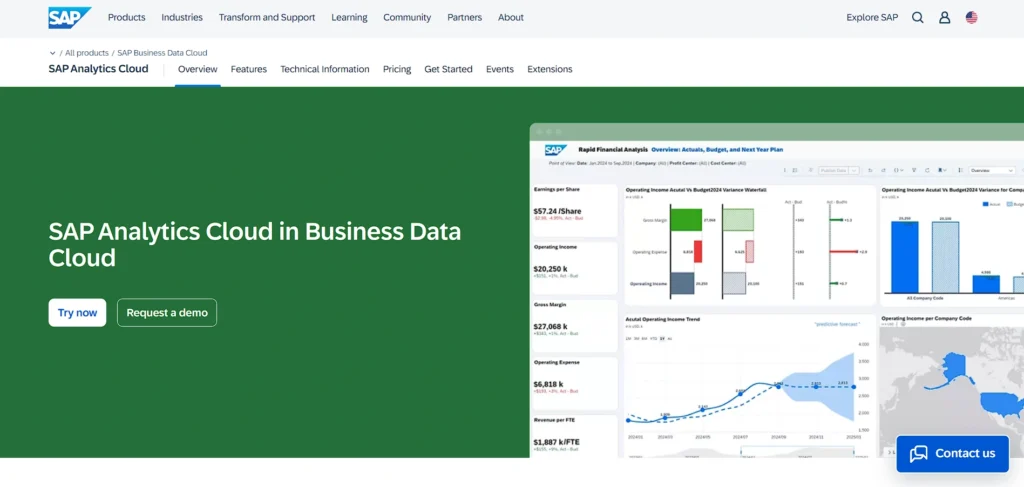
SAP Analytics Cloud is a platform that unites business intelligence, predictive analytics, and planning services into a cloud platform. It deploys AI and machine learning to identify underlying trends, make predictions and real-time what-if analysis. It allows finance, HR, and supply chain departments to base their insights and data on a single source of truth as long as it is connected to existing SAP systems and consequently contributes to sustainable development.
Key Features:
- Unified BI & planning
- Generative AI assistant
- Automated time-series modeling.
Pros:
- Seamless SAP integration
- Exceptional interdepartmental planning.
Cons:
- Needs SAP infrastructure.
- Inadequate niche modification.
8. SAS Viya
Website: https://www.sas.com/en_in/software/viya.html
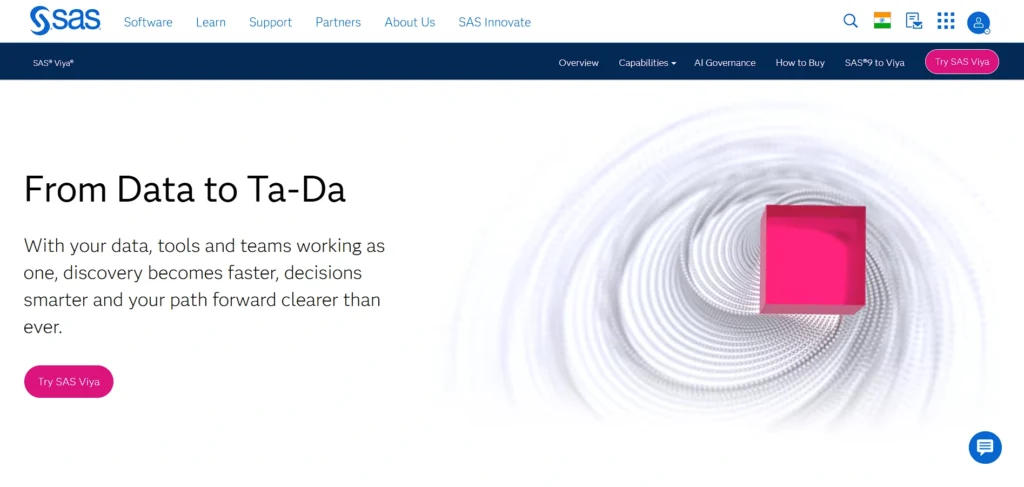
SAS Viya is the contemporary cloud-friendly edition of SAS analytical and predictive analytics tools. It identifies latent trends, automates sophisticated predictions, and easily implements machine learning models. SAS Viya enjoys strong data governance and security, which has made governments, healthcare providers, and banks trust it. It provides low-code interfaces and deep programming capabilities, allowing enterprise developers to create compliant and resilient predictive models to solve complex problems.
Key Features:
- Smart automated prediction.
- Hybrid coding interface
- Exemplary data administration.
Pros:
- Unmatched regulatory trust
- Manages complicated forecasting
Cons:
- Overly complex for SMBs
- Premium enterprise pricing
9. Tableau (by Salesforce)
Website: https://www.tableau.com/
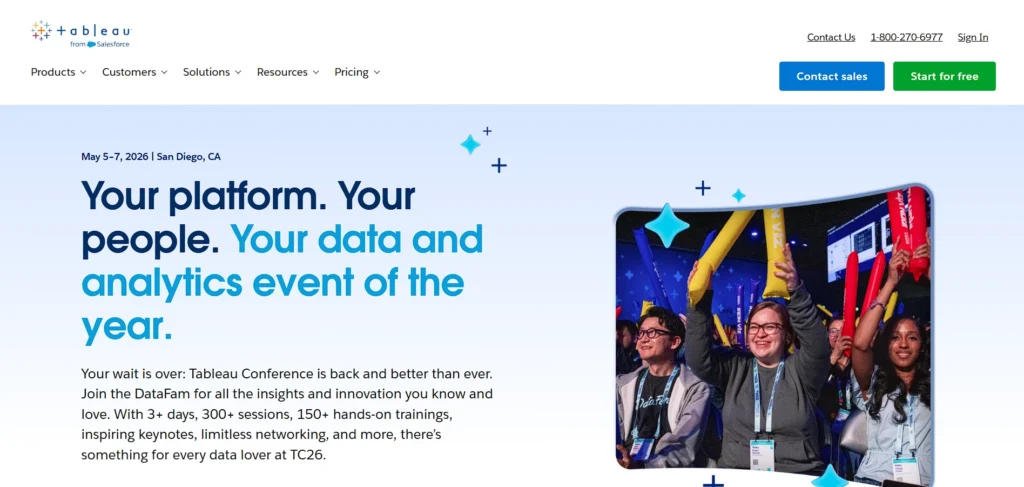
Tableau used to be the leading tool of chart and graph making. It has become a powerful predictive instrument when paired with Salesforce Einstein, particularly because it anticipates the next move. Tableau takes complex forecasts and transforms them into understandable dashboards that can be viewed and utilized immediately by the business leaders. It allows anyone without the technical knowledge to visualize trends, predict sales, and combine data, regardless of whether they are important or not. This graphical technique of work ensures predictions are used to make judgments throughout the entire firm.
Key Features:
- Building a dashboard through drag and drop.
- Built-in trend forecasting
- Salesforce CRM integration
Pros:
- Very easy to see insights
- Large user community
Cons:
- Requires more machine learning solutions.
- Slow on large sets of data.
10. ThoughtSpot
Website: https://www.thoughtspot.com/
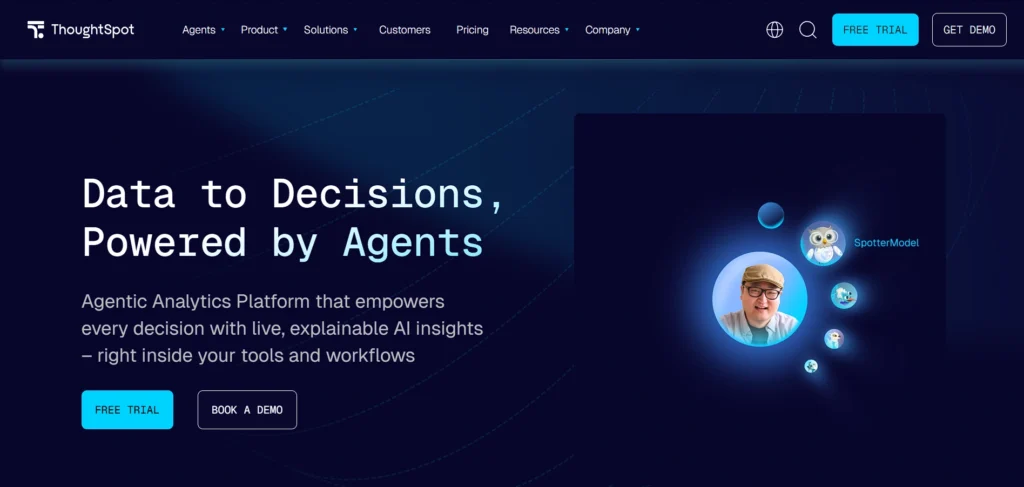
ThoughtSpot is a smart search database used to explore a business’s internal data. As one of the leading predictive analytics tools, it allows users to type queries in everyday language and instantly generate charts, predictions, and trend reports. It simplifies the process of enabling forecasts for everyone in the organization without relying on a central data team. Abnormal patterns and alerts are automatically identified, allowing frontline teams to act on real-time insights and improve daily operations and profitability.
Key Features:
- Natural language-based AI search.
- Automatic anomaly detection.
- Built in workflows into the platform.
Pros:
- No training needed
- Instant answers right away
Cons:
- Needs clean and orderly information
- Diversified choice of high-level customization
11. Google Cloud AI (Vertex AI)
Website: https://cloud.google.com/ai?hl=en
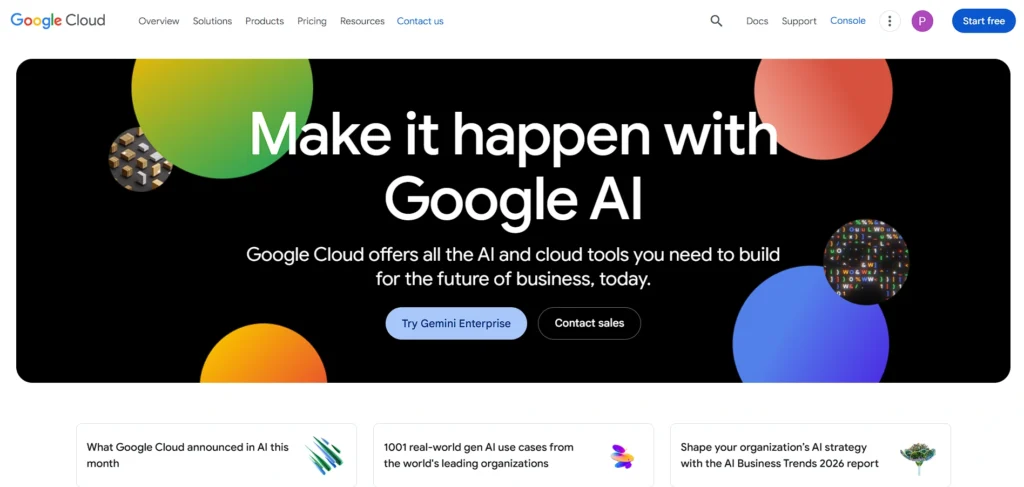
Google offers a full-managed machine-learning platform called Vertex AI. It is a collection of the best predictive tools that Google has to offer. Data scientists and engineers are able to produce, deploy and scale prediction models with speed. Vertex AI leverages great Google infrastructure and allows users to access BigQuery to do extensive data set analysis, and provide extremely accurate predictions on everything; including online shopping suggestions, smart pricing, and supply-chain planning.
Key Features:
- One stop workflow operations on machine-learners.
- Powerful AutoML tools
- Built-in integration with BigQuery.
Pros:
- Linear scales with Google’s infrastructure.
- Quick in working with big data.
Cons:
- Hard for beginners to use
- Must have cloud architecture knowledge
12. KNIME Analytics Platform
Website: https://www.knime.com/knime-analytics-platform
KNIME is an open-source data pipeline and prediction model builder that allows one to create data pipelines and prediction models by dragging and dropping nodes rather than writing code. It is integrated with numerous databases, machine-learning libraries and big-data systems. KNIME is also cheap and sophisticated due to a robust community that continuously develop new extensions and because of this, KNIME is enough to do business-level data mining and forecasting.
Key Features:
- Open source visual workflow editor.
- Many ready‑made nodes
- works with a variety of programming languages.
Pros:
- Free for individual use
- Scalable with contributions of the community.
Cons:
- Consumes a lot of resources on the desktop.
- Deployment of the servers may be expensive.
13. Databricks
Website: https://www.databricks.com/
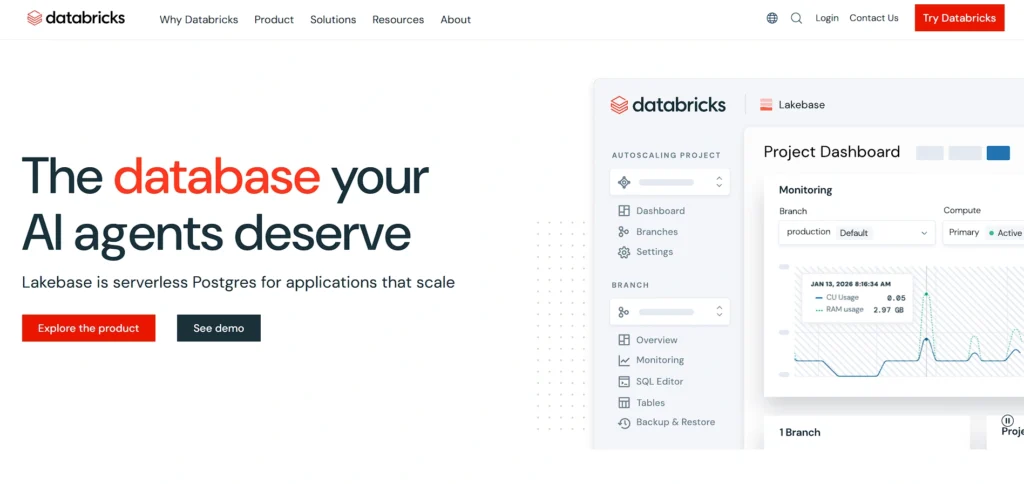
Databricks combines both data engineering and predictive analytics on Apache Spark. It also provides teams with a common workstation where data scientists, engineers, and analysts can work on big data in real-time. Databricks are a combination of data lakes and warehouses to form a lakehouse architecture, which accelerates the entire machine-learning process. Its application is optimal to businesses that are required to handle streaming data to develop sophisticated real-time prediction pipelines, such as a fraud detection system or real-time recommendation engine.
Key Features:
- Cohesive lakehouse design.
- Streaming analytical solutions.
- Shared working notebook environments.
Pros:
- Very fast processing
- Excellent teamwork support
Cons:
- Steep learning curve
- Requires knowledge of Spark
14. TIBCO Spotfire
Website: https://www.spotfire.com/
Spotfire is an advanced analytics software that integrates profound data presentation with powerful prediction applications. It is designed to process trading on complex and streaming data and is used in energy, manufacturing and finance. The prediction models, including regression and clustering, can be embedded into dashboards by the user. Spotfire also provides automatic AI hints and location information that allows leaders to identify the trends that were growing in the market right away and apply correct prediction policies without having to have a large team of data scientists.
Key Features:
- Streaming analytical solutions.
- Online predictive modeling.
- Sophisticated mapping of the earth.
Pros:
- Fast live data streaming
- Dashboards that are very interactive.
Cons:
- Can overwhelm beginners
- High cost
15. Qlik Sense
Website: https://www.qlik.com/us/products/qlik-sense
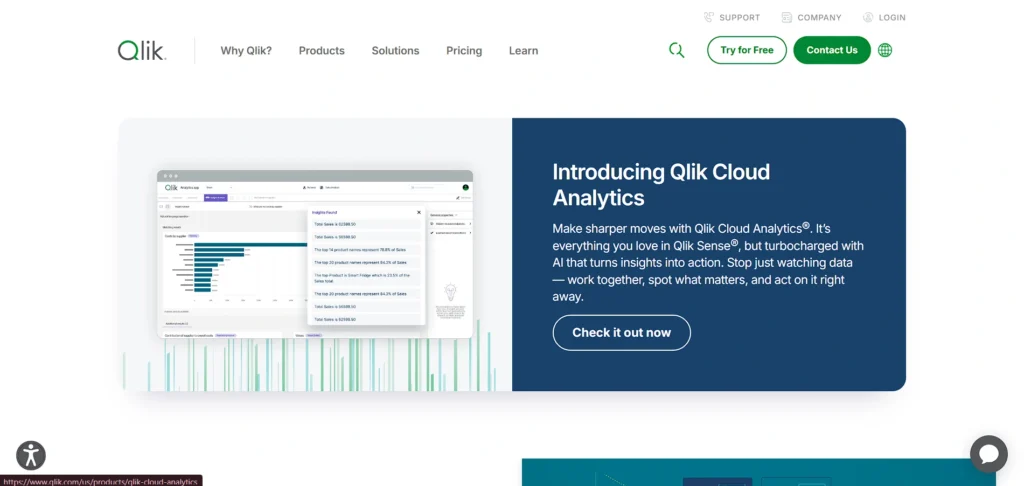
Qlik Sense has a special associative engine that reveals unseen connections within complicated data masses. Its augmented analytics and AI within predictive capabilities, though known to facilitate business intelligence, contribute to it being the most preferred prediction tool. Qlik Sense proactively generates prediction insights, forecasts and recommends visual representations. It enables the user to navigate data with liberty rather than predetermined query patterns, accelerating the process of meaningful predictions to assist organisations to increase revenues, reduce risk, and remain nimble.
Key Features:
- Associative data engine
- Artificial intelligence predictive data.
- Active interactive dashboards.
Pros:
- Fast exploration of data
- Good augmented intelligence.
Cons:
- Complex backend setup
- Must know the Qlik scripting.
Comparing the Top Predictive Analytics Platforms
| Tool | Platform Type | Ease of Use | Key Strengths | Best For |
|---|---|---|---|---|
| IBM SPSS | Desktop and Enterprise Analytics Platform | Easy | Strong statistical modeling, visual interface, R and Python integration | Researchers, marketing analysts, HR teams |
| Alteryx | Data Analytics and Automation Platform | Easy to Moderate | Automated data preparation, visual workflows, geospatial analytics | Business analysts and citizen data scientists |
| RapidMiner | Data Science and Machine Learning Platform | Moderate | AutoML capabilities, visual workflow builder, large algorithm library | Data analysts and enterprise analytics teams |
| DataRobot | Automated Machine Learning Platform | Moderate | Advanced AutoML, AI governance, enterprise-grade deployment | Large enterprises and regulated industries |
| Microsoft Azure Machine Learning | Cloud-Based Machine Learning Platform | Moderate to Advanced | Cloud scalability, deep Microsoft ecosystem integration | Enterprises using Microsoft ecosystem |
| H2O.ai | Open Source Machine Learning Platform | Moderate to Advanced | High-speed processing, Driverless AI automation, scalable architecture | Data scientists working with large datasets |
| SAP Analytics Cloud | Cloud Business Intelligence and Analytics Platform | Easy to Moderate | Unified BI, predictive analytics, and planning tools | Organizations using SAP infrastructure |
| SAS Viya | Enterprise AI and Advanced Analytics Platform | Moderate to Advanced | Strong governance, advanced statistical modeling, enterprise reliability | Government, banking, healthcare sectors |
| Tableau | Data Visualization and Analytics Platform | Easy | Powerful dashboards, built-in forecasting, strong data visualization | Business teams needing visual insights |
| ThoughtSpot | AI-Powered Analytics and Search Platform | Easy | Natural language data search, automated anomaly detection | Non-technical business users |
| Google Cloud Vertex AI | Cloud Machine Learning Platform | Advanced | Large-scale AI training, integration with BigQuery, strong cloud infrastructure | Data scientists and AI engineers |
| KNIME Analytics Platform | Open Source Data Science Platform | Moderate | Drag-and-drop workflows, strong community extensions | Small businesses and analysts |
| Databricks | Big Data and Machine Learning Platform | Advanced | Lakehouse architecture, real-time data processing, collaboration tools | Data engineering and AI teams |
| TIBCO Spotfire | Advanced Analytics and Data Visualization Platform | Moderate | Real-time analytics, predictive dashboards, geospatial analysis | Energy, manufacturing, and finance sectors |
| Qlik Sense | Business Intelligence and Predictive Analytics Platform | Moderate | Associative data engine, augmented analytics, interactive dashboards | Business intelligence and enterprise analytics teams |
Benefits of Using Predictive Analytics Tools
Good predictive analytics software requires time, as well as financial investments, but the benefits are worth it. Here are the main benefits:
- Data-Driven Decision Making: Eliminates Guessing. Shifts leaders to high probability forecasting from reactive reporting.
- Risk Reduction: Eliminate avoidable financial losses by forecasting bad credit, identifying issues in the supply chain, or identifying equipment failures.
- Operational Efficiency: Aids in the proper distribution of resources. An example is staff scheduling in hospitals and routing trucks in logistics teams, which require spending money and labor where necessary.
- Optimized Marketing and Sales ROI: Identifies high-quality marketing channels, anticipates customer churn before it occurs, and predictive lead scoring is used to help increase sales conversion rates.
There are lots of companies that do not get any profits due to one huge mistake. How can we not fall into the biggest trap in the industry?
Avoid these Predictive Analytics Mistakes
Many enterprise data projects fail to deliver results. The main reason is a single big error: Focus on buying tools instead of using predictions. Firms invest much on software, generate great forecasts, and fail to actually do anything with them.
- Perfectly Clean Data Hygiene: Garbage in, garbage out. When your CRM information is fragmented, AI cannot work. So first, develop strong data warehousing.
- Cross-functional Alignment: A model is no good when it fails to address a practical problem. Establish specific objectives (i.e. cut churn by 5 percent) prior to the construction of models.
- Commenting on workflow: Direct predictions to frontline laborers. A warning about high-danger churn should not merely exist in a dashboard, but it should be used to automatically send out a Slack message to the customer success team.
Conclusion
Predictive analytics tools are transforming how businesses make decisions by turning data into actionable insights. The 15 tools covered in this guide demonstrate a wide range of capabilities, from simple dashboards for small teams to advanced AI-powered platforms for enterprises. These tools help organizations forecast trends, optimize operations, improve marketing strategies, detect anomalies, and drive overall efficiency.
Selecting the right predictive analytics software depends on your business needs, budget, integration requirements, and desired level of automation. By leveraging the appropriate tool, companies can anticipate challenges, identify opportunities, and make data-backed decisions with confidence. Embracing predictive analytics not only improves operational performance but also provides a competitive advantage in an ever-evolving market. Staying informed about the latest tools and technologies ensures that businesses can continuously refine their strategies, maximize ROI, and remain ahead of industry trends.
FAQs
What is Predictive Analytics Software?
Software that utilises previous data, artificial intelligence, and statistics to predict the future, assists companies in the future by making decisions beforehand.
Do I Need a Data Scientist To Use Predictive Analytics Software?
No. Numerous websites have introduced the concept of low-code or Automated Machine Learning (AutoML) to allow business leaders and marketers to build precise predictions without code.
What Is The ROI of Predictive Analytics Tools?
Greater revenue and reduced risk, e.g. improved marketing conversion or the ability to identify equipment failures before they lead to downtime, are helpful sources of ROI.
What Is The Most Suitable Way to Choose a Predictive Analytics Platform?
Determine the relative skill level of your team (low-code vs. code-heavy) and ensure that it matches with your existing technology and your first test should be a Proof of Concept with your data.