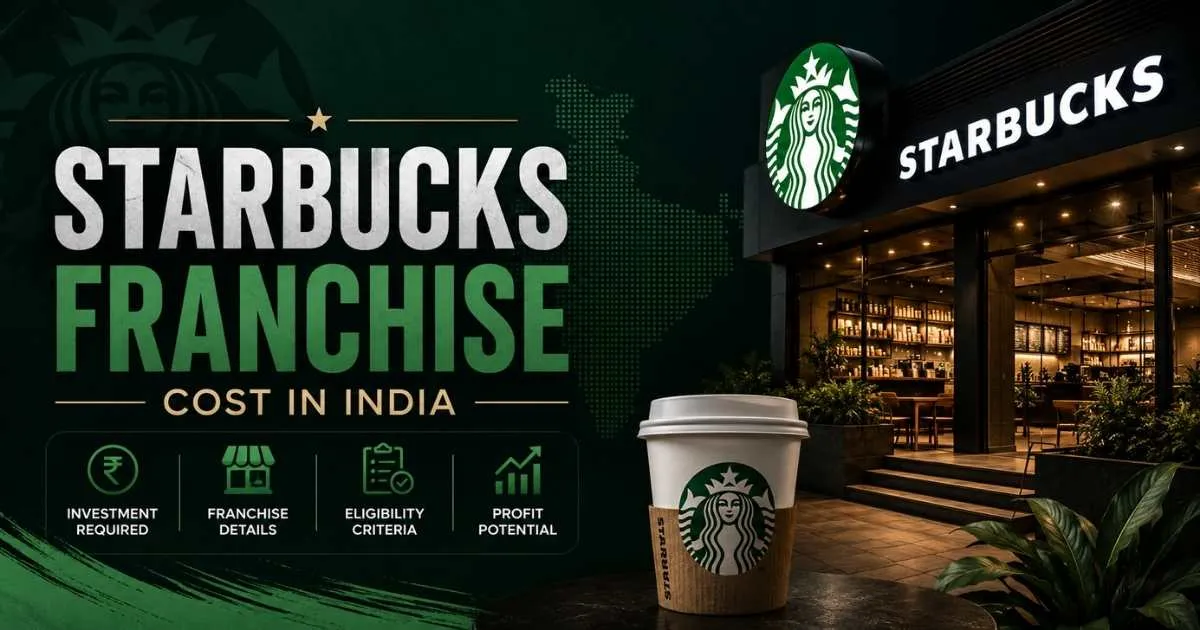
Every week, thousands of people in India search for ‘Starbucks franchise cost in India.’ It is one of the most looked-up franchise queries, and understandably so. Starbucks is perhaps the most aspirational coffee brand in the world. If you have sat in one of their outlets — the warm lighting, the leather seats, the smell of freshly brewed coffee — you have probably thought about owning one.
But here is the honest truth that most articles bury in the last paragraph: Starbucks does not sell franchises in India. Not to individuals. Not through traditional franchise agreements. Not yet.
What Starbucks does have is a joint venture model through Tata Starbucks Private Limited — and understanding exactly how this works, what it actually costs to be part of this ecosystem, and what your realistic alternatives are, is what this article is about.
We are not going to waste your time with vague numbers or generic content. Let us get into the real picture.
About Starbucks
| Founded | 1,971 |
| Headquarters | Seattle, Washington, USA |
| Global Presence | Operates in over 80 countries with 30,000+ locations |
| Indian Operations | Managed by Tata Starbucks Private Limited (a 50:50 joint venture between Starbucks Coffee Company and Tata Global Beverages) |
| Entry into India | 2012 |
| Number of Outlets in India | 550+ across major cities |
| Popular Indian Offerings | Masala Chai, Tandoori Paneer Sandwich, and other native Indian flavors |
Established in 1971, it is currently the global leader in the coffee house industry, with more than 30 thousand stores in 80 nations. The brand is famous for its quality coffee, new product creations that can be tasted, and warm atmosphere that attracts customers worldwide. Starbucks’ emphasis on the customer, like customization of orders and the experience, has a sure customer following.
In India, This brand is managed through Tata Starbucks Private Limited- a 50:50 joint venture of Starbucks Coffee Company and Tata Global Beverages. This was the beginning of the band’s operation in India; the first store was opened in Mumbai in 2012. Since then, it has grown to over three hundred operational outlets across most major Indian cities such as Delhi, Bangalore, Chennai, and Hyderabad.
From the consumption basket view, the brand has been good at positioning itself in the Indian market while at the same time covering the international standards in its products. Rare dishes such as the Masala Chai, Tandoori Paneer Sandwich, and other India-related products make it a major contender in the burgeoning café market within India. This has made it a brand that can suit Indian and other international customers making it a premier coffee brand in India.
Check out the chai sutta bar franchise cost.
How Starbucks Actually Operates in India — The Tata Partnership
Starbucks entered India in October 2012 through a 50:50 joint venture with Tata Consumer Products, forming Tata Starbucks Private Limited. Under this structure, every single Starbucks outlet in India is owned and operated by Tata Starbucks, not by individual franchisees.
This is different from how the brand works in many other countries. In countries like the USA and parts of Europe, Starbucks allows licensed store partnerships. In India, the company chose to go the joint venture route to maintain strict control over:
- Product quality: Ensuring every cup of coffee meets Starbucks’ global standards
- Supply chain: From sourcing Indian-grown coffee (Tata Coffee from Coorg and Karnataka) to supply chain logistics
- Brand consistency: Every store follows the same interior design, menu, and customer experience guidelines
- Premium positioning: Starbucks is positioning itself as a premium brand in India; allowing unchecked third-party operators would risk that
As of 2024, Tata Starbucks operates 400+ stores across India, with an ambitious target of 1,000 stores by 2028. This expansion plan does create opportunities — just not the traditional franchise kind.
So What Are Your Real Options?
If your goal is to be financially connected to Starbucks’ growth in India, here are the legitimate pathways available:
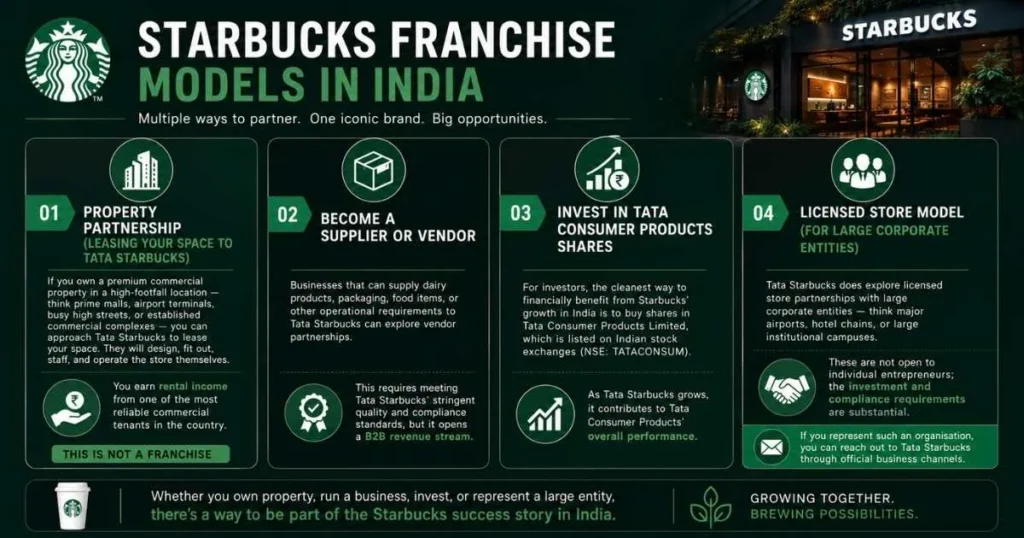
Option 1: Property Partnership (Leasing Your Space to Tata Starbucks)
If you own a premium commercial property in a high-footfall location — think prime malls, airport terminals, busy high streets, or established commercial complexes — you can approach Tata Starbucks to lease your space. They will design, fit out, staff, and operate the store themselves. You earn rental income.
This is not a franchise, but it does put Starbucks in your property and gives you a steady rental income stream from one of the most reliable commercial tenants in the country.
Option 2: Become a Supplier or Vendor
Businesses that can supply dairy products, packaging, food items, or other operational requirements to Tata Starbucks can explore vendor partnerships. This requires meeting Tata Starbucks’ stringent quality and compliance standards, but it opens a B2B revenue stream.
Option 3: Invest in Tata Consumer Products Shares
For investors, the cleanest way to financially benefit from Starbucks’ growth in India is to buy shares in Tata Consumer Products Limited, which is listed on Indian stock exchanges (NSE: TATACONSUM). As Tata Starbucks grows, it contributes to Tata Consumer Products’ overall performance.
Option 4: Licensed Store Model (For Large Corporate Entities)
Tata Starbucks does explore licensed store partnerships with large corporate entities — think major airports, hotel chains, or large institutional campuses. These are not open to individual entrepreneurs; the investment and compliance requirements are substantial. If you represent such an organisation, you can reach out to Tata Starbucks through official business channels.
Know about amul franchise cost in india.
What Would It Actually Cost to Set Up a Starbucks-Level Café?
Since individual franchise ownership is not available, many entrepreneurs ask: what would it cost to set up something comparable in scale and quality? Here is a realistic breakdown based on current market data:
| Cost Component | Estimated Range (INR) |
| Prime Location Lease / Deposit (metro city) | ₹20 Lakhs – ₹50 Lakhs |
| Interior Design & Fit-Out (premium quality) | ₹30 Lakhs – ₹60 Lakhs |
| Espresso Machines & Coffee Equipment | ₹10 Lakhs – ₹25 Lakhs |
| Furniture, Lighting & Ambience | ₹8 Lakhs – ₹20 Lakhs |
| Monthly Rent (prime urban location) | ₹5 Lakhs – ₹10 Lakhs/month |
| Staff Salaries (8–15 employees) | ₹3 Lakhs – ₹6 Lakhs/month |
| Food Licences & Compliance | ₹1 Lakh – ₹2 Lakhs |
| Working Capital (6 months) | ₹20 Lakhs – ₹40 Lakhs |
| Total Estimated Investment | ₹75 Lakhs – ₹2 Crores+ |
If the Tata Starbucks Licensed Store model were accessible to individual investors, estimates suggest the total investment (including setup, licensing, and initial operations) would range from ₹50 Lakhs to ₹1.5 Crores, based on space requirements of 500 to 1,500 sq. ft. in premium urban locations.
Starbucks Profit Potential & ROI
| Parameter | Estimated Range (2026) | Details |
|---|---|---|
| Annual Revenue | ₹1.5 Cr – ₹3 Cr | Premium locations (malls, high streets, airports) |
| Top Outlet Revenue | ₹3 Cr+ | High-footfall flagship stores |
| Monthly Revenue | ₹12 Lakh – ₹25 Lakh | Depends on city tier & location |
| Gross Profit Margin | 65% – 70% | High-margin beverage business |
| Operating Profit Margin | 15% – 20% | After rent, staff, utilities |
| Net Profit Margin | 12% – 18% | Realistic net earnings range |
| Initial Investment | ₹75 Lakhs – ₹2 Crores+ | Setup cost varies by location |
| Break-even Period | 18 – 36 months | Can extend up to 3–5 years |
| Average ROI | 15% – 25% annually | Higher in premium locations |
| High ROI Stores | 25% – 30%+ | Airports, corporate hubs |
| Investment Recovery Time | 4 – 5 years | Depends on operational efficiency |
Factors Affecting ROI
- Highest Terminus in Locations: On the contrary, they cover very high rents and, at the same time, generate extremely high revenues. Selection of a location could well be considered perhaps the single most decisive parameter of profitability.
- Operational Efficiency: Staff productivity, inventory control, and waste management have a direct impact on margins. Stores operating sound operational processes can improve profit margins of 3 to 5 percentage points compared with poorly managed outlets.
- Management: Promotion of specialty beverages, food pairing, and other high-margin items would significantly drive up overall profitability compared with revenue generated by stores that sell mostly basic coffee products.
- Competition Density: Foot traffic is generally lower in areas with a multitude of rival coffee chains or local cafes, making it more likely for stores to require increased advertising or promotional offers that often affect margins.
- Seasonal Variations: Despite these peaks and troughs, average sales range between 15 and 25 percent varying with the seasons at most Starbucks locations in India; thus projected to manage cash flows well and customize seasonal menus as an operation during the non peak periods to maintain profitability.
- Compliance Costs: Different statutory compliance costs emerge across states owing to varied state level regulations, implications of GST, and localized requirements by municipalities, resulting in certain metropolitans developing much higher regulatory burdens than others.
Why Starbucks Has Not Opened Franchising to Individuals in India
This is a question worth exploring. Several global QSR brands — Subway, Domino’s, McDonald’s — operate traditional franchise models in India. Why does Starbucks not?
A few reasons stand out:
- Brand protection: Starbucks is not competing on price in India. It is competing on experience. One inconsistent franchisee can damage the brand’s premium positioning significantly.
- Complexity of product: Coffee preparation at Starbucks’ standards requires specific equipment, training, and quality checks that are harder to maintain across hundreds of independent owners.
- Strength of the joint venture: The Tata partnership gives Starbucks a powerful local operator with existing supply chain, real estate relationships, and regulatory expertise. There is less incentive to open up franchising.
- Long-term strategy: Starbucks is still in a growth phase in India. Maintaining corporate control while scaling to 1,000 stores through Tata gives them more predictability.
The Starbucks Café Model — What Makes It Work
Understanding what makes Starbucks financially successful in India can help you benchmark any café investment you are considering:
Revenue Drivers
An average Tata Starbucks store in a prime metro location is estimated to generate ₹25 to ₹30 Lakhs in annual revenue, with a year-on-year growth rate of approximately 14%. The combination of dine-in, takeaway, and delivery (through Swiggy and Zomato) contributes to this.
Why the Premium Pricing Works
A standard coffee at Starbucks India costs ₹200 to ₹600 depending on the drink. Indian consumers, particularly in metros, are willing to pay this for the experience — the ambience, the customisation, the social signalling. This high average transaction value is why Starbucks can sustain high-rent prime locations.
The Loyalty Ecosystem
The Starbucks Rewards programme in India has built a strong repeat customer base. Members receive stars per purchase, redeemable for free drinks and food items. This loyalty system drives return visits and increases lifetime customer value significantly.
What Licences Does a Premium Café in India Need?
Whether you open a Starbucks-inspired café or any other premium coffee shop, these are the licences you will need:
- FSSAI Registration or Licence (mandatory for all food businesses)
- GST Registration
- Trade Licence from Municipal Corporation
- Shop and Establishment Act Registration
- Fire Safety Certificate (for dine-in operations above certain capacity)
- Music Licence (if playing background music)
- Lift licence (if multi-floor property)
- Eating House Licence (some states require this separately)
Space Requirements for a Premium Café
Tata Starbucks’ general requirements for licensed store locations give us a useful benchmark for the premium café category:
| Requirement | Specification |
| Minimum Floor Area | 500 – 1,500 sq. ft. |
| Minimum Frontage | 15 – 20 feet for visibility |
| Coffee Prep Area | Dedicated space for brewing equipment |
| Seating Capacity | 20 – 60 covers depending on size |
| Location Type | Malls, high streets, airports, premium offices |
| Infrastructure | UPS power, proper ventilation, adequate drainage |
How to Apply for a Starbucks Franchise in India
The management of the company internationally does not usually consider the use of franchisees for the growth and expansion of the brand with independent businessmen. It has an outlet in India through a joint venture with Tata Global Beverages. Consequently, to secure the franchise of Starbucks in India, people need to communicate with Tata Starbucks Pvt. Ltd. Here are the general steps involved if it decides to expand through franchising in the future:
- Research: First, you can learn about the Starbucks franchise cost in India, the presence of demand in the market, and the criteria for choosing partners.
- Prepare a Business Plan: Undertake a business plan that states your financial strength, market plan, and expected expansion.
- Initial Contact: First, a new applicant should learn about the local market and then contact Tata Starbucks Pvt. Ltd. and ask about available vacancies.
- Investment Capacity and Location Requirements: Evaluate the ability to provide an initial capital that is often a large sum for a franchise and select appropriate premises that will correspond to the target consumer base of the brand.
- Application Submission: Franchise opportunities may arise occasionally, and any candidate wishing to be a franchisee must provide a clear business plan.
- Approval and Agreement: When approved, the franchisees will sign a legal document to commence a business and purchase the required amount of franchise fees.
- Training and Set-Up: The franchise provides guidance to the franchisee to see that they follow the business running standards of the brand and provide customers with similar experiences.
Training and Support from Starbucks
The biggest advantage of working with this well-known coffee franchise is comprehensive training and assistance to the franchisors. Ensuring that partners are ready to maintain the company’s standards is the company’s major goal.
Support Provided:
- Comprehensive Initial Training: Employees of franchisees, on the one hand, and customers, on the other, get to experience the brand, its values, and operations as the head office has laid down.
- Ongoing Operational Support: Systematic support is given to the franchisees on store management and marketing aspects, as well as other day-to-day running of the business, which ensures that franchisees operate efficiently.
- Supply Chain Efficiency: Afr Franchisees are able to tap existing supply chains, which enables them to obtain quality coffee beans, bakery products, and all other inventory at regulated prices.
- Marketing Resources: Availability of established marketing tools and techniques ensures outlets are well marketed, and customer traffic is established.
- Community Engagement: It fosters the franchisees’ involvement in community activities of that state, making them stronger brand associations and leading to success.
Pros and Cons of Owning a Starbucks Franchise
Pros:
- Global Brand Recognition: Starbucks is a well-known brand that is popular all over the world. People are attracted to the product because it is well known to be high quality.
- High Profit Margins: Starbucks franchises are usually established at high-traffic locations, and due to the expensive brands under which it operates, the restaurants offer attractive profit margins.
- Comprehensive Support and Training: On the side of the franchises, they will be TRAINED and GIVEN A LOT OF SUPPORT BY STARBUCKS IN THE RUNNING OF ITS BUSINESS.
- Large-Scale Marketing and Advertising: Starbucks devotes much attention to advertising activity and guarantees a constant flow of customers to franchises.
- Consistent Quality Standards: Your franchise as a partner creates value that customers expect to get from Starbucks all over the world, increasing the amount of brand trust.
Cons:
- High Initial Investment: Starbucks franchise cost in India is relatively high; therefore, it is hard for small investors to venture into the market.
- Limited Operational Control: The principles of a franchise operation heavily regulate franchisees’ freedom of creative decision-making.
- Competitive Market Landscape: The coffee market in India is fairly fragmented, and various companies are jostling for positions both domestically and internationally.
- Ongoing Royalty Fees: Franchisees pay normal royalties, affecting the business’s general profit.
- Requirement for Prime Locations: To achieve high profitability, most of the franchise outlets need prime locations, which increases expenditure.
Alternatives to Starbucks — Café Franchises You Can Actually Own
If you want to be in the premium café business in India, there are brands that do offer legitimate franchise opportunities. Here is a comparison:
| Brand | Franchise Model | Approx. Investment | Royalty | Profit Margin |
| Starbucks (Tata) | No franchise / JV only | Not available | N/A | 15–25% |
| Café Coffee Day | Franchise available | ₹15 – ₹30 Lakhs | ~5% | 10–20% |
| Barista | Franchise available | ₹25 – ₹50 Lakhs | 6–8% | 15–25% |
| Blue Tokai | Select partnerships | ₹20 – ₹40 Lakhs | Varies | 20–30% |
| Third Wave Coffee | Franchise model | ₹40 – ₹80 Lakhs | Varies | 20–28% |
| Gloria Jean’s | Franchise available | ₹30 – ₹60 Lakhs | 6% | 15–22% |
Blue Tokai and Third Wave Coffee are particularly interesting alternatives for 2026. They are growing fast in metro cities, have strong brand identities, and their franchise costs are realistic for individual investors who want the premium café positioning without Starbucks’ unavailability.
The India Coffee Market in 2026 — Why Timing Matters
India’s coffee culture has changed dramatically over the past decade. The country has traditionally been a tea-drinking nation, but urban millennials and Gen Z consumers have shifted significantly toward café culture. Here are some numbers that matter for any investor in this space:
- Market growth: India’s café and coffee shop industry is expanding rapidly, with a projected 11%+ CAGR through 2034.
- Consumer behaviour: Urban consumers, particularly in the 22 to 35 age group, visit cafés 2 to 4 times per week
- Work from café trend: The WFH and hybrid work culture has made cafés the preferred ‘third place’ for working and socialising
- Specialty coffee boom: Third Wave and specialty coffee is growing faster than mainstream coffee in metro cities
- Delivery growth: Online ordering through Swiggy and Zomato has added a significant revenue channel for cafés
Final Thoughts: Be Informed, Not Disappointed
The Starbucks dream is real — the brand, the experience, the customer loyalty. But for now, individual franchise ownership in India is not on the table. If you came here looking to invest, the most useful thing you can do is redirect that energy toward the alternatives that do offer real franchise opportunities.
Premium café culture in India is growing fast. You do not need to own a Starbucks to profit from it. You need a good location, the right brand partnership, and a commitment to delivering a quality experience. That combination — with the right brand — can build a very successful business in 2026.
Check out details about:
FAQs
Q1: Can I directly own a Starbucks franchise in India?
No. Starbucks operates in India exclusively through its 50:50 joint venture with Tata Consumer Products. Individual franchise ownership is not available to the public.
Q2: How can I contact Tata Starbucks for a property lease opportunity?
You can reach out through the official Tata Starbucks India website or through their corporate contact channels. They are actively looking for premium locations, especially in Tier 2 cities, as part of their 1,000-store expansion plan.
Q3: What is the profit margin for Starbucks stores in India?
Premium café businesses in India typically earn net profit margins between 15% and 25%, with well-located metro outlets achieving the higher end of this range. Starbucks stores are estimated to generate ₹25 to ₹30 Lakhs in annual revenue.
Q4: Are there any plans for Starbucks to open franchise ownership in India?
There are no public announcements as of May 2026 indicating that Tata Starbucks plans to open individual franchise ownership. Given their expansion strategy and the strength of the Tata partnership, this is unlikely in the near term.
Q5: What is the best alternative to a Starbucks franchise for an Indian investor?
Barista, Blue Tokai, and Third Wave Coffee are the strongest alternatives for investors who want premium café ownership with realistic investment levels and an actual franchise model. Each has different investment requirements and royalty structures.