
The organized tea cafe industry in India has grown rapidly over the last few years. While coffee chains once dominated the cafe market, tea-focused brands are now attracting both customers and investors. Tea remains the most consumed beverage in India, creating a strong demand for affordable tea outlets in cities, towns, and even smaller markets.
Among the many tea franchise opportunities available today, Tea Time has emerged as one of the fastest-growing brands in the country. The company has built a large network of outlets by offering affordable beverages, simple operations, and a business model that requires relatively low investment compared to traditional restaurant franchises.
In this detailed guide, we will explore everything you need to know about the Tea Time franchise in India, including investment breakdown, monthly earnings, menu pricing, location requirements, franchise application process, and whether the business is worth investing in 2026.
What Is Tea Time Franchise? Brand History, Business Model & Growth

Tea Time is an Indian tea cafe chain that has gained significant popularity for serving quality tea and snacks at affordable prices. Founded in Hyderabad in 2016, the brand entered the market with a simple goal: to make premium-quality tea accessible to everyone without charging premium cafe prices.
Tea Time Brand Overview
| Particulars | Details |
| Brand Name | Tea Time |
| Founded | 2016 |
| Founder | Uday Srinivas Tangella |
| Headquarters | Hyderabad, Telangana |
| Industry | Tea cafe & Quick Service Restaurant |
| Business Type | Franchise-Based Tea Chain |
| Primary Products | Tea, Coffee, Snacks, Shakes |
| Presence | 4,000+ outlets across India* |
Numbers may change as the company continues expansion. Today, Tea Time is considered one of the most affordable and scalable franchise opportunities in India’s tea cafe segment. Its growing brand recognition, relatively low entry cost, and strong demand for tea-based products continue to attract entrepreneurs looking for a profitable small-business opportunity.
Why Investing In a Tea Time Franchise Makes Sense In 2026
Choosing the right franchise is one of the most important decisions for any entrepreneur. While there are hundreds of franchise opportunities available in India, not all of them offer the right balance of affordability, brand recognition, and profit potential. This is one of the reasons why the Tea Time franchise continues to attract investors across the country.
One of the biggest advantages of investing in a Tea Time franchise is the relatively low investment requirement. Many restaurant and cafe franchises require investments ranging from ₹20 lakh to ₹1 crore or more. In comparison, the Tea Time franchise cost is considerably lower, making it accessible to first-time business owners, salaried professionals, and small investors.
Another factor that works in favor of Tea Time is India’s strong tea-drinking culture. Tea is not a luxury product. It is a daily habit for millions of people. Many consumers purchase tea multiple times a day, whether during work breaks, social gatherings, meetings, or travel. This consistent demand creates opportunities for repeat business and regular revenue generation.
Another reason many entrepreneurs consider Tea Time a smart investment is its operational simplicity. Unlike large restaurants that require complex kitchens and extensive food preparation, Tea Time outlets focus on a relatively streamlined menu. This makes inventory management, staff training, and daily operations easier to handle.
Location flexibility is another major advantage. A Tea Time outlet can perform well in various locations, including:
- Commercial markets
- Educational institutions
- IT parks
- Residential neighborhoods
- Transportation hubs
- High-footfall shopping areas
This flexibility allows investors to identify locations that match their budget and target audience.
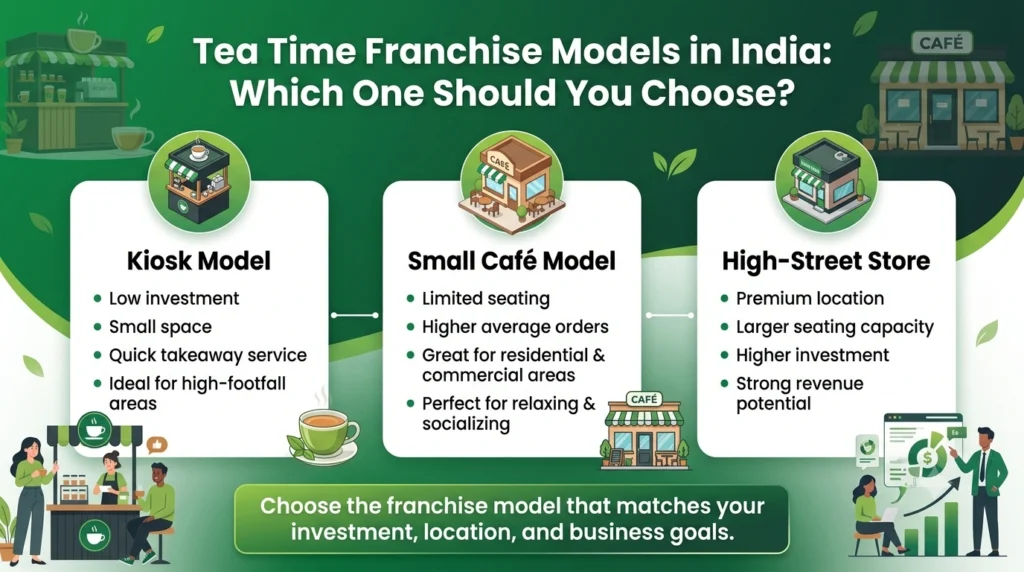
Tea Time Franchise Models in India: Which One Should You Choose?
1. Kiosk Model
The kiosk model is generally suitable for entrepreneurs who want to start with a smaller investment and limited space. These outlets are designed to serve customers quickly and efficiently without requiring a large seating area. Since the space requirement is relatively small, rental expenses are usually lower. This can help reduce overall operating costs while still allowing the outlet to serve a high volume of customers.
The kiosk model works particularly well in locations where foot traffic remains consistently high throughout the day. Customers can quickly purchase tea, snacks, or beverages and continue with their daily activities.
2. Small cafe Model
The small cafe model is among the most popular formats for Tea Time franchise owners. This setup includes limited seating arrangements where customers can relax, socialize, or conduct informal meetings while enjoying tea and snacks. Because customers spend more time inside the outlet, they often order additional items such as snacks, coffee, or specialty beverages. This can increase the average bill value and improve revenue potential.
Small cafe outlets are commonly located in residential areas, commercial markets, and mixed-use neighborhoods where customer traffic remains steady throughout the day.
3. High-Street Store Model
The high-street model is typically designed for premium commercial locations with significant customer footfall. These outlets often feature larger spaces, enhanced interiors, and more extensive seating arrangements. However, higher footfall usually comes with increased rental expenses and setup costs. Investors considering this format should carefully evaluate local demand and expected customer volume before making a decision.
When managed properly, a high-street outlet can generate strong sales due to its strategic location and increased customer capacity.
Tea Time Franchise Cost in India (2026): Complete Investment Breakdown
One of the first questions potential investors ask is, “How much does a Tea Time franchise cost?” Understanding the complete investment requirement is important because the total cost goes beyond the franchise fee. Apart from obtaining franchise rights, you will also need to budget for store setup, equipment, furniture, inventory, and various operational expenses.
However, the exact investment can vary depending on factors such as city, store size, rental costs, interior requirements, and the franchise model you choose. The table below provides an estimated breakdown of the investment required for a Tea Time franchise in 2026.
Tea Time Franchise Cost Breakdown (2026)
| Expense Head | Estimated Cost |
| Franchise Fee | ₹4 lakh – ₹5 lakh |
| Interior Setup & Renovation | ₹2 lakh – ₹4 lakh |
| Equipment & Machinery | ₹1.5 lakh – ₹3 lakh |
| Furniture & Fixtures | ₹50,000 – ₹2 lakh |
| Branding & Signage | ₹50,000 – ₹1 lakh |
| Initial Inventory & Raw Materials | ₹50,000 – ₹1 lakh |
| Security Deposit (Rent) | ₹50,000 – ₹2 lakh |
| Licenses & Registrations | ₹20,000 – ₹50,000 |
| Miscellaneous Expenses | ₹50,000 – ₹1 lakh |
| Total Estimated Investment | ₹8 lakh – ₹18 lakh |
Tea Time Franchise Profit Margin: Expected Monthly Sales, Income & Earnings
Tea Time franchise profit depends on factors such as outlet location, daily customer footfall, and operating expenses. A well-managed outlet in a busy area can generate healthy monthly sales, resulting in attractive income and profit margins. Understanding the expected monthly earnings helps investors estimate their return on investment (ROI) and plan for long-term business growth.
Estimated Monthly Revenue and Profit Potential
The table below illustrates a typical earning scenario for a moderately performing Tea Time outlet.
| Particulars | Estimated Figures |
| Average Customers Per Day | 150 – 300 |
| Average Bill Value | ₹40 – ₹80 |
| Daily Revenue | ₹6,000 – ₹24,000 |
| Monthly Revenue | ₹1.8 lakh – ₹7.2 lakh |
| Monthly Operating Expenses | ₹80,000 – ₹3 lakh |
| Estimated Monthly Profit | ₹50,000 – ₹2 lakh+ |
Understanding How Revenue is Generated
The primary source of revenue for a Tea Time outlet comes from beverage sales. Since tea is the flagship product, it contributes a significant portion of daily transactions. However, successful outlets rarely depend on tea sales alone.
Most profitable stores increase their revenue by encouraging customers to purchase complementary items such as snacks, coffee, sandwiches, puffs, biscuits, and other quick-service products. These additional purchases can increase the average bill value and improve overall profitability.
For example, a customer who initially visits for a cup of tea may also purchase a snack or bakery item. When this happens repeatedly throughout the day, the cumulative impact on monthly revenue can be substantial.
Gross Profit Margin on Tea and Beverages
One of the reasons tea businesses attract investors is the relatively strong margin structure of beverages. The raw material cost of preparing a cup of tea is usually much lower than its selling price. After accounting for ingredients such as tea powder, milk, sugar, and packaging, the remaining amount contributes toward covering operating expenses and generating profits.
This favorable cost structure allows franchise owners to maintain healthy margins while still offering affordable prices to customers. However, gross profit should not be confused with net profit. Business owners must still account for rent, employee salaries, electricity bills, maintenance costs, and other recurring expenses before determining their actual earnings.
Major Monthly Expenses That Affect Profitability
Several operational costs directly impact monthly profits. Rent is often one of the largest recurring expenses, especially in prime commercial locations. While a premium location may generate higher sales, excessively high rental costs can reduce net profits.
Employee salaries represent another major expense. Most outlets require staff members to handle beverage preparation, customer service, billing, and cleaning responsibilities. Utilities such as electricity, water, internet services, and equipment maintenance also contribute to monthly operating costs. Outlets with refrigeration units, lighting systems, and air conditioning may incur higher utility bills.
Inventory replenishment is another ongoing expense. Raw materials must be purchased regularly to ensure uninterrupted operations. Managing these expenses efficiently can significantly improve profitability.
Tea Time Franchise ROI & Break-Even Period: How Long Does It Take to Recover Your Investment?
Before investing in any franchise, entrepreneurs naturally want to know how quickly they can recover their initial investment. This is where Return on Investment (ROI) and break-even analysis become important.
Since the Tea Time franchise cost is relatively affordable compared to many food and beverage franchises, the break-even period can be shorter than that of larger restaurant businesses. However, actual timelines depend heavily on sales performance and operational efficiency.
Estimated ROI and Break-Even Analysis
| Metric | Estimated Figures |
| Initial Investment | ₹8 lakh – ₹18 lakh |
| Monthly Revenue | ₹1.8 lakh – ₹7.2 lakh |
| Monthly Net Profit | ₹50,000 – ₹2 lakh+ |
| Estimated Break-Even Period | 12 – 30 Months |
| Potential Annual ROI | 25% – 60%+ |
Tea Time Menu with Latest Price List (2026)
The menu plays a major role in the success of any food and beverage business. One of the biggest reasons behind Tea Time’s popularity is its ability to offer a wide range of beverages and snacks at affordable prices. The brand caters to students, office workers, families, and daily commuters by keeping its products reasonably priced while maintaining quality and consistency.
The exact menu and pricing may vary slightly depending on the city, outlet format, and company updates. However, the following table provides an overview of commonly available products and their approximate prices.
Tea Time Tea Menu (2026)
| Item | Approximate Price |
| Regular Tea | ₹10 – ₹15 |
| Ginger Tea | ₹15 – ₹20 |
| Masala Tea | ₹15 – ₹20 |
| Cardamom Tea | ₹15 – ₹20 |
| Lemon Tea | ₹15 – ₹25 |
| Green Tea | ₹20 – ₹30 |
| Irani Chai | ₹20 – ₹30 |
| Premium Special Tea | ₹25 – ₹40 |
Tea remains the highest-selling category across most Tea Time outlets. Products such as ginger tea, masala tea, and Irani chai are particularly popular among regular customers. Since tea is affordable, many customers visit multiple times during the week, creating consistent footfall for franchise owners.
Coffee and Beverage Menu
| Item | Approximate Price |
| Regular Coffee | ₹20 – ₹30 |
| Filter Coffee | ₹25 – ₹40 |
| Cold Coffee | ₹40 – ₹80 |
| Milkshakes | ₹50 – ₹100 |
| Fruit-Based Beverages | ₹40 – ₹80 |
| Chocolate-Based Drinks | ₹50 – ₹100 |
Coffee and specialty beverages often contribute higher margins compared to regular tea products. They also appeal to younger consumers who prefer variety and cafe-style experiences. Many outlets use these products to increase average transaction values and improve overall profitability.
Snacks and Quick Bites
| Item | Approximate Price |
| Veg Puff | ₹15 – ₹30 |
| Samosa | ₹15 – ₹25 |
| Sandwiches | ₹40 – ₹80 |
| Biscuits | ₹10 – ₹30 |
| Cookies | ₹20 – ₹50 |
| Bakery Items | ₹20 – ₹60 |
| Namkeen & Savories | ₹20 – ₹50 |
Snacks play an important role in boosting revenue. A customer who visits for tea often adds a snack to the order, increasing the overall bill amount. This is one of the reasons why many successful Tea Time outlets focus on promoting beverage-and-snack combinations.
Why the Tea Time Menu Works So Well
The Tea Time menu is designed to serve a broad customer base rather than a niche audience. Its products are affordable enough for students while still appealing to working professionals and families. The menu also supports repeat purchases. Unlike luxury products that customers buy occasionally, tea and snacks are everyday consumption items. This creates opportunities for recurring revenue and customer loyalty.
Another advantage is operational simplicity. Most products can be prepared quickly, allowing outlets to serve more customers during peak hours without long waiting times. For franchise owners, this combination of affordability, variety, and high demand helps create a sustainable business model with strong revenue potential.
Tea Time Franchise Location & Space Requirements
Choosing the right location is one of the most important decisions a franchise owner will make. Even the strongest brand can struggle in a poor location, while a strategically placed outlet can attract steady customer traffic and generate strong sales.
Many industry experts consider location selection to be more important than the size of the investment itself. Before investing in a Tea Time franchise, entrepreneurs should carefully evaluate the area, customer demographics, competition, accessibility, and footfall potential.
Minimum Space Requirements
The exact space requirement depends on the franchise model chosen by the investor.
| Franchise Model | Approximate Space Requirement |
| Kiosk Model | 100–200 sq. ft. |
| Small cafe Model | 200–500 sq. ft. |
| High-Street Store Model | 500+ sq. ft. |
A kiosk format generally requires less space and lower rental costs. On the other hand, cafe-style outlets need additional seating arrangements, customer waiting areas, and storage space. Investors should select a format that aligns with both their budget and the characteristics of the target location.
Importance Of High Footfall Locations
Tea Time outlets depend heavily on regular customer traffic. Therefore, selecting an area with high daily footfall can significantly improve business performance.
Locations that typically perform well include:
- College and university areas
- IT parks and office complexes
- Commercial markets
- Shopping streets
- Residential neighborhoods
- Bus terminals and railway stations
- Metro station surroundings
- Hospital zones
These locations provide access to large numbers of potential customers throughout the day. For example, an outlet located near an office district may benefit from morning tea sales, lunch-hour traffic, and evening customers. Similarly, a store near a college can attract students throughout the day.
How Many Staff Members Does a Tea Time Outlet Need?
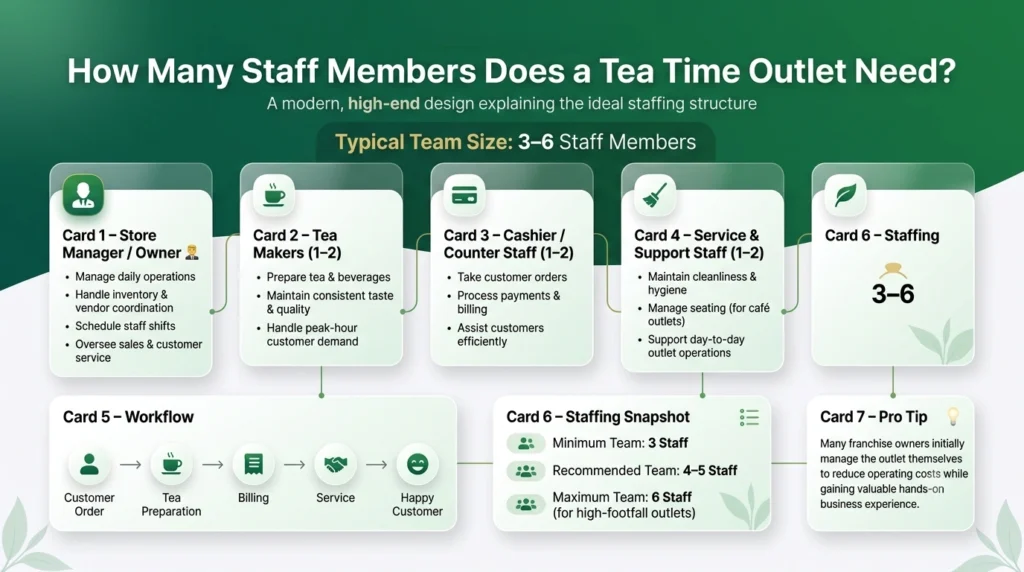
One of the advantages of operating a Tea Time franchise is that it does not require a large workforce. Compared to full-service restaurants that may need chefs, supervisors, waiters, cashiers, and kitchen staff, Tea Time outlets can generally function efficiently with a relatively small team.
Before investing, entrepreneurs should understand the manpower requirements because employee salaries represent one of the largest recurring operational expenses.
Store Manager or Owner’s Role
Many Tea Time franchise owners actively participate in day-to-day operations, especially during the initial stages of the business. This approach helps reduce staffing expenses while allowing owners to understand customer preferences and operational challenges.
The store manager is generally responsible for:
- Daily operations
- Inventory management
- Customer service supervision
- Staff scheduling
- Sales monitoring
- Vendor coordination
For smaller outlets, the owner often performs many of these responsibilities personally.
Tea Makers and Beverage Preparation Staff
Tea preparation is the core activity of the business. Employees assigned to beverage preparation must ensure consistency in taste, quality, and presentation. Since customers often return because they enjoy a specific flavor or experience, maintaining product consistency is extremely important. During peak hours, especially in busy commercial areas, having more than one tea maker can help reduce waiting times and improve customer satisfaction.
Cashier and Counter Staff
Counter staff handle customer orders, billing, payment processing, and basic customer interaction. In smaller outlets, one employee may manage both billing and customer service responsibilities. Larger stores with higher footfall may require dedicated personnel to ensure smooth operations during rush hours. Friendly customer interaction can have a significant impact on repeat business and customer loyalty.
Service and Support Staff
cafe-format outlets generally require service staff to maintain cleanliness, manage seating areas, assist customers, and support daily operations. These employees play an important role in creating a positive customer experience. A clean and organized environment often encourages customers to stay longer and return more frequently.
Tea Time Franchise Eligibility Criteria
Many aspiring entrepreneurs assume that only experienced business owners can operate a franchise. Fortunately, Tea Time is designed to be accessible to a wide range of investors, including first-time entrepreneurs.
The company generally focuses on selecting franchise partners who have the financial capability, commitment, and willingness to follow the brand’s operating standards.
While specific requirements may change over time, understanding the general eligibility criteria can help potential applicants determine whether they are a good fit for the business.
Basic Eligibility Requirements
To apply for a Tea Time franchise, applicants typically should meet the following criteria:
- Be at least 18 years of age.
- Have the required investment capacity.
- Possess basic business management skills.
- Be willing to follow company guidelines and operating procedures.
- Have access to a suitable commercial location or the ability to acquire one.
- Demonstrate commitment to managing the business effectively.
Meeting these requirements does not automatically guarantee approval, but it improves the likelihood of a successful application.
Financial Readiness
One of the most important eligibility factors is financial preparedness. Since the Tea Time franchise cost includes setup expenses, equipment purchases, inventory investment, and working capital requirements, applicants should ensure they have sufficient funds before applying.
Many franchise businesses struggle not because of poor sales but because owners underestimate the capital required during the early months of operation. Applicants should ideally have enough resources not only for the initial investment but also for ongoing operational expenses until the business stabilizes.
Business Experience: Is It Mandatory?
Previous business experience can certainly be helpful, but it is not always mandatory. Many Tea Time franchise owners enter the food and beverage industry for the first time. The company’s training and operational support systems are designed to assist entrepreneurs who may not have prior experience running a cafe or restaurant. However, applicants who possess basic knowledge of customer service, business management, and financial planning often find it easier to manage daily operations.
Importance of Location Availability
A suitable location is one of the most critical requirements during the franchise approval process. The company may evaluate factors such as:
- Customer footfall
- Accessibility
- Visibility
- Local competition
- Market demand
Even if an applicant has sufficient funds, a poor location can reduce the chances of approval because location directly affects business success. Investors should therefore spend time identifying potential sites before submitting their application.
Commitment to Daily Operations
Tea Time generally prefers franchise partners who are actively involved in the business rather than purely passive investors. Owners who regularly monitor operations often achieve better results because they can quickly address customer concerns, manage staff performance, and maintain quality standards. This does not mean the owner must personally handle every task. However, active supervision can significantly improve operational efficiency and profitability.
Documents Required for Tea Time Franchise Application
Once you have evaluated the investment, selected a suitable location, and decided to proceed with the business, the next step is preparing the required documentation. Like most franchise brands, Tea Time conducts a verification process before approving new franchise partners. Proper documentation helps the company verify the applicant’s identity, financial capability, and business readiness.
Submitting complete and accurate documents can also speed up the approval process and reduce unnecessary delays. While the exact requirements may vary depending on company policies and local regulations, most applicants are generally asked to provide a combination of personal, financial, and business-related documents.
Common Documents Required for Tea Time Franchise
| Personal Documents | Business & Property Documents |
| Aadhaar Card | Shop Ownership Documents (if applicable) |
| PAN Card | Rent Agreement or Lease Agreement |
| Passport-Size Photographs | Property NOC (if required) |
| Address Proof | Shop Layout or Floor Plan |
| Bank Statements | Trade License (if applicable) |
| Income Proof | GST Registration (if applicable) |
| Identity Proof | Local Business Approvals |
The company may request additional documents depending on the location, franchise model, and individual circumstances of the applicant.
How to Start a Tea Time Franchise in India: Step-by-Step Application Process
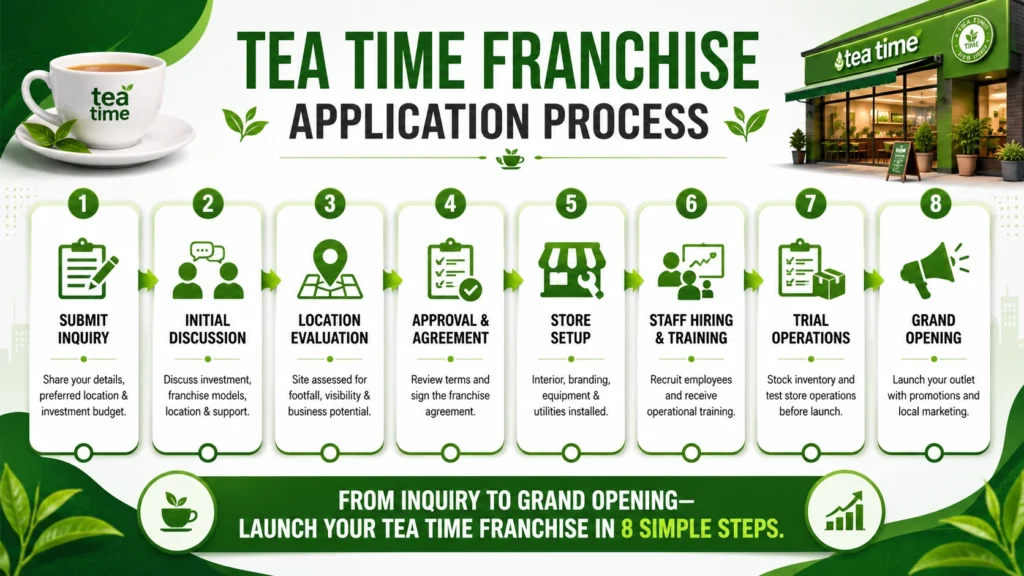
Many aspiring entrepreneurs are interested in the Tea Time franchise but are unsure about the actual application process. Fortunately, the process is generally straightforward and follows a structured sequence from initial inquiry to store launch.
Understanding each stage can help investors prepare effectively and avoid common mistakes during the application journey.
Step 1: Submit a Franchise Inquiry
The process usually begins with an inquiry through the company’s official franchise channels. At this stage, applicants provide basic information such as:
- Name and contact details
- Preferred city
- Proposed business location
- Investment budget
- Business background
This initial inquiry allows the franchise team to understand the applicant’s interest and determine whether the opportunity is suitable. Providing accurate information at this stage can help facilitate smoother communication later in the process.
Step 2: Initial Discussion with the Franchise Team
After receiving the inquiry, the company’s representatives may contact the applicant for a preliminary discussion. During this conversation, several topics are typically discussed, including:
- Investment requirements
- Franchise model options
- Location expectations
- Business potential
- Company support systems
This is also an opportunity for applicants to ask questions regarding profitability, operational requirements, and franchise policies. Prospective franchise owners should use this stage to gather as much information as possible before making a commitment.
Step 3: Location Identification and Evaluation
Once both parties express interest in moving forward, the next step involves location assessment. If the applicant already has a property, the franchise team may evaluate whether it meets the company’s requirements. Factors commonly reviewed include:
- Customer footfall
- Visibility
- Accessibility
- Nearby competition
- Commercial activity
In some cases, the company may provide suggestions for improving the location or recommend alternative sites. This stage is extremely important because location selection can directly impact sales, profitability, and long-term success.
Step 4: Franchise Approval and Agreement Signing
If the company is satisfied with the applicant and proposed location, the approval process moves forward. At this stage, franchise terms are discussed and formal agreements are signed. These agreements typically outline:
- Franchise rights
- Operational guidelines
- Brand usage policies
- Financial obligations
- Support services
Applicants should carefully review all terms before signing any documents. Seeking professional legal advice can be beneficial when reviewing franchise agreements, particularly for first-time entrepreneurs.
Step 5: Outlet Design and Store Setup
After completing the agreement process, the outlet setup phase begins. This stage generally includes:
- Interior work
- Store branding
- Furniture installation
- Equipment procurement
- Utility connections
- Signage installation
The objective is to create a store environment that aligns with Tea Time’s brand standards and customer expectations. The duration of this phase depends on the size of the outlet and the complexity of the setup.
Step 6: Staff Hiring and Training
Once the store is nearing completion, franchise owners can begin recruiting employees. The company typically provides training and operational guidance to help staff understand:
- Product preparation methods
- Hygiene standards
- Customer service protocols
- Billing procedures
- Inventory management
Proper training ensures consistency across all franchise locations and helps maintain customer satisfaction.
Step 7: Inventory Procurement and Trial Operations
Before the official launch, franchise owners usually stock the outlet with the necessary inventory and conduct trial operations. This stage allows staff to become familiar with workflows and helps identify operational issues before customers begin visiting regularly. Minor adjustments related to service speed, inventory handling, and staff coordination can often be addressed during this period.
Step 8: Grand Opening and Business Launch
The final stage is the official opening of the outlet. Many franchise owners conduct local marketing activities during launch, including promotional offers, introductory discounts, and community outreach initiatives.NA successful launch can help generate initial customer awareness and encourage repeat visits during the early months of operation.
Tea Time Franchise Support, Training & Operational Assistance
One of the biggest advantages of investing in a franchise business instead of starting an independent tea cafe is the support system that comes with an established brand. New entrepreneurs often worry about operational challenges, staff management, inventory control, and customer acquisition. This is where franchise support can make a significant difference.
Tea Time has expanded rapidly across India by creating a standardized operating model that franchise partners can follow. Rather than leaving business owners to figure everything out on their own, the company generally provides guidance at various stages of the franchise journey.
While the level of support may evolve over time, franchise owners can typically expect assistance in areas such as outlet setup, staff training, branding, operations, and business management.
Site Selection and Location Guidance
The success of a tea franchise largely depends on choosing the right location. Since not every commercial space is suitable for a Tea Time outlet, location assessment becomes an important part of the setup process. The company may review factors such as:
- Customer footfall
- Nearby businesses
- Visibility
- Accessibility
- Competition
- Local demographics
This evaluation helps identify whether the proposed location has the potential to generate sufficient customer traffic. For first-time entrepreneurs, this guidance can reduce the risk of selecting a poor location that may negatively affect business performance.
Store Design and Setup Assistance
Creating a consistent customer experience across franchise outlets requires standardization. To achieve this, Tea Time generally provides guidance regarding:
- Store layout
- Branding elements
- Signage placement
- Customer seating arrangements
- Equipment positioning
- Interior design standards
A professionally designed outlet not only enhances the customer experience but also strengthens brand recognition. Proper planning during the setup stage can improve operational efficiency and create a more attractive environment for customers.
Staff Training Programs
Employee training is critical for maintaining product quality and service standards. Even if a franchise owner has no prior experience in the food and beverage industry, structured training can help bridge the knowledge gap. Training programs may cover:
- Tea preparation techniques
- Product consistency standards
- Food safety practices
- Hygiene protocols
- Customer service skills
- Billing procedures
- Inventory management
Well-trained employees are more likely to provide a positive customer experience, which can directly influence repeat business and customer retention.
Tea Time vs Top Tea Franchise Brands in India: Investment & Profit Comparison
The tea cafe segment in India has become increasingly competitive. Several brands have expanded aggressively in recent years, giving entrepreneurs multiple franchise options to choose from. The ideal choice depends on an investor’s budget, business goals, preferred location, and risk appetite.
Tea Franchise Comparison Table (2026)
| Brand | Estimated Investment | Brand Presence | Target Market | Profit Potential |
| Tea Time | ₹8 lakh – ₹18 lakh | Very Strong | Mass Market | High |
| Chai Sutta Bar | ₹15 lakh – ₹30 lakh | Strong | Youth & Urban Customers | High |
| Chai Point | ₹30 lakh+ | Established | Corporate & Urban Markets | Moderate to High |
| MBA Chai Wala | ₹12 lakh – ₹25 lakh | Growing | Youth Segment | Moderate to High |
| Chaayos | ₹50 lakh+ | Premium Brand | Metro Cities | High |
Pros and Cons Of Owning A Tea Time Franchise
Every business opportunity comes with both advantages and challenges. While the Tea Time franchise has attracted thousands of entrepreneurs across India, it is important for potential investors to evaluate the opportunity objectively before making a financial commitment.
The Tea Time franchise offers several benefits, particularly for first-time entrepreneurs looking to enter the food and beverage sector. At the same time, there are certain limitations that investors should consider before proceeding.
Advantages and Disadvantages of Tea Time Franchise
| Advantages | Disadvantages |
| Relatively affordable investment requirement | Success depends heavily on location |
| Established and recognized brand | Competition from local tea stalls and cafes |
| Strong demand for tea across India | Profitability varies by market |
| Simple business operations | Requires active management and supervision |
| Training and franchise support available | Rental expenses can affect margins |
| Multiple franchise format options | Sales may fluctuate based on local demand |
| Potential for repeat customers | Staff turnover can impact operations |
Potential Risks and Challenges of a Tea Time Franchise Business
While franchise businesses offer many advantages, no investment opportunity is completely free from risk. Before investing in a Tea Time franchise, entrepreneurs should understand the challenges that could affect business performance.
Being aware of these risks allows investors to prepare better strategies and make more informed decisions. In many cases, identifying potential problems early can significantly improve the chances of long-term success.
Choosing the Wrong Location
Location remains the single most important factor affecting a Tea Time franchise. A poor location can limit customer traffic, reduce sales, and delay profitability regardless of the strength of the brand. Some investors make the mistake of choosing a property simply because the rent is low. However, low rental costs cannot compensate for insufficient customer footfall.
Before finalizing any site, investors should carefully evaluate visibility, accessibility, surrounding businesses, and customer movement patterns. A strong location can support growth, while a poor location can become a long-term challenge.
Competition from Local Tea Vendors
India has a deeply rooted tea culture, and local tea stalls are present in almost every market. These vendors often operate with minimal overhead expenses and may offer lower prices than organized cafe chains. As a result, Tea Time outlets must compete by offering:
- Better hygiene standards
- Consistent quality
- Branded experience
- Product variety
- Comfortable customer environment
Understanding local competition is therefore an essential part of the investment decision.
Rising Rental Costs
Commercial real estate costs continue to increase in many cities and towns. While premium locations can generate strong sales, high rental expenses may reduce profitability if revenue growth does not keep pace. Investors should avoid committing to rental agreements that place excessive pressure on monthly cash flow. A sustainable rent-to-revenue ratio is generally more important than securing the most prestigious location available.
Staff Recruitment and Employee Retention
The food and beverage industry often experiences employee turnover. Staff members may leave unexpectedly, requiring owners to recruit and train replacements. Frequent employee changes can affect service quality, operational efficiency, and customer experience. To reduce this risk, franchise owners should focus on:
- Providing a positive work environment
- Offering competitive salaries
- Maintaining clear operational procedures
- Conducting regular training
A stable workforce can significantly improve business performance.
Inconsistent Customer Demand
Although tea enjoys year-round demand, customer traffic may still fluctuate. Factors that can influence sales include:
- Seasonal changes
- Local events
- Economic conditions
- Competition
- Nearby business activity
For example, outlets located near educational institutions may experience lower traffic during vacation periods. Similarly, stores dependent on office workers may be affected by changes in workplace attendance patterns. Understanding local customer behavior can help owners prepare for these fluctuations.
Tea Time Franchise Contact Details & Official Website (2026)
Before signing any agreement or making any payment, investors should verify all information through official channels and carefully review the franchise terms and conditions.
Tea Time Franchise Contact Information
| Particulars | Details |
| Brand Name | Tea Time |
| Industry | Tea cafe & Quick Service Restaurant |
| Founded | 2016 |
| Headquarters | Hyderabad, Telangana |
| Official Website | https://teatimegroup.com |
| Franchise Enquiry | Available through the official website |
| Business Category | Tea cafe Franchise |
Is Tea Time Franchise Worth Investing in 2026?
This is perhaps the most important question for any prospective investor. After reviewing the investment requirements, profit potential, franchise support, and operational model, the final decision comes down to whether the business aligns with your financial goals and expectations. The answer depends on several factors, including your budget, preferred location, involvement level, and long-term business objectives.
For many entrepreneurs, the Tea Time franchise offers an attractive balance between affordability and growth potential. Compared to many restaurant and cafe franchises, the initial investment is relatively manageable. This lowers the entry barrier for aspiring business owners who want to enter the food and beverage sector without investing a very large amount of capital.
The brand’s extensive outlet network also adds credibility. Customers are generally more comfortable purchasing from a recognized brand than from an unknown business. This brand recognition can help new franchise owners attract customers more quickly.
Explore More Franchise:
Conclusion
The Indian tea cafe market continues to expand as consumers increasingly prefer organized and branded outlets for their daily tea and snack requirements. Among the many franchise opportunities available today, Tea Time has established itself as one of the most recognizable and accessible brands in the segment.
The Tea Time Franchise Cost is relatively affordable when compared to many restaurant and cafe franchises, making it an attractive option for both first-time entrepreneurs and experienced business owners. Combined with strong market demand, repeat-customer potential, and franchise support, the business offers a compelling opportunity for those looking to enter the food and beverage industry.
If you are looking for a business with moderate investment requirements, strong consumer demand, and the backing of an established brand, the Tea Time franchise is certainly worth considering. By conducting proper research and implementing effective business practices, entrepreneurs can improve their chances of building a successful and profitable outlet.