Most organizations prepare for cyberattacks. Firewalls are upgraded. Threat monitoring improves. Incident response plans sit ready.
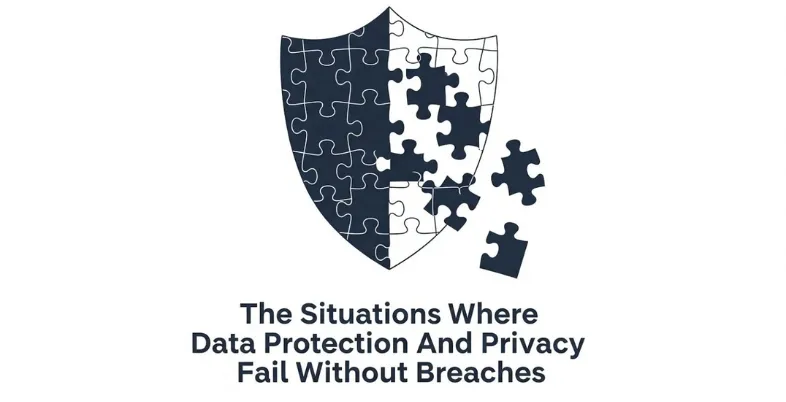
Yet many failures in data protection and privacy happen without hackers, malware, or dramatic headlines. Trust erodes quietly through everyday decisions, flawed processes, and systems that work exactly as designed but still expose people.
No breach notification arrives. No alarms sound. The damage still happens.
These failures matter because customers rarely distinguish between a hack and negligence. If personal data feels mishandled, confidence disappears either way.
When Employees Create Exposure Without Realizing It
Human error remains one of the most common causes of privacy failure. Not malicious intent. Ordinary work.
A file gets shared with the wrong recipient. A link remains public longer than expected. Access permissions stay open after a project ends.
Each action feels small. Together, they weaken privacy protections.
Common situations include:
- sending documents to incorrect email addresses
- uploading internal files to public repositories
- sharing screenshots containing personal data
- storing sensitive files on unsecured devices
The risk is not technical sophistication. It is speed. Modern workflows move faster than oversight.
Misconfigured access controls amplify the problem. Employees often retain permissions long after they need them, violating the principle of least privilege. Data becomes visible internally far beyond its intended audience, creating exposure without any intrusion.
Strong policies help, but monitoring and automation reduce reliance on perfect human behavior.
Systems That Were Never Designed With Privacy in Mind
Many privacy problems begin long before deployment. Systems built for growth or convenience often treat privacy as an add-on rather than a foundation.
When privacy controls arrive late, they rarely fit cleanly.
Poor architecture creates quite a few failures, such as:
- unclear data ownership across departments
- uncontrolled internal data flows
- logging systems that retain sensitive information indefinitely
- default settings that collect more data than necessary
Regulations like GDPR emphasize privacy by design for a reason. Retrofitting privacy into existing infrastructure is expensive and inconsistent. Data continues moving in ways no one fully maps.
The organization remains compliant on paper while operational reality tells a different story.
Over-Collecting Data That Was Never Needed
Organizations rarely suffer because they collected too little data. They struggle because they collected too much.
Extra information feels harmless at first. It becomes a liability later.
Examples appear everywhere:
- signup forms requesting unnecessary personal details
- analytics tracking beyond functional needs
- indefinite storage of inactive customer records
- duplicated datasets across teams
Every additional field expands risk exposure. Even without a breach, misuse, internal access, or accidental disclosure becomes more likely.
Data protection and privacy weaken when retention lacks purpose. Information should exist only as long as it serves a defined function. Anything beyond that creates silent vulnerability.
Third-Party Tools That Extend Risk Beyond Visibility
Modern businesses rely heavily on vendors, SaaS platforms, and integrations. Each partner introduces another privacy environment outside direct control.
Failures occur not because vendors are malicious, but because oversight fades after onboarding.
Typical gaps include:
- unclear data processing responsibilities
- missing audit rights in contracts
- weak access controls within vendor systems
- undocumented sub-processors handling data downstream
A company may maintain strong internal security while unknowingly exposing data through external services.
Vendor risk rarely looks dramatic. It looks administrative. Contracts skipped, reviews delayed, permissions unchecked.
Organizations working with reputation and privacy specialists, such as NetReputation, often find that vendor ecosystems create more exposure than internal infrastructure.
When Employees Don’t Understand Privacy Expectations
Policies alone do not protect data. Behavior does.
Many employees receive security training once and never revisit it. Over time, convenience replaces caution.
Privacy failures often stem from:
- reused passwords across services
- misunderstanding data sensitivity levels
- oversharing information in collaboration tools
- clicking links that bypass internal safeguards
These situations do not trigger breach alerts. Systems function normally while privacy erodes gradually.
Education must evolve alongside workflows. Training tied to real scenarios works better than compliance checklists that employees forget immediately.
Legal Compliance That Exists Only on the Surface
Organizations frequently meet regulatory requirements technically while failing them practically.
Consent banners illustrate the problem well. Users click acceptance without understanding the tracking scope, withdrawal options remain buried, and data flows continue unchanged.
Common compliance failures include:
- confusing consent language
- bundled permissions that remove genuine choice
- Withdrawal processes are harder than opt-in
- unclear explanations of data usage
No attacker is involved. Still, privacy expectations are violated.
Regulators increasingly penalize these situations because intent matters less than user experience. If individuals cannot realistically control their data, protection has already failed.
Software Bugs and Technical Limitations
Not every privacy issue results from human decisions. Technology itself introduces risk.
Bugs expose data through unintended behavior:
- outdated dependencies leaking information
- logging errors, capturing sensitive inputs
- synchronization glitches exposing records temporarily
- legacy systems lacking modern safeguards
These issues operate quietly. Systems appear stable while vulnerabilities persist beneath the surface.
Routine patching and dependency monitoring reduce risk, but organizations often underestimate how quickly technical debt turns into privacy exposure.
Business Processes That Ignore Data Lifecycle Reality
Many privacy failures stem from operations rather than technology.
Data enters organizations easily. Leaving is harder.
Process gaps commonly include:
- no defined retention schedules
- unclear ownership of datasets
- absent data classification standards
- delayed incident reporting procedures
Without governance, information accumulates indefinitely. Old records become invisible liabilities.
Privacy maturity depends less on tools and more on disciplined workflows. When processes fail, protections collapse even without external pressure.
Why These Failures Matter More Than Breaches
Breaches attract headlines because they are dramatic. Silent failures damage trust more slowly but often more deeply.
Customers judge outcomes, not causes. Whether exposure comes from hackers or poor practices changes little from their perspective.
Data protection and privacy succeed only when daily operations align with stated promises. Policies alone cannot carry that weight.
Organizations that treat privacy as ongoing operational design rather than emergency response build resilience long before problems appear.
The absence of a breach does not mean protection is working. Often, it means the real risks have not yet been noticed.