In India, the demand for inexpensive retail products is very high. This presents a huge business opportunity for business owners who want to run a value-based retail business. Out of many options in the market, 99 Store franchise cost has become the top attraction for businessmen seeking the least-costly retail franchise opportunity.
The simple concept of the 99 Store is to sell a wide variety of essential products at cheap prices that every Indian shopper will be drawn to. In addition to these numerous essential and house-related products, stores of this nature have a lot to offer in the form of kid’s toys, gifts and personal care products.
It’s critical to first analyze the company’s franchising model, investment costs, earning potential, company’s operational and training support, and risks associated with opening such an outlet. Here, we are bringing you the entire analysis of the 99 Store franchise cost, their expected return, eligibility criteria and the process of applying for the 99 Store franchise in India by the year 2026.
What Is the 99 Store Franchise? Understanding the Brand in 2026

A 99 Store franchise is a business venture in the value-retail sector that offers a massive range of budget-friendly retail items, thereby satisfying budget-conscious shoppers. In the value-retail industry, the brand aims to sell a wide assortment of household, and personal care items, toy and gift, home decor and utility products to its customers at reasonable prices.
In today’s market, affordable retail shops are one of the most rapidly growing formats in the Indian market. The growth has occurred due to the growing consumer preference for low-cost products without compromising quality or variety, resulting in the increasing popularity of stores of this type. These stores are visited by every strata of society – young and old, students, and working professionals.
The Business Philosophy Behind 99 Store
The idea of 99 Stores is rooted in providing a high volume of products at affordable costs. Their pricing strategy focuses on bulk selling of products at extremely low prices that bring a high number of customers and customers keep on returning to their stores. In fact, many customers shop a number of things in a single trip, and thereby contribute significantly to a massive sales volume each day.
The aim is to target customers who are price sensitive but also look for quality products. This ensures the growth of the business over time with increasing customer traffic. This business model benefits from high volume, fast inventory turnover, and strong customer loyalty.
How 99 Store Differs from Traditional Supermarkets and Kirana Stores
| Factor | 99 Store | Supermarket | Kirana Store |
| Pricing Strategy | Value-focused | Mixed pricing | Flexible pricing |
| Product Variety | Budget retail products | Large assortment | Daily essentials |
| Store Format | Compact retail outlet | Large retail space | Small neighborhood store |
| Customer Base | Value-conscious shoppers | Mass-market consumers | Local residents |
| Inventory Turnover | Fast | Moderate | Moderate |
Unlike supermarkets, which often require large spaces and significant investment, 99 Store outlets typically operate in smaller retail formats. Compared to kirana stores, they offer a wider range of non-grocery products and standardized merchandising. This unique positioning helps attract customers looking for affordable shopping experiences beyond daily necessities.
Understanding the 99 Store Franchise Business Model
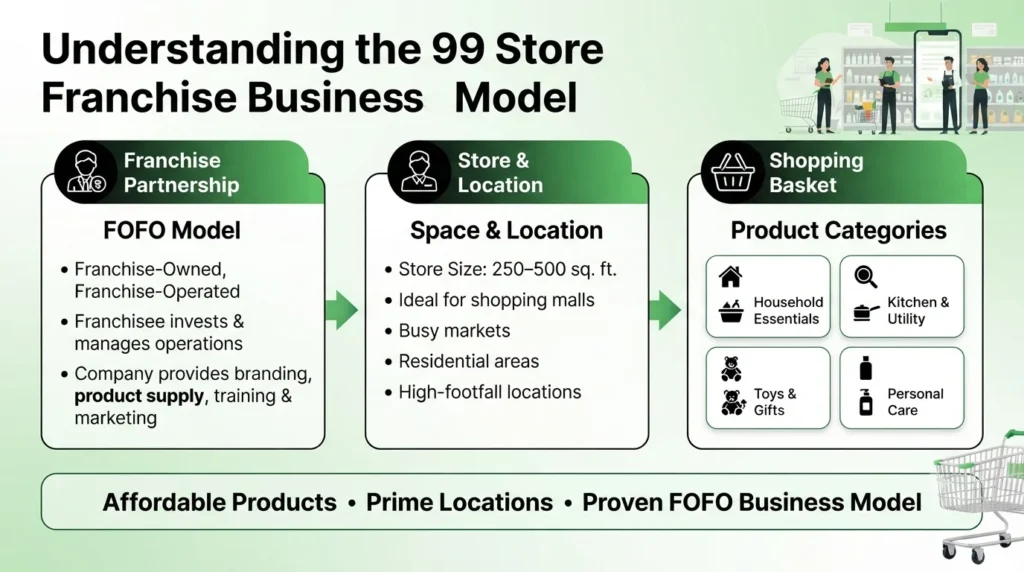
The 99 Store franchise model is straightforward, ensuring ease of operation for its franchisees. As a 99 Store franchisee, you will operate a retail store selling a range of budget-friendly products that are all procured through the franchisor’s extensive network. Sales revenue is generated from these product sales.
Franchise Ownership Structure (FOFO Model)
Most of the franchises associated with the value-retail sector follow the Franchise-Owned, Franchise-Operated (FOFO) business model. This model requires the franchisee to invest capital in opening their outlet, be responsible for its daily management and customer services and hire their employees to carry out the daily operational work.
The parent company, 99 Store, lends support by providing them access to their brands, management advice, a global supply network and marketing assistance. Since it helps business owners to make their own decisions, this is often the preferred business strategy for entrepreneurs.
Minimum Space and Location Requirements
To set up a 99 Store, it is crucial that the location is strategic. These stores need space for inventory and merchandise display, and most importantly, they should be situated where a maximum number of customers will visit and be drawn towards your products. Some of the suggested location types for a 99 Store franchise are:-
- In busy shopping centres or complexes
- On popular shopping streets
- Near residential communities and complexes
Generally, retail space with a minimum of 250 square feet (sq ft) to 500 sq ft of area is recommended. While exact measurements might differ, ensuring the store is accessible and highly visible is key.
Product Categories Sold in a 99 Store
The 99 Store has a wide array of products for a varied customer base, including:-
- Household Essentials: Items such as cleaners, storage boxes, organization items, brooms, kitchen towels, mops, etc., that people need in their day-to-day lives and are often purchased without giving it too much thought as it is a necessity.
- Kitchen and Utility Products: Various kinds of kitchen accessories, such as containers, food containers, tiffins, small appliances, kitchen gadgets, cutlery, dinnerware etc, can bring a good flow of income for your store.
- Toys and Gift Items: This includes toys for kids, return gifts for birthday parties, inexpensive gift items for all occasions such as personalized mugs, cute figurines, decorative pieces, etc.
- Personal Care Products: This category involves the sale of products like hair accessories, brushes, combs, cosmetic accessories, hair clips, skincare products etc., which many people use on a daily basis.
99 Store Franchise Cost in India: Complete Investment Breakdown (2026)
Before investing, it is important to understand the complete 99 Store franchise cost rather than focusing only on the franchise fee. For most franchisees, the biggest expenses are store interiors and initial inventory. A well-designed store can improve customer experience and encourage higher sales, while maintaining adequate inventory ensures that customers find a wide range of products during every visit.
Estimated Investment Breakdown
| Expense Head | Estimated Cost (₹) |
| Franchise Fee | ₹1 Lakh – ₹3 Lakhs |
| Store Interiors & Fixtures | ₹2 Lakhs – ₹5 Lakhs |
| Initial Inventory | ₹3 Lakhs – ₹8 Lakhs |
| Branding & Signage | ₹50,000 – ₹1.5 Lakhs |
| Equipment & Billing Setup | ₹50,000 – ₹2 Lakhs |
| Security Deposit (Rent) | ₹50,000 – ₹3 Lakhs |
| Working Capital | ₹1 Lakh – ₹3 Lakhs |
| Total Estimated Investment | ₹8 Lakhs – ₹25 Lakhs+ |
The total 99 Store franchise cost can vary significantly depending on the market. A store in a metro city may require higher rental deposits and interior costs, while a similar outlet in a Tier-3 city could be launched with a lower investment. Investors should also maintain sufficient working capital to manage expenses during the initial months of operation.
Investment by City Type: Tier-1 vs Tier-2 vs Tier-3 Markets
| City Category | Estimated Investment |
| Tier-1 Cities (Delhi, Mumbai, Bengaluru, Hyderabad) | ₹15 Lakhs – ₹25 Lakhs+ |
| Tier-2 Cities | ₹10 Lakhs – ₹18 Lakhs |
| Tier-3 Cities & Small Towns | ₹8 Lakhs – ₹15 Lakhs |
The choice of city where you set up can have a huge impact on both startup costs and potential profitability.
Tier-1 cities have larger potential customer bases and more footfall, but come with a significantly higher price tag on rent, salaries, and operational costs.
Tier-2 cities can often be a “sweet spot”. The cost of rent will be lower than metro markets, while there’s increasing purchasing power and customer demand. This can be the ideal opportunity for many franchise investors looking for a good balance of investment and revenue generation potential.
Tier-3 cities and smaller towns typically require the lowest investment cost to set up. Competition might also be lower in certain areas, but sales volume will be influenced by local purchasing power and population density. Even so, a significant amount of market research before selecting a city is essential, regardless of investment scale.
Hidden Costs New Franchisees Often Overlook
Staff Salaries
Many first-time investors focus on setup costs and underestimate payroll expenses. Even a small retail outlet requires staff for customer service, billing, inventory management, and store maintenance. Salaries represent an ongoing expense that directly affects profit margins and should be included in financial planning from the beginning.
Local Marketing
Unless your franchise brand provides extensive local marketing support, you will almost certainly need to allocate a part of your budget to local promotions. Flyer distribution, local advertisements in Newspapers and online, and other local promotions will help increase visibility and drive footfall.
Utility Bills
This might seem obvious, but many new investors forget to factor in costs such as electricity, internet, and water for air conditioning and lighting in your stores. Even billing equipment will consume electricity. All of these will contribute to your ongoing monthly expenses.
Inventory Replenishment
Your customers want the latest and the best. They might clear your shelves of popular items in a matter of days. You will need to constantly restock, which means another expense for inventory. Make sure your startup capital can account for frequent inventory purchases.
Store Maintenance
While a franchisee might initially spend on interior design, the upkeep of display shelves, billing counters, AC units, lighting fixtures and even clean store upkeep requires capital. These need to be maintained or replaced as and when they become old, thus becoming another ongoing expense.
99 Store Franchise Profit Margin & Revenue Potential
Mainly to ascertain if the investment offers profitable returns. Of course, these vary on the basis of the store location, customer footfall, and management’s efficiency, but knowing how margins are typically derived can be helpful.
Retail stores typically make money based on volume rather than high markups on individual products. This means that profitability hinges on the ability to sell a lot of items in a given period.
Consequently, store location, the ability to sell quickly through a higher rate of inventory turnover, and high customer footfall are key determinants.
Gross Profit vs Net Profit- What Is the Actual Margin?
Many franchise investors confuse gross profit with net profit. Understanding the difference is important when evaluating the earning potential of a 99 Store outlet.
Gross profit refers to the difference between the selling price and the cost of purchasing products. Since many value-retail products are sourced at wholesale prices, franchisees may achieve healthy gross margins on individual items.
However, net profit is the amount that remains after deducting all operating expenses, including:
- Rent
- Salaries
- Utilities
- Marketing expenses
- Inventory losses
- Maintenance costs
- Taxes and compliance expenses
A store may generate strong sales and gross margins but still struggle if operating costs are not controlled. Successful franchise owners focus on both revenue growth and cost management to maximize profitability.
In most cases, actual net profit depends heavily on location, sales volume, and operational efficiency rather than product pricing alone.
Break-Even Timeline: How Long Until You Get Your Investment Back?
When you’re thinking about investing in any franchise, especially something as established and seemingly low-barrier-to-entry as a franchise for 99 Store, you want to know one thing- when will I make my money back? The truth is, no one can give you a definite answer for the 99 Store franchise cost recovery.
Most retail franchises, including those in the value retail space like 99 Store, expect their franchisees to be breaking even somewhere between 18 to 36 months from launch. That’s not a guarantee of any means, however, because every store and every location is a little different. What’s on the ground factors that contribute to when you’ll recoup your initial outlay:
Store’s Footfall: A store in a busy high-street with great visibility will get more eyeballs than one tucked away in a less prominent location.
Inventory Control: Managing stock efficiently is vital in a value retailer like 99 Store to ensure consistent availability, avoid wastage, and maximize margins.
Customer Retention: Customers who come back for more business provide consistent cash flow.
What to look out for and avoid with 99 Store:
- Total monthly sales volume
- Rent and utility costs
- Margin for each product in your store
- Your competitors in the vicinity.
- How effective your marketing will be.
Whether your customers will continue coming back for more. It’s always advised not to budget assuming you’re getting the absolute best-case scenario. Better to be a bit pessimistic and conservative with your financial plans and take the extra money from there if you do better than expected.
Can I Open Multiple 99 Store Franchises?
This is a very common question once an entrepreneur is considering a value retail franchise model like that of 99 Store, as if they have found a winning formula they’d want to scale it.
Franchise networks generally like to see their franchisees succeed and will usually encourage successful franchisees to expand their business by purchasing more locations. For example, once you’ve opened one and it’s running successfully, producing a stable profit and has systems in place, you could then go on to purchase a second 99 Store.
The benefits of operating more than one location include better purchasing power with the suppliers, more effective brand reach across the area and more efficiency if management resources are shared across stores. However, only open up additional locations if you’ve got solid plans and infrastructure in place, and have a capable management team to handle each outlet without causing undue stress.
What Kind of Help Can I Expect from 99 Store as a Franchisee?
One of the biggest draws of a franchise business compared to an independent startup is the inherent level of support that the franchisor can offer, especially for newcomers.
Whilst not every franchisor will offer the same level of support, here’s generally what you can expect:
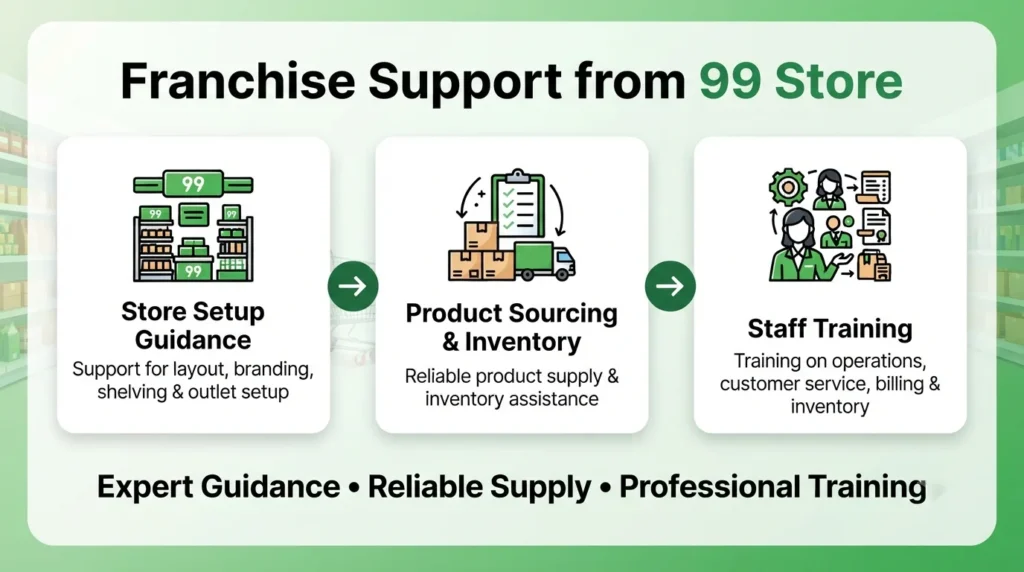
- Store Setup Guidance: The establishment phase of a retail store involves numerous decisions from layout, to shelving, branding, fixtures, and fitting out the premises. Franchisors like 99 Store have done this numerous times before, so can advise you on everything from optimizing layout and product placement, to branding execution, helping you create an appealing and efficient store for customers.
- Product Sourcing and Inventory: Management Getting your products on the shelves is critical, and this involves establishing a network of suppliers. If you were going to do it all on your own, finding a good network could be a difficult process. Franchisors like 99 Store will likely have a tried-and-tested supply chain management solutions in place that you can tap into to ensure the consistent supply of good quality products at competitive prices.
- Staff Training Programs: A vital aspect of any retail operation is staff performance and customer service. Many franchisors provide extensive training programs for new franchisees and their staff. The training can cover aspects of customer service, inventory control, cash handling and store operations, giving your staff the knowledge and confidence they need to be effective employees and help you maximize sales.
Eligibility Requirements for a 99 Store Franchisee
Although you might have the initial cash required to invest in a 99 Store franchise, there are several other criteria that will typically be needed before they will approve you.
- Location of Store: The most crucial requirement for any retail store- and that of 99 Store included- is finding the right location. This will involve selecting a high foot-fall area with excellent visibility and accessibility that is either in a residential or busy commercial district.
- Financial standing: Your financial status must show that you are able to cover both your 99 Store franchise fee, but you must also have access to enough capital for initial setup of the shop and working capital to cover your business expenses for a set period after the store opens before it becomes profitable.
- Business Skills and experience: While not essential in all cases, previous experience in the retail sector such as stock control, customer service, management or sales would stand you in good stead, as would previous business management or ownership. These skills are important to effectively managing the business.
- Personality: Certain attributes are vital when running a retail business such as your determination, ability to learn and manage, problem-solving and resilience. If you’re eager and willing to learn, there’s always support there.
Steps To Apply For a 99 Store Franchise in India (2026)
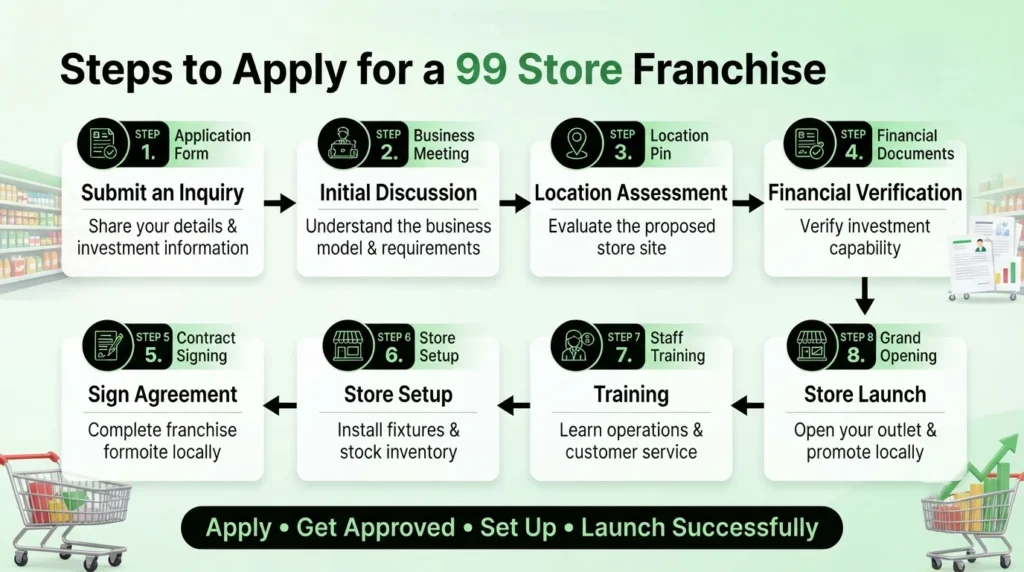
- Submit a franchise inquiry: First of all, you should visit the website of the company and search the franchise tab. Once you are there, fill in your basic details like name, address, business details and what kind of investment you are willing to make in the franchise business and submit.
- First Discussion With Franchise Team: Once the company’s team looks into your franchise inquiry form, you’ll be contacted by one of their franchise executives who will tell you in detail about the business and its requirements like investment amount, business expectations, business opportunities available.
- Location Assessment: Once your company’s team checks that you are a good prospect they’ll visit your shortlisted place or you might suggest one for your store. The location needs to be assessed based on the area’s demographics, traffic volume, competition nearby, accessibility.
- Financial Check: You might also have to disclose the financials of your investment which could help you to establish the funds to open a store and also run it. The franchisor will also take your financials into account to see if you have the funds to support working capital of your store too.
- Franchise Agreement: Once you get approved for a 99 Store franchise then you need to sign up for a franchise agreement. The agreement consists of the rights and duties of both the partners, the franchise fees and operational responsibilities.
- Setup and Operational Process: After you complete the agreement formalities you need to set up your store which consists of shelves, display racks, billing, storage space etc. Once you complete this process you’ll need to order stock and you might need help from the company for the same.
- Training and Management Development: If it’s required you and your employees will need to be trained for daily operations, inventory management, customer service, and in store management.
- Store Opening: Your store is ready to be opened after the entire above process. Plan out events or offer launch discounts for better promotion.
Documents Required for 99 Store Franchise Application
Most franchise applications require basic identity, financial, and property-related documents. Commonly requested documents include:
- PAN Card
- Aadhaar Card
- Passport-size photographs
- Address proof
- Bank statements
- Property ownership or lease documents
- GST registration (if applicable)
- Business registration documents (if applicable)
Keeping these documents ready can help speed up the approval and verification process.
Legal and Compliance Requirements Prior to Opening a 99 Store
Prior to starting retail business as a franchisee, you have certain legal & regulatory compliance measures to fulfil:
GST Registration (Goods & Service Tax): When your business reaches the given turnover threshold or it is included in the mandatory GST Registration List then you have to obtain the same, so that you can lawfully collect & deposit GST on sale, whilst keeping the business finances clean.
Shop and Establishment License: A majority of retailers in India get Shop & establishment licenses to register their retail unit as well as control & organize working hours, leave & employment details etc. Of shop staff & workmen.
Local Municipal Permissions: A particular local municipal authority may impose regulations & may also require additional permission on account of commercial activity, building construction or signage you are planning. Check up with them in order to fulfil their formalities if necessary. Trademark and Branding Compliance.
Follow brand guidelines: Do not misuse the brand logo, advertising campaigns, and store setup that has been established by the franchisor, unless permitted in the Franchise Agreement.
What Are The Key Risks & Challenges Of A 99 Store Franchise?
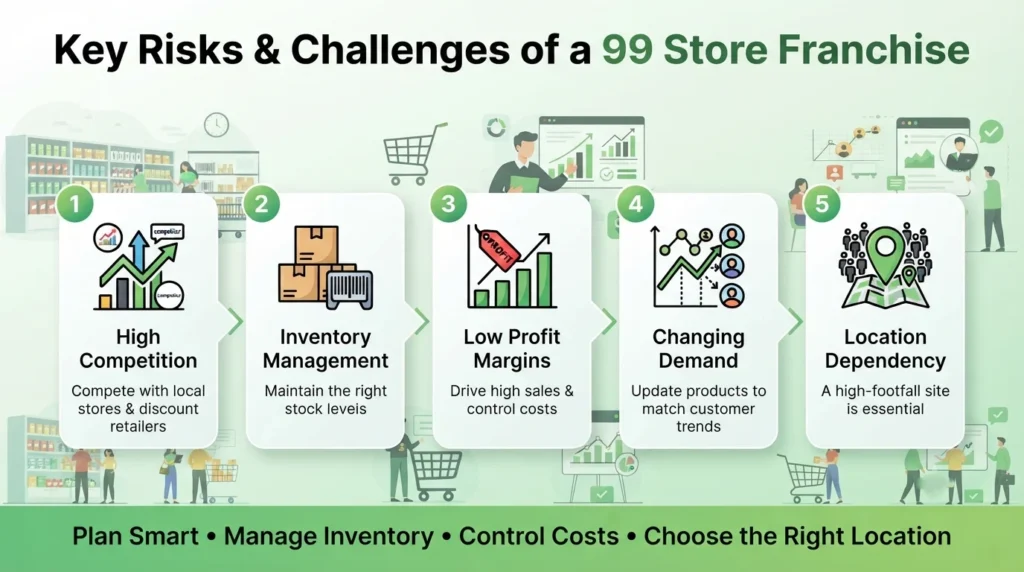
When compared with larger franchise outlets, a 99 store franchise might be an appealing alternative. Nonetheless, here are few of the key challenges involved in owning one:
- Competition From Local retailers: You have several nearby, localized retailers you need to contend with, such as mom and pop shops, kirana outlets and discount retailers. Differentiate your outlet with product variety and store displays in order to survive.
- Inventory Management: Retail business hinges on a right blend of stock management. You have to keep your capital blocked due to excess inventory & can also miss out on profits if you have less stock to display.
- Margin Pressure: A retail establishment can make good money but also has a relatively lower profit margin as value based. Your primary aim will have to get a high volume of sales along with low overhead costs like rent, staff salaries etc.
- Changes in Consumer Preferences: Customer demand and market trends can change quickly, making products with high demand today, a low seller in the near future. Constant monitoring of sales trends will enable you to adapt to changes in fashion.
- Location Dependency: The place where you select a franchise store is extremely important. The location of your store is a major factor of a thriving retail business or the other way around- no matter how well-managed a 99 store outlet may be; it may fail if the location has very little foot-fall.
99 Store vs Super 99 vs 99Nine Store- What Is the Difference?
Entrepreneurs often compare different value-retail franchises before investing. While these brands operate within a similar segment, they may differ in terms of investment requirements, product assortment, store formats, and expansion strategies.
| Feature | 99 Store | Super 99 | 99Nine Store |
| Business Model | Value Retail | Discount Retail | Value Retail |
| Investment Range | Moderate | Moderate to High | Moderate |
| Product Categories | Wide Variety | Extensive Variety | Everyday Utility Products |
| Store Size | Small to Medium | Medium to Large | Small to Medium |
| Brand Presence | Growing | Established in Several Markets | Expanding |
| Target Customers | Budget-Conscious Shoppers | Mass-Market Consumers | Value-Focused Buyers |
The right choice depends on your budget, preferred store size, local market demand, and long-term business goals. Comparing franchise support, operational requirements, and investment expectations can help you make a more informed decision before committing capital.
Is the 99 Store Franchise Worth It in 2026?
The answer depends on your investment budget, business goals, location, and ability to manage a retail operation effectively. The 99 Store franchise cost is generally lower than many food, restaurant, and large-format retail franchises, which makes it attractive for first-time entrepreneurs. However, like any business, success is not guaranteed and depends heavily on execution.
Before investing, it is important to evaluate both the advantages and potential challenges of the opportunity.
Reasons to Consider Investing
Growing Demand for Value Retail
Indian consumers are becoming increasingly price-conscious, especially in the face of rising living costs. Value-retail stores that offer affordable products continue to attract customers across urban and semi-urban markets. This trend creates opportunities for franchisees to build a loyal customer base and generate repeat sales throughout the year.
Relatively Moderate Investment Requirement
Compared to many restaurant, supermarket, and specialty retail franchises, the 99 Store franchise cost is often more accessible. This lower entry barrier allows aspiring business owners to enter the organized retail sector without committing extremely large amounts of capital.
Diverse Product Portfolio
A typical 99 Store sells products across multiple categories, including household items, kitchen accessories, gifts, toys, personal care products, and seasonal merchandise. This diversity helps reduce dependence on a single product category and allows the store to serve a broader customer base.
Conclusion
The 99 Store franchise cost makes it an appealing option for entrepreneurs looking to enter India’s growing value-retail market. With an estimated investment that is generally lower than many large retail and food franchises, it offers an accessible pathway into organized retail business ownership.
Beyond the initial investment, prospective franchisees should carefully evaluate factors such as location quality, inventory management, operating expenses, and customer demand. The franchise’s diverse product range and focus on affordability can create opportunities for steady sales and repeat customers when managed effectively.
Like any retail business, profitability depends on execution. Investors who select the right location, maintain strong inventory control, and deliver a positive shopping experience are more likely to achieve sustainable growth. Before investing, it is advisable to conduct thorough research, review the latest franchise information, and assess local market conditions to determine whether the opportunity aligns with your financial and business goals.