India’s jewellery industry continues to be one of the strongest retail sectors in the country. Gold jewellery is deeply connected to Indian culture, weddings, festivals, and investments. As consumers increasingly prefer branded and certified jewellery, organized jewellery retailers have gained a significant share of the market.
Among all jewellery brands, Tanishq has built a reputation that few competitors can match. Backed by Titan Company Limited and the Tata Group, the brand is known for trust, transparency, quality craftsmanship, and certified jewellery products. Over the years, Tanishq has expanded across major cities as well as emerging markets, making it one of India’s most recognized jewellery brands.
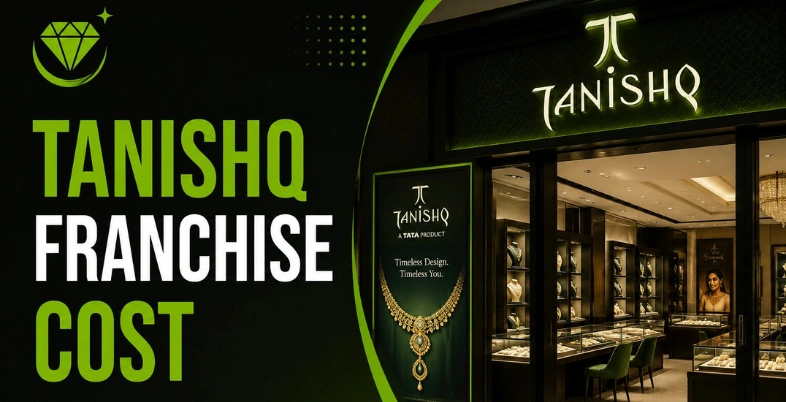
Because of this strong brand value, many entrepreneurs and investors search for information about the Tanishq Franchise Cost and the process of partnering with the company. However, unlike food franchises or retail stores that require a few lakhs of investment, a Tanishq showroom is a large-scale business opportunity that demands substantial capital, premium retail space, and long-term commitment.
In this guide, we will cover the complete Tanishq Franchise Cost in India, expected profit potential, return on investment, eligibility requirements, application process, and everything else investors need to know before making a decision.
About Tanishq: Brand History, Market Presence & Business Overview

Tanishq is one of India’s most trusted jewellery brands and operates under Titan Company Limited, which is part of the Tata Group. The brand was launched in 1994 with the objective of bringing transparency, quality assurance, and modern retail practices to India’s jewellery industry.
Before organized jewellery retail became popular, many consumers relied on local jewellers for their purchases. While these businesses had strong local relationships, issues related to purity, pricing transparency, and certification often existed. Tanishq helped change consumer perceptions by introducing certified jewellery, transparent pricing, modern showrooms, and standardized customer service.
Today, Tanishq offers a wide range of products including gold jewellery, diamond jewellery, platinum collections, wedding jewellery, daily wear ornaments, and premium designer collections. The brand serves customers across different age groups and income segments, although it is primarily positioned as a premium jewellery retailer.
One of the biggest strengths of Tanishq is customer trust. Jewellery purchases often involve significant financial investment, and buyers prefer brands that provide authenticity and quality assurance. This trust has helped Tanishq establish a strong presence across India.
Tanishq Brand Snapshot
| Particulars | Details |
| Brand Name | Tanishq |
| Parent Company | Titan Company Limited |
| Group | Tata Group |
| Founded | 1994 |
| Headquarters | Bengaluru |
| Industry | Jewellery Retail |
| Products | Gold, Diamond, Platinum Jewellery |
| Presence | Hundreds of Stores Across India |
| Target Market | Premium Jewellery Buyers |
For investors, partnering with a trusted brand like Tanishq can provide credibility and access to an established customer base that may take years to build independently.
Tanishq Franchise At A Glance (2026 Quick Facts Table)
Before exploring the investment details, it is important to understand the scale of opportunity that a Tanishq showroom represents. Many people compare jewellery franchises with food, retail, or service-based franchises. However, a Tanishq store operates on a completely different level in terms of investment, infrastructure, inventory, and business operations.
A jewellery showroom requires substantial capital because a significant portion of the investment is tied to gold, diamond, and precious jewellery inventory. In addition, premium store design, security systems, trained staff, and a prime commercial location are essential for maintaining the brand’s standards.
The table below provides a quick overview of the key aspects investors should know before considering a Tanishq franchise opportunity.
Tanishq Franchise Quick Facts
| Parameter | Details |
| Brand Name | Tanishq |
| Parent Company | Titan Company Limited |
| Industry | Jewellery Retail |
| Business Model | Primarily FOCO / Partnership-Based |
| Estimated Investment | ₹10 Crore – ₹30+ Crore |
| Store Size Requirement | 2,000 – 5,000+ Sq. Ft. |
| Product Categories | Gold, Diamond, Platinum & Bridal Jewellery |
| Target Market | Premium & Upper-Middle-Class Customers |
| ROI Timeline | Approximately 4–8 Years |
| Ideal Locations | High-Street Markets, Premium Commercial Areas, Malls |
| Operational Support | Training, Marketing, Inventory & Business Support |
| Business Experience Preferred | Yes |
| Suitable for First-Time Entrepreneurs | Generally No |
One important point to understand is that Tanishq is highly selective when choosing business partners. The company focuses on maintaining brand consistency and customer trust across all locations. As a result, investors are usually evaluated not only on financial capability but also on business experience, property quality, and long-term commitment.
This is not a low-investment franchise designed for quick returns. Instead, it is a long-term retail business opportunity that can potentially generate substantial revenue when operated successfully in the right market.
India’s Jewellery Market In 2026- Why This Business Makes Sense
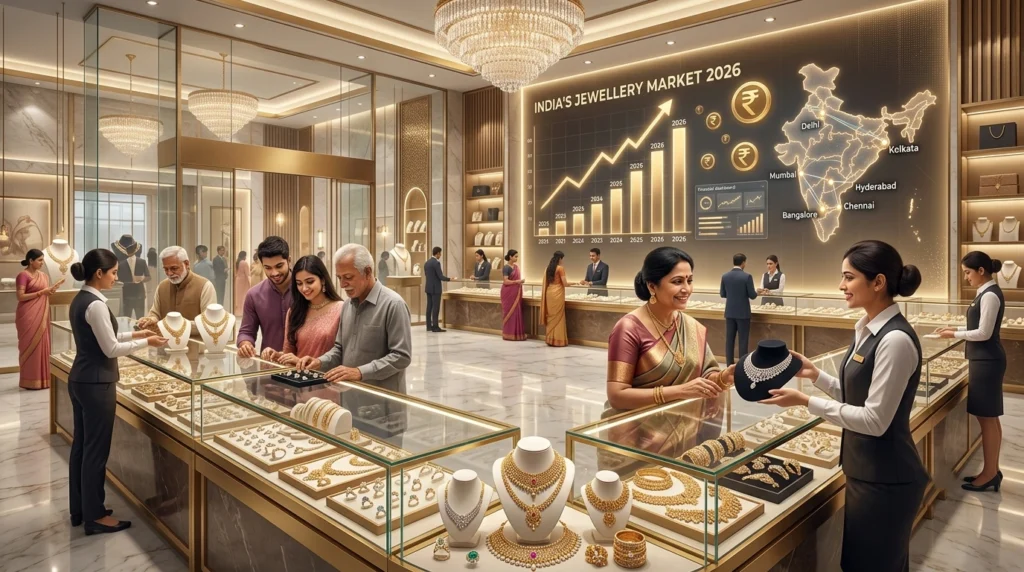
India has one of the largest jewellery markets in the world. Jewellery is not viewed only as a fashion accessory; it is also associated with tradition, celebrations, investments, and wealth preservation. This unique combination creates a strong and consistent demand that continues year after year.
From weddings and festivals to family celebrations and gifting occasions, jewellery remains deeply embedded in Indian culture. Even during changing economic conditions, gold and jewellery often continue to attract consumer interest because many buyers view them as long-term assets rather than discretionary purchases.
In recent years, the jewellery industry has undergone significant transformation. Consumers are becoming more aware of jewellery purity, hallmarking standards, certification, and transparent pricing. This shift has benefited organized brands like Tanishq because customers increasingly prefer trusted retailers over unorganized local sellers.
Another major trend is the growing demand for diamond and lightweight jewellery. Younger consumers are purchasing jewellery not only for weddings but also for personal use, office wear, and special occasions. This has expanded the customer base beyond traditional buyers.
Urbanization has also contributed to the growth of branded jewellery retail. As more consumers move toward organized shopping experiences, premium showrooms offering quality assurance and professional customer service continue to gain market share.
Key Factors Driving Jewellery Market Growth
Growing Preference for Branded Jewellery
Customers today are more informed than ever before. They want transparency in pricing, certified products, and reliable after-sales service. Branded retailers have built their reputation around these factors, making them attractive choices for jewellery buyers.
For brands like Tanishq, this shift works in their favor because trust plays a major role in purchase decisions involving high-value products.
Strong Wedding Jewellery Demand
India’s wedding industry remains one of the largest drivers of jewellery sales. Families often allocate a significant portion of wedding budgets to gold and diamond jewellery purchases.
Since weddings occur throughout the year across different regions of the country, they provide a recurring source of demand for jewellery retailers. Bridal collections continue to be one of the most profitable categories for established jewellery brands.
Increasing Demand Beyond Metro Cities
While major metropolitan cities remain important markets, jewellery demand is also growing rapidly in Tier 2 and Tier 3 cities. Rising incomes, greater awareness of branded products, and increasing consumer confidence have created opportunities for premium jewellery retailers in emerging markets.
This expansion has allowed brands like Tanishq to extend their presence beyond traditional urban centers.
Gold as Both Jewellery and Investment
Unlike many retail products, gold jewellery serves two purposes. Customers purchase it for personal use, but they also view it as a form of wealth preservation.
This dual benefit often helps sustain demand even during periods of economic uncertainty. Many consumers continue to buy gold regularly because they see it as a long-term asset.
Why Investors Are Looking At Jewellery Retail
From an investment perspective, jewellery retail offers access to a market with strong cultural demand and long-term growth potential. The industry’s foundation is supported by weddings, festivals, gifting traditions, and investment-driven purchases.
However, success in jewellery retail requires more than demand alone. Factors such as brand reputation, location quality, inventory management, customer trust, and operational excellence play a critical role in determining profitability.
This is one of the reasons why many investors prefer established brands like Tanishq. Rather than building credibility from scratch, they gain access to a recognized name that already enjoys significant trust among consumers.
Tanishq Franchise Business Models Explained — COCO vs FOCO
One of the biggest misconceptions surrounding the Tanishq Franchise Cost is that Tanishq operates like a traditional franchise business where anyone can pay a franchise fee, open a store, and manage operations independently. In reality, the company’s expansion model is far more structured and selective.
Before considering an investment, it is important to understand how these models work and what role a franchise partner typically plays.
Understanding the COCO Model
| Particulars | Details |
| Full Form | Company Owned Company Operated |
| Investment by Partner | Not Required |
| Store Ownership | Tanishq / Titan |
| Operations | Managed by Tanishq |
| Inventory Ownership | Tanishq |
| Decision Making | Controlled by Tanishq |
Under the COCO model, the company owns the showroom, invests in the business, manages employees, controls inventory, and handles daily operations.
This model gives Tanishq complete control over the customer experience and operational standards. Most flagship stores and strategically important locations are often operated through this model.
For investors, the COCO model generally does not offer direct franchise ownership because the company retains full ownership and management responsibility.
Understanding the FOCO Model
| Particulars | Details |
| Full Form | Franchise Owned Company Operated |
| Investment by Partner | Required |
| Store Ownership | Franchise Partner |
| Operations | Guided and controlled by Company Standards |
| Property Contribution | Often Required |
| Long-Term Partnership | Yes |
The FOCO model is more relevant for investors interested in partnering with Tanishq.
Under this structure, the franchise partner typically contributes capital, commercial property, or both, while the company maintains strict control over branding, operational procedures, merchandising standards, customer experience, and various business processes.
This arrangement helps protect the brand’s reputation while allowing expansion into new markets.
Because jewellery retail involves large inventory values and strong trust requirements, many premium brands prefer this structure over a completely independent franchise model.
Tanishq Franchise Cost In India -Complete Investment Breakdown
The Tanishq Franchise Cost is significantly higher than most franchise opportunities available in India. While food franchises may require investments of a few lakhs or a few crores, a Tanishq showroom often requires an investment running into multiple crores due to inventory requirements, premium retail infrastructure, and operational standards.
Many prospective investors focus only on franchise fees. However, in the jewellery business, inventory often represents the largest portion of the total investment.
The exact investment can vary depending on factors such as city, store size, property ownership, showroom format, and inventory levels. Nevertheless, investors should be prepared for a substantial financial commitment.
Estimated Tanishq Franchise Cost Breakdown
| Expense Head | Estimated Cost |
| Franchise / Partnership Investment | ₹2 Crore – ₹5 Crore |
| Store Interiors & Showroom Setup | ₹1 Crore – ₹3 Crore |
| Security Deposit / Property Costs | ₹50 Lakh – ₹2 Crore |
| Jewellery Inventory | ₹5 Crore – ₹20+ Crore |
| Security & Technology Systems | ₹20 Lakh – ₹50 Lakh |
| Initial Marketing & Launch Expenses | ₹10 Lakh – ₹30 Lakh |
| Working Capital Reserve | ₹50 Lakh – ₹2 Crore |
| Total Estimated Investment | ₹10 Crore – ₹30+ Crore |
The actual requirement may vary based on store size, city, and business model.
Why the Investment Is So High
Some investors are surprised by the scale of the Tanishq Franchise Cost in India. However, the high investment requirement reflects the nature of the jewellery industry itself.
A premium jewellery showroom combines:
- High-value inventory
- Luxury retail infrastructure
- Advanced security systems
- Professional staffing
- Brand-compliant customer experience
These factors collectively contribute to the large capital requirement.
While the investment may seem substantial, it also creates a significant barrier to entry, limiting competition and helping established brands maintain their market position.
For financially strong investors seeking a long-term retail business backed by one of India’s most trusted jewellery brands, the opportunity can be attractive. However, it is essential to evaluate the investment carefully and approach the business with realistic expectations regarding returns and timelines.
Tanishq Franchise Profit, Revenue & Monthly Income (2026 Data)
After understanding the Tanishq Franchise Cost, the next question most investors ask is whether the business can generate sufficient returns to justify such a large investment. This is a reasonable concern because opening a jewellery showroom requires significantly more capital than most retail franchise opportunities available in India.
Monthly revenue can vary significantly from one location to another. A showroom in a major metropolitan city may generate much higher sales than a store located in a smaller market. Factors such as local purchasing power, customer demographics, and brand presence also play an important role.
Estimated Revenue and Earnings Potential
| Metric | Estimated Range |
| Average Monthly Revenue | ₹1 Crore – ₹10+ Crore |
| Average Annual Revenue | ₹12 Crore – ₹120+ Crore |
| Gross Profit Margin | Varies by Product Mix |
| Net Profit Margin | Generally Lower Than Revenue Suggests |
| Break-Even Period | Several Years |
| Business Type | Long-Term Asset-Based Retail |
The figures above are only indicative estimates and can vary widely based on location, store size, inventory levels, and market conditions.
Understanding Revenue Potential
One of the biggest advantages of operating a jewellery business is the high transaction value.
Unlike a café or retail store that relies on hundreds of small purchases every day, jewellery retailers can generate substantial revenue from a limited number of transactions. Wedding purchases, festive shopping, and investment-driven gold buying often contribute significantly to annual sales.
A well-located Tanishq showroom in a strong market may attract customers seeking:
- Bridal jewellery collections
- Gold ornaments
- Diamond jewellery
- Platinum jewellery
- Investment-oriented purchases
- Festival and gifting purchases
Because of the premium nature of these products, revenue figures can appear very attractive compared to many other retail sectors. However, investors should remember that higher revenue does not automatically translate into higher profits.
Expected ROI On A Tanishq Franchise — Is It Worth It?
Return on Investment (ROI) is one of the most important considerations for any business decision. Since the Tanishq Franchise Cost can range from ₹10 crore to ₹30 crore or more, investors naturally want to understand how long it may take to recover their capital and start generating meaningful returns.
The answer depends on several factors, including store location, investment size, market demand, operational efficiency, and overall business performance. However, the advantage of this model is that it operates in a sector with strong demand, high customer trust, and significant barriers to entry.
Estimated ROI and Break-Even Analysis
| Metric | Estimated Range |
| Initial Investment | ₹10 Crore – ₹30+ Crore |
| Annual Revenue Potential | ₹12 Crore – ₹120+ Crore |
| Estimated Break-Even Period | 4 – 8 Years |
| Investment Horizon | Long Term |
| Wealth Creation Potential | High (for successful stores) |
These estimates are indicative and actual results may vary considerably depending on individual circumstances.
Space And Location Requirements For A Tanishq Store
Investors planning to apply for a Tanishq partnership should therefore ensure they have access to a suitable commercial property that meets the company’s standards.
Typical Space Requirements
| Requirement | Recommendation |
| Store Area | 2,000 – 5,000+ Sq. Ft. |
| Location Type | High-Street Market, Premium Commercial Area, Mall |
| Frontage | Wide and Highly Visible |
| Parking | Strongly Preferred |
| Customer Accessibility | Easy Access from Main Roads |
| Security Infrastructure | Essential |
| Store Format | Premium Jewellery Showroom |
The exact space requirement may vary depending on the city, market potential, and showroom format.
Why Location Matters in Jewellery Retail
Location influences almost every aspect of showroom performance.
Unlike convenience purchases, jewellery buying is often a planned activity. Customers usually prefer visiting well-known commercial districts or established retail destinations when making high-value purchases. A strategically located showroom can therefore attract significantly more visitors than a store in a less visible area.
A premium location also helps strengthen customer confidence. When consumers see a Tanishq store situated in a reputable commercial zone, it reinforces the brand’s image and credibility.
Additionally, locations with strong footfall can increase opportunities for walk-in customers, festive shoppers, and wedding-related purchases. Since jewellery retail depends heavily on customer trust and visibility, choosing the right location can have a direct impact on long-term revenue.
Tanishq Franchise Eligibility And Requirements
Not everyone who is interested in a Tanishq franchise will qualify to become a business partner. Since the investment involved is substantial and the brand’s reputation is built on trust and consistency, Tanishq typically follows a selective evaluation process when considering potential partners.
The company generally looks for individuals, business groups, or organizations that can demonstrate financial strength, business capability, and a commitment to maintaining high operational standards.
Unlike low-investment franchise opportunities that focus primarily on application fees, Tanishq evaluates the overall suitability of the applicant and their ability to support a long-term retail operation.
1. Financial Eligibility Requirements
One of the most important criteria is financial capability.
A Tanishq showroom may require an investment ranging from ₹10 crore to ₹30 crore or more. As a result, applicants must have access to sufficient funds to cover infrastructure development, inventory purchases, working capital, and ongoing operational expenses.
The company may assess:
- Available capital
- Business assets
- Financial stability
- Creditworthiness
- Ability to sustain long-term operations
Applicants should be prepared to demonstrate that they have the resources necessary to support a large-scale retail business.
2. Business Experience And Industry Knowledge
While prior jewellery experience may not always be mandatory, business experience is generally considered a significant advantage.
Managing a premium retail operation involves responsibilities such as:
- Team management
- Customer service oversight
- Financial planning
- Inventory monitoring
- Operational control
Applicants with experience in retail, luxury products, hospitality, real estate, or other customer-facing industries may be viewed more favorably because they already understand many aspects of business management.
Experience can help reduce operational challenges and improve the likelihood of long-term success.
3. Property and Location Requirements
As discussed earlier, property quality is a major factor in the evaluation process.
Applicants who already own or control commercial property in a premium location may have an advantage during the assessment stage.
The company typically looks for locations that offer:
- Strong visibility
- Easy accessibility
- Adequate space
- Parking facilities
- High-income customer base
- Long-term growth potential
A strong property proposal can significantly strengthen a franchise application.
4. Management and Operational Capability
Opening a Tanishq showroom requires more than financial investment. The company also seeks partners who can actively support business operations and maintain brand standards.
This includes the ability to:
- Build and manage teams
- Oversee daily operations
- Maintain customer service quality
- Follow company guidelines
- Ensure compliance with operational procedures
Even when the company provides training and support, local management capability remains an important factor in showroom performance.
Documents Required To Apply For A Tanishq Franchise
Before approving a franchise or partnership proposal, Tanishq typically conducts a detailed evaluation of the applicant’s financial background, business capabilities, and proposed location. To support this assessment, applicants are usually required to submit various personal, financial, business, and property-related documents.
Since a Tanishq showroom involves a significant investment and long-term business commitment, documentation requirements are generally more extensive than those of low-investment franchise opportunities.
Common Documents Required for a Tanishq Franchise Application
| Personal Documents | Business & Financial Documents |
| PAN Card | GST Registration (if applicable) |
| Aadhaar Card | Business Registration Documents |
| Passport-Size Photographs | Company Incorporation Certificate |
| Address Proof | Financial Statements |
| Identity Proof | Income Tax Returns |
| Bank Statements | Net Worth Proof |
The exact documentation requirements may vary depending on the applicant’s profile, business structure, and proposed location.
Step-By-Step Process To Apply For A Tanishq Franchise
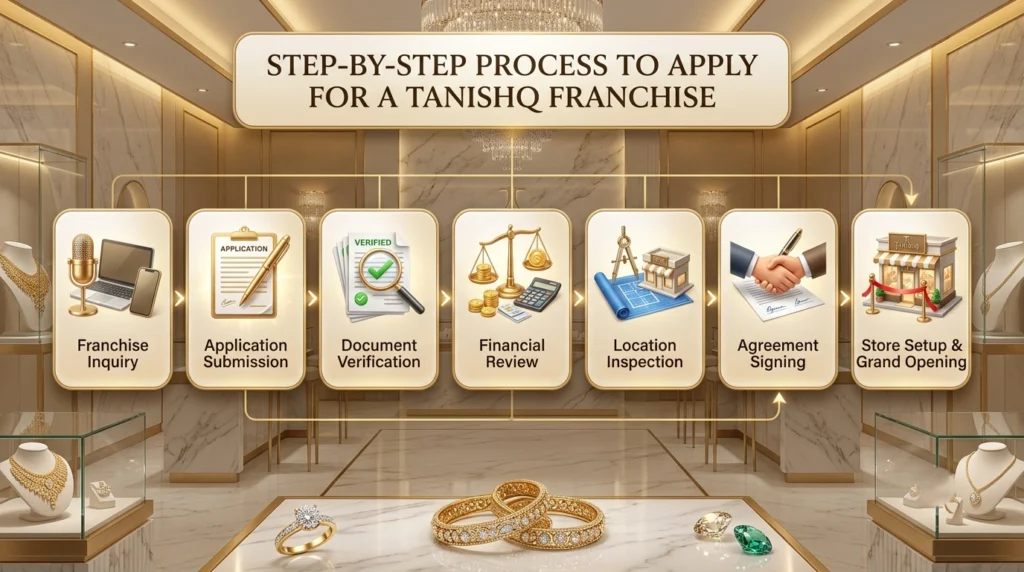
Step 1: Submit an Initial Franchise Inquiry
The process usually begins when an interested investor contacts the company through official channels and expresses interest in becoming a franchise or business partner.
At this stage, applicants typically provide basic information such as:
- Name and contact details
- Business background
- Preferred city or market
- Available investment capacity
- Property information (if available)
This initial inquiry helps the company determine whether the applicant fits the general profile of a potential franchise partner.
Step 2: Preliminary Discussion and Screening
Once the inquiry is reviewed, the company may conduct an initial discussion with the applicant.
The purpose of this stage is to understand:
- Business experience
- Financial capability
- Expansion plans
- Market understanding
- Long-term objectives
This conversation helps both parties determine whether there is a potential fit before investing significant time in the evaluation process.
Applicants should be prepared to discuss their business background and explain why they are interested in partnering with Tanishq.
Step 3: Financial Assessment and Due Diligence
Since the investment requirement is substantial, financial evaluation becomes one of the most important stages of the process.
The company may review:
- Net worth
- Financial statements
- Business assets
- Funding sources
- Investment capability
The objective is to ensure that the applicant can comfortably support the showroom’s development and operational requirements.
Strong financial credentials can significantly strengthen an application.
Step 4: Location and Property Evaluation
After financial suitability is established, the proposed location is usually assessed.
The company may evaluate factors such as:
- Store size
- Visibility
- Accessibility
- Parking availability
- Surrounding customer demographics
- Commercial potential
Location analysis is critical because even a strong brand requires a suitable market to achieve long-term success.
In some cases, applicants may be asked to provide additional information or consider alternative properties if the proposed site does not meet company standards.
Step 5: Business Proposal Review
At this stage, the company conducts a broader assessment of the overall business opportunity.
This review may include:
- Market potential
- Competitive environment
- Growth prospects
- Investment feasibility
- Long-term sustainability
The objective is to ensure that the showroom has a reasonable chance of succeeding within the selected market.
Both the company and the investor must be confident that the partnership will be mutually beneficial before moving forward.
Step 6: Approval and Partnership Discussions
If the application successfully clears the previous stages, formal discussions regarding the partnership structure typically begin.
Topics may include:
- Commercial terms
- Investment commitments
- Operational responsibilities
- Store development plans
- Brand standards
- Agreement conditions
This stage is important because it establishes the framework for the long-term business relationship.
Applicants should carefully review all terms before proceeding.
Step 7: Store Development and Setup
Once agreements are finalized, showroom development begins.
This phase generally includes:
- Interior construction
- Store design implementation
- Security system installation
- Technology setup
- Product display preparation
- Recruitment planning
Since Tanishq maintains strict standards regarding customer experience and branding, showroom development is typically carried out according to detailed guidelines.
Depending on the project scope, this phase may take several months to complete.
Step 8: Staff Recruitment and Training
Before launch, employees must be recruited and trained.
Training often focuses on:
- Customer service
- Product knowledge
- Sales techniques
- Operational procedures
- Security protocols
- Brand standards
Well-trained employees play a major role in delivering the premium experience customers expect from Tanishq.
This stage helps ensure that the team is fully prepared before the showroom opens to the public.
Step 9: Store Launch and Ongoing Operations
The final stage is the official showroom launch.
Once operational, the focus shifts toward:
- Customer acquisition
- Sales growth
- Service quality
- Inventory management
- Operational efficiency
The success of the showroom ultimately depends on maintaining strong customer relationships while consistently meeting the brand’s standards.
Support And Training Provided By Tanishq To Franchisees
When investing several crores into a jewellery retail business, investors naturally want to know what kind of support they will receive from the brand. This becomes even more important in the case of Tanishq because operating a premium jewellery showroom involves much more than simply displaying products and making sales.
A successful showroom requires trained staff, strong inventory management, customer service excellence, security systems, marketing initiatives, and operational consistency. Since Tanishq has spent decades building customer trust, the company places significant importance on maintaining the same standards across all locations.
This is one of the reasons many investors are attracted to the brand despite the high Tanishq Franchise Cost. Instead of building systems from scratch, partners benefit from the experience, processes, and operational expertise developed by one of India’s leading jewellery retailers.
While the exact level of support may vary depending on the business arrangement and location, franchise partners can generally expect assistance in several important areas.
Store Planning and Setup Assistance
Setting up a premium jewellery showroom is a complex process. Every aspect of the store must reflect the brand’s image while also providing a comfortable and secure environment for customers.
To achieve this, Tanishq may provide guidance during the showroom development stage. This can include recommendations related to store layout, customer flow, display planning, branding standards, and overall showroom presentation.
The objective is to create a consistent customer experience across all locations. Whether a customer visits a showroom in Delhi, Mumbai, Bengaluru, or a Tier 2 city, they should experience similar standards of quality and professionalism.
This support can be particularly valuable because mistakes made during store development are often expensive and difficult to correct later.
Employee Recruitment and Staff Training
Employees play a critical role in jewellery retail.
Customers purchasing gold, diamond, or bridal jewellery often spend considerable time evaluating products before making a decision. They expect knowledgeable staff who can explain designs, purity standards, certification details, pricing structures, and purchase options.
For this reason, staff training is a major component of the support provided by Tanishq.
Training programs may focus on:
- Product knowledge
- Customer service standards
- Sales techniques
- Jewellery certification awareness
- Store operations
- Billing procedures
- Brand values and customer interaction
A well-trained team not only improves customer satisfaction but can also increase sales conversions and encourage repeat business.
Product Knowledge and Sales Excellence
Selling jewellery is very different from selling everyday retail products.
Customers often make emotional purchasing decisions connected to weddings, anniversaries, celebrations, and investments. Sales teams must therefore understand both the products and the customer’s needs.
Training in this area helps employees:
- Understand jewellery collections
- Explain craftsmanship and design features
- Discuss diamond and gold specifications
- Recommend suitable products
- Build customer confidence
This expertise helps create a more personalized shopping experience and strengthens customer trust in the brand.
Tanishq Franchise Vs Competitors-Which Is Better For You?
Investing in a jewellery franchise is a major financial decision. The right choice depends on factors such as your investment capacity, preferred market, business goals, and the availability of partnership opportunities in your city.
| Brand | Market Position | Key Strength | Target Customer Segment | Presence in India |
| Tanishq | Premium Jewellery Brand | Trust, Certification, Brand Reputation | Premium & Upper-Middle-Class Buyers | Very Strong |
| Kalyan Jewellers | Mass Premium | Wedding Jewellery & Traditional Collections | Family & Wedding Buyers | Very Strong |
| Malabar Gold & Diamonds | Premium to Mass Premium | Large Product Portfolio | Diverse Customer Segments | Very Strong |
| Joyalukkas | Premium Jewellery Retailer | International Presence | Premium Buyers | Strong |
| PNG Jewellers | Heritage Jewellery Brand | Strong Regional Trust | Traditional Jewellery Buyers | Moderate to Strong |
| Senco Gold & Diamonds | Mid-Premium | Lightweight & Contemporary Jewellery | Urban Buyers | Strong |
| TBZ (Tribhovandas Bhimji Zaveri) | Premium Heritage Brand | Legacy & Bridal Jewellery | Premium Wedding Buyers | Moderate |
| Reliance Jewels | Organized Retail Jewellery | Retail Network Strength | Mass & Premium Buyers | Strong |
| Bhima Jewellers | Traditional Jewellery Specialist | South Indian Gold Jewellery | Traditional Buyers | Strong in South India |
| Khazana Jewellery | Regional Premium Brand | Wedding & Gold Jewellery | Family-Oriented Buyers | Moderate |
What Makes Tanishq Stand Out?
Despite intense competition, Tanishq continues to maintain a leadership position in India’s organized jewellery market.
Some of the factors that help distinguish the brand include:
- Strong Tata Group backing
- High customer trust
- Premium showroom experience
- Certified jewellery products
- Nationwide presence
- Strong bridal and diamond jewellery segments
- Established marketing and brand recognition
These advantages have helped the brand maintain relevance even as competition within the jewellery industry continues to increase.
Explore More Franchise Option:
Pros And Cons Of Owning A Tanishq Franchise
Before investing several crores into a showroom, entrepreneurs should carefully evaluate both sides of the opportunity. Understanding the strengths and limitations of the business can help investors set realistic expectations and make more informed decisions.
Advantages and Disadvantages of a Tanishq Franchise
| Advantages | Disadvantages |
| Strong brand reputation | Very high investment requirement |
| Backed by Tata Group | Long ROI timeline |
| High customer trust | Not suitable for small investors |
| Premium product portfolio | Significant inventory investment |
| Established operating systems | Strict operational standards |
| Marketing and training support | Location-dependent performance |
| Growing demand for branded jewellery | Higher business complexity |
Is Tanishq Franchise Profitable in 2026?
The profitability of a Tanishq franchise is one of the most searched topics among potential investors. After all, when the Tanishq Franchise Cost can range from ₹10 crore to ₹30 crore or more, it is natural to ask whether the business can generate enough returns to justify such a significant investment.
The honest answer is that a Tanishq showroom can be profitable, but profitability is not automatic. Success depends on several factors, including location quality, market demand, inventory management, customer service, operational efficiency, and the overall strength of the local jewellery market.
One reason investors are attracted to Tanishq is the brand’s strong reputation. Customers already trust the brand, which can reduce some of the challenges involved in building awareness from scratch. In addition, jewellery remains one of India’s most resilient retail categories because demand is supported by weddings, festivals, gifting occasions, and investment-driven purchases.
However, investors should understand that jewellery retail is a capital-intensive business. A large portion of the investment remains tied up in inventory, and returns generally take longer compared to smaller retail businesses.
Why Tanishq Franchise Is Not Suitable For First-Time Business Owners
Many franchise opportunities in India are designed specifically for beginners. Brands in sectors such as food, beverages, education, and retail often offer relatively low investment requirements and straightforward operating models that are easier for new entrepreneurs to manage.
The Tanishq franchise is very different. While the brand offers significant advantages, it also comes with responsibilities and financial commitments that may be overwhelming for someone entering business ownership for the first time. This does not mean first-time entrepreneurs cannot succeed, but they should carefully evaluate whether they are prepared for the scale and complexity of the opportunity.
1. Extremely High Capital Requirement
The most obvious reason is the investment requirement.
The Tanishq Franchise Cost in India can exceed ₹10 crore and may reach ₹30 crore or more depending on the showroom size and inventory requirements. This level of investment is far beyond what most first-time business owners are comfortable committing.
A new entrepreneur may find it difficult to manage such a large financial commitment, especially when the investment recovery period can extend over several years.
2. Complex Inventory Management
Jewellery inventory is not like inventory in a clothing store or café.
A single item can be worth thousands or even lakhs of rupees. Managing inventory efficiently requires careful planning, strong controls, and continuous monitoring.
Mistakes in inventory management can have significant financial consequences because large amounts of capital are involved.
3. Higher Security Responsibilities
Security is a major consideration in jewellery retail.
A showroom may contain inventory worth several crores, making it essential to maintain robust security measures at all times. This includes physical security systems, inventory controls, operational procedures, and risk management practices.
For someone who has never managed a high-value retail business before, these responsibilities can be challenging and stressful.
Conclusion: Should You Invest In A Tanishq Franchise?
The Tanishq Franchise Cost is undoubtedly one of the highest among retail franchise opportunities in India. With an estimated investment ranging from ₹10 crore to ₹30 crore or more, this is not a business designed for small investors or entrepreneurs looking for quick returns.
If you are an experienced investor looking to build a premium retail business with long-term growth potential, the Tanishq franchise may be worth serious consideration. On the other hand, if you are seeking a low-cost or quick-return franchise opportunity, there are likely more suitable options available.
Ultimately, the decision should be based on your financial capacity, business experience, investment goals, and willingness to commit to a long-term retail venture. For the right investor, partnering with Tanishq can provide access to one of the strongest and most respected brands in India’s jewellery industry.