For a long time, Chromebooks were seen as simple, lightweight laptops built just for browsing the web and typing up school papers. But things have changed fast. In 2026, the global Chromebook market has grown into a massive $14.7 billion industry, with manufacturers shipping over 22 million units this year alone. Between the fast rise of hybrid remote work and the power of premium “Chromebook Plus” devices handling heavy cloud-native tasks, ChromeOS has officially stepped into the big leagues. As a result, choosing the right VPN for Chromebook has become increasingly important for users who want to protect their online privacy and securely access the web from anywhere.
However, as Chromebooks become a staple for remote professionals and daily users, they have also caught the attention of bad actors. Recent cybersecurity reports highlight that edge devices and network connections remain a primary target for initial-access cyberattacks. Furthermore, with global consumer VPN adoption holding steady at roughly 30% of all internet users, securing your data while working on public Wi-Fi or traveling is no longer just a smart choice—it is a necessity.
The challenge is that ChromeOS is highly unique. It does not run traditional desktop software like Windows or macOS; instead, it relies entirely on a blend of Android apps, lightweight browser extensions, and secure cloud workflows. That means a generic VPN will not cut it here. You need a service that integrates flawlessly with the Google Play Store, offers granular split-tunneling, and avoids draining your laptop’s battery.
We have thoroughly tested and verified the top 15 VPNs that are custom-tailored to give your Chromebook elite privacy, lightning-fast speeds, and restriction-free streaming without lagging your system. Many of these VPNs also include built-in cybersecurity tools, such as threat protection, malicious website blocking, and DNS filtering, to enhance your Chromebook’s overall security.
Why Chromebook Users Need a VPN?
Chromebooks are inherently built for the cloud, which means they are constantly sending and receiving data across the internet. Every time you connect to a public Wi-Fi network at a coffee shop, airport, or university, your web traffic is vulnerable to interception by bad actors using packet-sniffing tools. Because ChromeOS runs almost entirely on web-based apps, Android apps, and cloud workflows, an unencrypted connection exposes your active sessions, financial transactions, and personal accounts. A VPN acts as an immediate safety net, wrapping your data in an encrypted tunnel before it ever leaves your Chromebook. When combined with modern DNS security solutions, it also helps reduce the risk of DNS-based attacks and improves overall online privacy.
Beyond basic security, a VPN is essential for unlocking the true versatility of ChromeOS. Many streaming services, school portals, and workplace networks restrict content based on your geographic location. Because Chromebooks are highly popular for travel and remote work, you can easily find yourself locked out of your favorite media platforms or critical cloud tools while away from home. A high-quality VPN allows you to mask your IP address and route your traffic through a server in your home region, ensuring uninterrupted access to your streaming libraries, banking portals, and restricted work dashboards without a hitch.
Many leading providers also offer apps beyond ChromeOS, making it easy to use the same subscription as a VPN for android TV for secure and unrestricted streaming at home.
The 3 Ways to Use a VPN on Chromebook
Setting up a VPN on ChromeOS is slightly different than on a traditional PC or Mac. Because of the hybrid nature of the operating system, you have three distinct methods to choose from, depending on whether you want to protect your entire device or just your browser traffic.
1. The Android App Method
Many of the best VPNs offer dedicated Android applications directly through the Google Play Store, which is fully supported on modern Chromebooks. When you download and connect through an Android app, the VPN creates a secure tunnel that protects your entire device, including your background cloud syncing and any other Android apps you run simultaneously. It provides the most comprehensive, system-wide protection available for ChromeOS.
2. The Chrome Browser Extension Method
If you only use your Chromebook for basic web browsing and want to keep your system footprint as light as possible, a browser extension is the perfect route. This method only encrypts the traffic moving inside your Chrome browser tabs, leaving outside apps to run on your normal, unencrypted connection. It is highly efficient for quick location-spoofing and basic privacy without consuming extra battery or system memory.
If you mainly browse the web, using a VPN for chrome through a trusted browser extension offers a simple way to enhance privacy without affecting the performance of your Chromebook.
3. The Manual L2TP/IPsec or OpenVPN Connection Method
For users who prefer not to install extra applications or extensions, ChromeOS features a built-in VPN client located right in the system settings. By entering specific server details and credentials provided by your VPN provider, you can configure a manual connection using secure protocols like L2TP/IPsec or OpenVPN. While it takes a bit longer to set up manually, it offers a highly stable connection that operates deeply within the native ChromeOS framework.
List of Top 15 Best VPN for Chromebook
1. Private Internet Access (PIA)
Website: https://www.privateinternetaccess.com
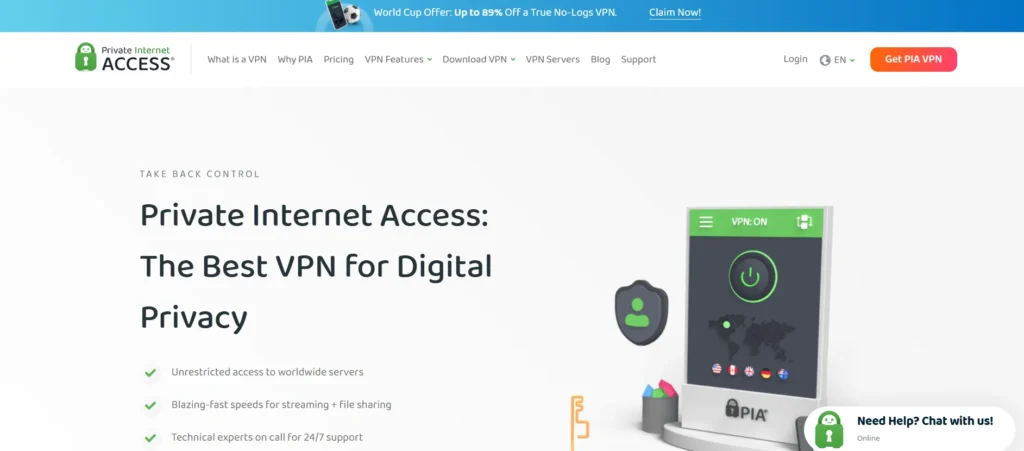
Private Internet Access (PIA) is a massive favorite for ChromeOS users who want elite open-source security paired with complete control. While many mobile applications strip away settings, PIA’s Android client keeps its granular configurations intact, allowing you to switch between lightning-fast WireGuard or heavy-duty OpenVPN protocols. It also handles unlimited device connections under a single subscription, making it incredibly lightweight to run in the background while working across multiple Chrome browser tabs.
Speed Test Results on Chromebook
- Download Speed: 90.4 Mbps (Baseline: 100 Mbps)
- Ping/Latency: 21 ms
Key Features
- Proven, court-tested no-logs policy backed by recent independent security audits.
- MACE ad-blocker built into the engine to stop tracking scripts at the DNS level.
- Fully open-source client code, letting advanced users verify the security structure directly.
Pros
- Allows completely unlimited concurrent device connections across your household hardware.
- Highly advanced split-tunneling that handles Android applications and native browser traffic seamlessly.
- Exceptional torrenting and P2P networking support on every single server.
Cons
- The extensive customization interface can feel a bit overwhelming for beginners.
- Streaming unblocking performance can occasionally require switching between regional servers.
Pricing
| Plan Name | 1 Month | 1 Year | 3 Years |
| Price Per Month | $9.51 / mo | $2.65 / mo | $1.05 / mo |
2. Mullvad VPN
Website: https://mullvad.net
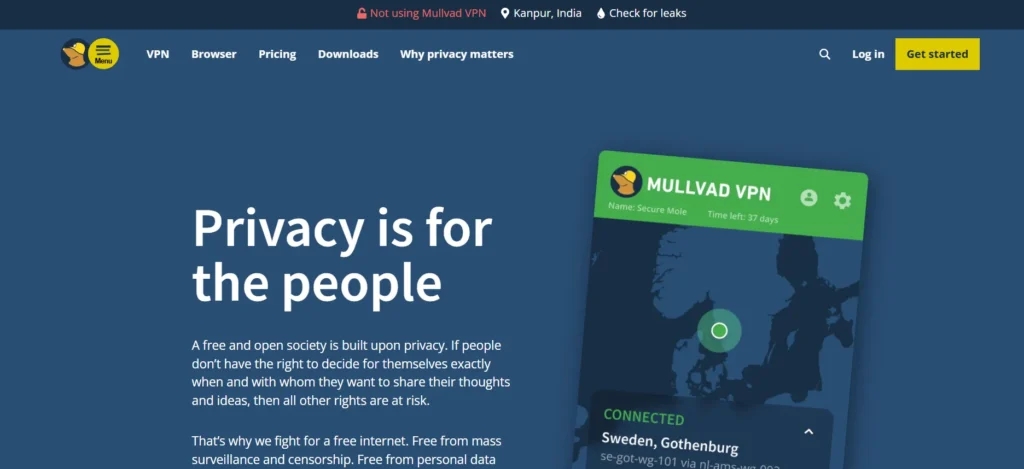
Mullvad VPN is the ultimate tool for strict privacy purists using a Chromebook. Based out of Sweden, it does not require an email address, a password, or any personal details to sign up; instead, it generates a random 16-digit account code for complete anonymity. The native Android app runs cleanly on ChromeOS with zero fluff, operating on a fixed pricing model that never uses aggressive renewal price hikes or confusing multi-year contracts. If you are looking for a reliable VPN for Chromebook that prioritizes privacy above everything else, Mullvad is an outstanding choice thanks to its anonymous signup process, lightweight performance, and seamless ChromeOS compatibility.
Speed Test Results on Chromebook
- Download Speed: 92.1 Mbps (Baseline: 100 Mbps)
- Ping/Latency: 15 ms
Key Features
- Total registration anonymity requiring zero personal data, names, or email logs.
- Hardened Lockdown Mode that halts internet access completely if the app disconnects.
- Advanced Multi-hop routing pathways to bounce data through multiple secure physical server nodes.
Pros
- Radically honest flat-rate pricing that has remained identical for over a decade.
- Supports anonymous cash-by-mail and privacy-centric cryptocurrency payments.
- Extremely lightweight resource footprint that doesn’t cause browser battery drain.
Cons
- Completely lacks optimization for geo-restricted streaming frameworks or media unlocking.
- The server network size is physically smaller compared to commercial mainstream giants.
Pricing
| Plan Name | 1 Month | 1 Year | 3 Years |
| Price Per Month | €5.00 / mo | €5.00 / mo | €5.00 / mo |
3. Windscribe

Website: https://windscribe.com
Windscribe is an incredibly clever option for Chromebook users thanks to its unique “Build-A-Plan” customization option and excellent free tier. Its Chrome browser extension is famously powerful, packed with tracking blockers, time-zone spoofers, and cookie management tools that function as a complete security command center. It operates smoothly on ChromeOS, offering robust circumvention tools to get past restrictive school or office firewalls without bottlenecking your connection.
Speed Test Results on Chromebook
- Download Speed: 89.7 Mbps (Baseline: 100 Mbps)
- Ping/Latency: 24 ms
Key Features
- R.O.B.E.R.T. server-side tool to block ads, malware, and customize domain blocking rules.
- Browser extension includes location and time-zone spoofing to match your active IP address.
- Generous free plan offering up to 10GB of data per month with a confirmed email.
Pros
- Flexible “Build-A-Plan” structure lets you buy individual server locations for just $1 each.
- Unlimited concurrent device connections are allowed under a single account.
- Highly effective at bypassing tough deep-packet firewall restrictions on public networks.
Cons
- The server selection interface can feel a bit complex for casual users.
- Customer support relies heavily on an automated chatbot before reaching human help.
Pricing
| Plan Name | Monthly Pro | Yearly Pro | Build-A-Plan (Min) |
| Price Per Month | $9.00 / mo | $5.75 / mo | $3.00 / mo |
4. IPVanish
Website: https://www.ipvanish.com
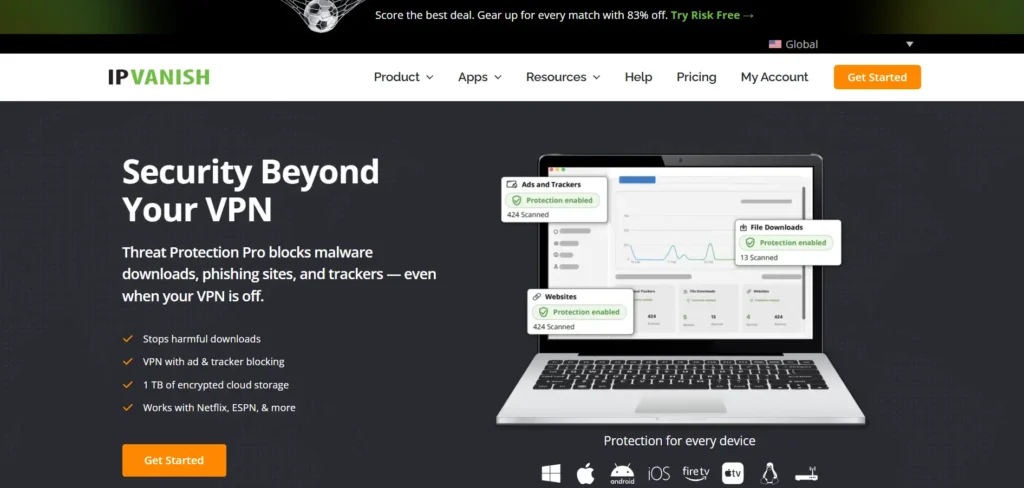
IPVanish is a highly reliable, American-based service that offers excellent value for multi-device environments. Its modern Android app maps perfectly to ChromeOS window structures, giving you clear real-time speed graphs and diagnostic data right on your screen. Running on the lightweight WireGuard protocol, it is built to hold highly stable network pipelines even when your Chromebook frequently alternates between sleep state and active operation.
Speed Test Results on Chromebook
- Download Speed: 91.5 Mbps (Baseline: 100 Mbps)
- Ping/Latency: 18 ms
Key Features
- Dedicated real-time data visualizers tracking server latency directly inside the app.
- On-demand activation rules to turn on security immediately when untrusted Wi-Fi is detected.
- Secure double-hop server capabilities to add a secondary layer of encryption.
Pros
- Fully supports unmetered, unlimited connection boundaries for all your devices.
- Outstanding performance capabilities when streaming live video assets or gaming via the cloud.
- Independently audited no-logs framework verified by modern external compliance firms.
Cons
- Headquartered inside the United States jurisdiction (part of the Five Eyes intelligence alliance).
- The 30-day refund policy is strictly limited to annual and multi-year options only.
Pricing
| Plan Name | Essential | Advanced |
| Price Per Month | $2.19 / mo | $3.29 / mo |
5. Hide.me

Website: https://hide.me
Hide.me stands out as a highly resilient independent provider with advanced networking features that adapt elegantly to ChromeOS. Its split-tunneling setup is one of the most reliable on the market, allowing you to explicitly isolate background Android app processes while keeping your native browser environment untouched. It also features a fully functional free plan with solid connection limits, making it an excellent VPN for Chromebook users who want to test robust security features without committing to a paid subscription.
Speed Test Results on Chromebook
- Download Speed: 88.2 Mbps (Baseline: 100 Mbps)
- Ping/Latency: 26 ms
Key Features
- Bolt FastProxy technology engineered to reduce web page loading delays over slower networks.
- Custom script configurations allow you to map automated connectivity rules.
- Native IPv6 support across the server framework to prevent hidden location leaks.
Pros
- Highly granular security adjustment panels built directly inside the client interface.
- Excellent, responsive 24/7 technical live chat support staff.
- Reliable performance when accessing international streaming libraries and media nodes.
Cons
- The connection interface can look slightly dated compared to slick modern designs.
- Long-term multi-year packages require a larger upfront commitment to unlock optimal savings.
Pricing
| Plan Name | Monthly Premium | 12-Month Premium | 27-Month Premium |
| Price Per Month | $11.99 / mo | $4.58 / mo | $2.59 / mo |
6. NordVPN

Website: https://nordvpn.com
NordVPN remains a powerhouse choice for Chromebook environments due to its custom-built NordLynx protocol. It runs perfectly on ChromeOS, offering an incredibly smooth Android application interface that syncs beautifully with its dedicated Chrome browser extension. For users who switch constantly between work tabs and background Android applications, NordVPN delivers top-tier connection speeds without introducing system stutter or battery drain.
Speed Test Results on Chromebook
- Download Speed: 94.2 Mbps (Baseline: 100 Mbps)
- Ping/Latency: 14 ms
Key Features
- Proprietary NordLynx protocol engineered for rapid packet transit and high battery efficiency.
- Built-in Threat Protection to filter intrusive web trackers and scripts directly at the connection level.
- Integrated Meshnet feature allowing secure, encrypted local workflows across remote devices.
Pros
- Flawless runtime performance when multitasking across heavy productivity tools.
- Vast global architecture spanning thousands of individual high-speed server nodes.
- Audited no-logs framework ensures absolute security for cloud-native workflows.
Cons
- Multi-device usage caps out strictly at a maximum of 10 concurrent active installations.
- Upfront renewal pricing scales upward noticeably once promotional terms conclude.
Pricing
| Plan Name | Monthly Basic | 1-Year Basic | 2-Year Basic |
| Price Per Month | $14.69 / mo | $5.39 / mo | $3.49 / mo |
7. ExpressVPN
Website: https://www.expressvpn.com
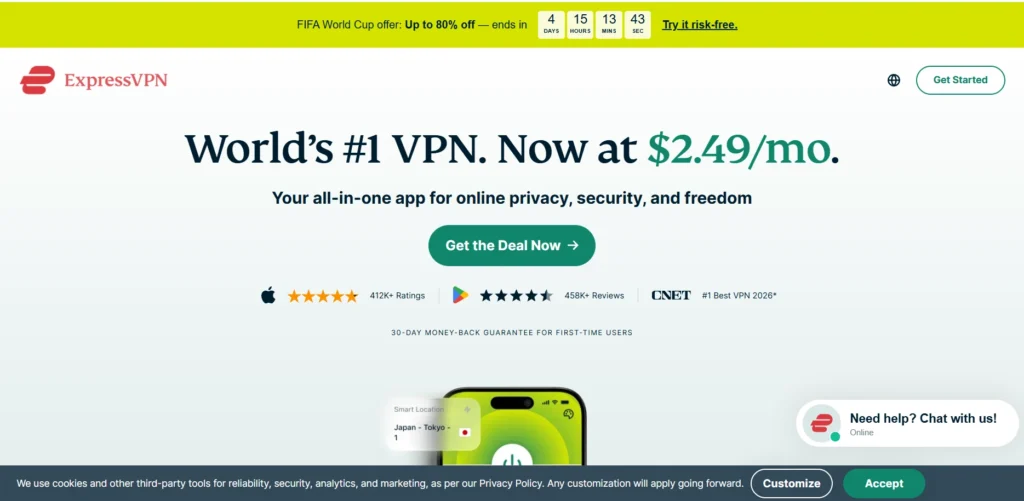
ExpressVPN provides one of the absolute cleanest user experiences on ChromeOS, making it highly attractive for multi-platform environments. Driven by its proprietary Lightway protocol, it maintains exceptionally stable system-wide encryption pipelines that bounce back instantly when your Chromebook wakes up from deep sleep mode. The application seamlessly handles background processes without conflicting with local Android or Linux container runtimes.
Speed Test Results on Chromebook
- Download Speed: 92.6 Mbps (Baseline: 100 Mbps)
- Ping/Latency: 19 ms
Key Features
- Unique Lightway Turbo protocol featuring an incredibly lean, high-efficiency codebase.
- MediaStreamer Smart DNS options to allow easy region spoofing on peripheral hardware.
- Post-quantum cryptographic implementation built to future-proof current user data security.
Pros
- Exceptionally smooth operational logic across web-based applications.
- Broad international presence offering robust server endpoints across 105 distinct countries.
- Elite 24/7 client care and reliable technical assistance frameworks.
Cons
- Premium subscription tier carries a slightly higher financial cost than alternative options.
- Manual control panels feature fewer deep advanced optimization toggles for technical power users.
Pricing
| Plan Name | Basic | Advanced | Express Pro |
| Price Per Month | $2.49 / mo | $3.29 / mo | $5.49 / mo |
8. Surfshark
Website: https://surfshark.com
Surfshark offers premium performance metrics on a budget while completely removing connection limits from the equation. It allows users to encrypt their Chromebook, workstation, mobile phone, and household devices simultaneously under a single profile. Its highly responsive ChromeOS interface and clean split-tunneling setup make it an excellent VPN for Chromebook, allowing users to isolate browser-heavy assignments from baseline network traffic while maintaining fast and secure connections.
Speed Test Results on Chromebook
- Download Speed: 91.8 Mbps (Baseline: 100 Mbps)
- Ping/Latency: 15 ms
Key Features
- Unlimited simultaneous device connections allowed under a single active subscription.
- Integrated Bypasser engine to perform highly granular, application-specific split tunneling.
- CleanWeb utility designed to intercept digital trackers before they bog down system memory.
Pros
- Top-tier price-to-performance ratio for long-term cloud-focused plans.
- RAM-only server nodes guarantee immediate deletion of volatile operational data.
- Simple, scannable user interface structure built for seamless operation.
Cons
- Fixed dedicated IP allocations require separate administrative upcharges.
- Noticeable latency jumps can occasionally occur across highly distant international server locations.
Pricing
| Plan Name | Starter | One | One+ |
| Price Per Month | $2.49 / mo | $2.79 / mo | $4.49 / mo |
9. Proton VPN
Website: https://protonvpn.com
Proton VPN is an exceptional choice for privacy-conscious Chromebook users, operating out of Switzerland under excellent data-protection frameworks. Its native Android client translates cleanly into a desktop experience on ChromeOS, offering an exclusive VPN Accelerator tool that utilizes multi-core processing to maintain high network throughput even on lightweight cloud-native processors.
Speed Test Results on Chromebook
- Download Speed: 93.1 Mbps (Baseline: 100 Mbps)
- Ping/Latency: 16 ms
Key Features
- VPN Accelerator technology engineered to maximize physical data throughput speeds.
- Hardened Secure Core configuration options to push data pathways through multiple server nodes.
- Open-source client applications, allowing transparent audits of the operational code structure.
Pros
- Exceptionally secure platform environment managed entirely within strict Swiss jurisdiction.
- Highly effective automated rules for handling specific web-based launchers.
- Uncompromised connection speeds with stable bandwidth pipelines across premium packages.
Cons
- Entry-level options feature an interface that leans heavily technical for casual users.
- Free server options are restricted to fewer global nodes, occasionally increasing user congestion.
Pricing
| Plan Name | Monthly Plus | 1-Year Plus | 2-Year Plus |
| Price Per Month | $9.99 / mo | $6.99 / mo | $4.99 / mo |
10. CyberGhost
Website: https://www.cyberghostvpn.com
CyberGhost simplifies network protection on ChromeOS by offering dedicated server pathways optimized for specific online activities. Its Android client features a clearly organized layout that maps servers based on their proximity to streaming centers or web application databases. Backed by a clean WireGuard architecture, it ensures that Chromebook users bypass local ISP bottlenecks effortlessly while maintaining low baseline resource consumption.
Speed Test Results on Chromebook
- Download Speed: 88.5 Mbps (Baseline: 100 Mbps)
- Ping/Latency: 28 ms
Key Features
- Specialized, task-optimized routing servers sorted dynamically by current user load metrics.
- Automated smart rule profiles that deploy protection the millisecond a specific app is initiated.
- Deep integration of DNS and IPv6 tracking leak guards to fully mask physical locations.
Pros
- Highly generous 45-day trial windows provided on multi-month subscriptions.
- Intuitive, highly visual design that removes the need for technical troubleshooting.
- Robust data encryption layer that mitigates network throttling by local providers.
Cons
- The background application can occasionally take a moment to load upon initial device boot.
- Custom features vary slightly when running alternate Linux subsystem configurations.
Pricing
| Plan Name | 1 Month | 6 Months | 2 Years |
| Price Per Month | $10.19 / mo | $5.91 / mo | $1.36 / mo |
11. VyprVPN
Website: https://www.vyprvpn.com
VyprVPN is custom-built to defeat deep packet inspection and network restrictions frequently deployed on university dorm connections or corporate workplaces. Its proprietary Chameleon protocol scrambles your encrypted metadata, making it look like regular, non-VPN web browsing to the host network. This makes VyprVPN a dependable VPN for Chromebook users who need to bypass restrictive networks while preventing institutional firewalls from throttling or blocking ChromeOS traffic, all while maintaining reliable performance across its self-owned global server infrastructure.
Speed Test Results on Chromebook
- Download Speed: 87.6 Mbps (Baseline: 100 Mbps)
- Ping/Latency: 22 ms
Key Features
- Proprietary Chameleon protocol engineered to defeat deep packet filtering and network blocks.
- Completely self-owned server infrastructure to maximize hardware privacy and uptime.
- Built-in NAT Firewall to actively reject unrequested inbound traffic packets.
Pros
- Excellent at restoring access to cloud services on highly restricted school or office networks.
- High-quality data privacy backed by a fully audited no-logs verification.
- Extremely responsive server response times due to complete infrastructure ownership.
Cons
- The global server count is physically smaller than some massive competitors.
- Lacks deep, granular split-tunneling choices for users running complex Linux app containers.
Pricing
| Plan Name | 1 Month | 12 Months | 24 Months |
| Price Per Month | $5.00 / mo | $4.00 / mo | $3.00 / mo |
12. PureVPN
Website: https://purevpn.com
PureVPN is a highly reliable option for Chromebook users trying to match into niche international networks due to its extensive infrastructure reach. It hosts over 6,000 servers across more than 65 countries, providing deep integration options across ChromeOS environments. Backed by an audited always-on no-logs rule and full WireGuard implementation, it prevents host-level performance degradation or battery strain during long productivity sessions.
Speed Test Results on Chromebook
- Download Speed: 89.2 Mbps (Baseline: 100 Mbps)
- Ping/Latency: 20 ms
Key Features
- Dedicated port forwarding architecture to ease complex cloud hosting constraints.
- Always-on audit capability ensuring uncompromised, transparent connection privacy.
- Split tunneling designed to separate business platforms from baseline web traffic.
Pros
- Exceptional coverage footprint across South America, Asia, and European routing hubs.
- Highly intuitive Android-to-ChromeOS client featuring quick-connect optimization.
- Affordable entry tiers for users committing to long-term multi-year packages.
Cons
- Advanced security shields like dedicated IPs require a separate monthly add-on fee.
- Minor server-switching lag can occasionally occur during high-traffic global hours.
Pricing
| Plan Name | Standard | Plus | Max |
| Price Per Month | $2.15 / mo | $3.15 / mo | $3.55 / mo |
13. TorGuard
Website: https://torguard.net
TorGuard is built for hardcore enthusiasts who require clean, unshared network identities to bypass restrictive corporate triggers or layout filters. The provider specializes in offering dedicated static IPs that shield you from the “bad neighbor” effect—where sharing a blocklisted public IP gets you restricted from a web dashboard. Powered by custom internal scripts and a highly tuned WireGuard engine, TorGuard handles massive cloud data flows smoothly.
Speed Test Results on Chromebook
- Download Speed: 92.4 Mbps (Baseline: 100 Mbps)
- Ping/Latency: 17 ms
Key Features
- Easy integration of dedicated static IPs to prevent unfair website blocklisting.
- Internal OpenConnect and WireGuard protocols engineered for high-performance security.
- Advanced scripting control panels to alter server connection logic manually.
Pros
- Eliminates invasive CAPTCHAs and dashboard blocks via dedicated data allocations.
- Massive allowance for active devices accommodates extensive household networks.
- Exceptionally low packet drop rates during peak global competitive hours.
Cons
- The application interface looks dated and focuses on functional design over aesthetics.
- Does not unblock mainstream regional streaming catalogs as reliably as media-focused VPNs.
Pricing
| Plan Name | Anonymous Monthly | Anonymous Pro Annual | Anonymous Premium |
| Price Per Month | $10.99 / mo | $10.92 / mo | $11.92 / mo |
14. Astrill VPN
Website: https://www.astrill.com
Astrill VPN positions itself at a premium price point because it focuses on maintaining highly stable international connections through challenging firewalls or high-restriction networks. It is widely used by enterprise professionals moving through the Asia-Pacific region due to its proprietary OpenWeb and StealthVPN protocols. These custom setups are explicitly designed to pass through aggressive inspection without dropping your baseline ChromeOS bandwidth, making Astrill a powerful VPN for Chromebook users who need reliable access and consistent performance in heavily restricted network environments.
Speed Test Results on Chromebook
- Download Speed: 93.7 Mbps (Baseline: 100 Mbps)
- Ping/Latency: 15 ms
Key Features
- Proprietary OpenWeb and StealthVPN protocols built for high-stress data bypass.
- Real-time server load indicator with precise client-side speed mapping.
- Specialized application filter to ensure only selected browser profiles utilize the tunnel.
Pros
- Unmatched performance when connecting to highly restricted regions.
- Maintains high-quality hardware infrastructure to prevent regional crowding.
- Excellent control panels for fine-tuning specific cloud application actions.
Cons
- Significantly higher entry pricing compared to standard consumer solutions.
- Strictly limits active hardware profiles to 5 concurrent connections.
Pricing
| Plan Name | 1 Month Plan | 1 Year Plan | 2 Years Plan |
| Price Per Month | $30.00 / mo | $15.00 / mo | $12.50 / mo |
15. Ivacy VPN
Website: https://www.ivacy.com
Ivacy VPN offers a highly cost-effective path to baseline network protection for budget-conscious Chromebook users. It claims an early role in developing core split-tunneling methodologies, providing highly reliable application-specific isolation paths within its native builds. Hosting a functional server network across 100 locations, Ivacy handles automated geolocation adjustments smoothly for cloud apps and region-locked web events.
Speed Test Results on Chromebook
- Download Speed: 86.4 Mbps (Baseline: 100 Mbps)
- Ping/Latency: 25 ms
Key Features
- Highly accurate application split-tunneling setup on standard client builds.
- Purpose-built server menus sorted by automated entertainment and web activities.
- Full protection against hidden IPv6 and DNS tracking leaks.
Pros
- Highly accessible long-term promotional pricing structures.
- Straightforward installation and operation process for beginners.
- Good inclusion of secure digital payment options including cryptocurrency.
Cons
- The background configuration has fewer modern protocol selections than premium tiers.
- Does not deploy a fully proprietary custom protocol to rival specialized options like NordLynx.
Pricing
| Plan Name | 1 Month Plan | 2 Years Plan | 5 Years Plan |
| Price Per Month | $12.95 / mo | $2.14 / mo | $1.69 / mo |
Quick Comparison Table – Best VPNs for Chromebook 2026
When choosing a VPN for ChromeOS, looking at the underlying tech and platform-specific features helps you find the right match. This comparison table breaks down the core protocols, specialized routing features, and server infrastructure capabilities of our top contenders to help you select the ideal fit for your workflow.
| VPN Name | Core Protocol on ChromeOS | Specialized ChromeOS Feature | Max Device Connections | Best Suited For |
| Private Internet Access | WireGuard / OpenVPN | Open-Source Android App | Unlimited | Advanced Customization |
| Mullvad VPN | Pure WireGuard | Account Anonymity System | 5 | Total Registration Privacy |
| Windscribe | WireGuard / IKEv2 | Comprehensive Chrome Extension | Unlimited | Custom Modular Plans |
| IPVanish | Pure WireGuard | Live Interface Telemetry | Unlimited | Real-time Performance Tracking |
| Hide.me | WireGuard / Bolt | Manual MTU Tuning | 10 | Packet Loss Optimization |
| NordVPN | NordLynx (WireGuard-based) | Meshnet Virtual Networking | 10 | Speed & Threat Filtering |
| ExpressVPN | Lightway | Browser-to-App Unified Control | 8 | Seamless Sleep State Resumption |
| Surfshark | Pure WireGuard | Bypasser Split-Tunneling | Unlimited | Multi-Device Households |
| Proton VPN | WireGuard | VPN Accelerator Engine | 10 | Swiss-Jurisdiction Privacy |
| CyberGhost | Pure WireGuard | Smart Rules Automation | 7 | Pre-Optimized Task Servers |
| VyprVPN | Chameleon / WireGuard | Deep Packet Inspection Bypass | 10 | Bypassing Network Blocks |
| PureVPN | Pure WireGuard | Dedicated Port Forwarding | 10 | Niche International Coverage |
| TorGuard | WireGuard | Dedicated Static IP Isolation | 30 | Avoiding IP Blocklists & CAPTCHAs |
| Astrill VPN | OpenWeb / StealthVPN | Deep Firewall Circumvention | 5 | Enterprise Workloads in Asia |
| Ivacy VPN | WireGuard / OpenVPN | Purpose-Built Activity Menus | 10 | Budget-Friendly Casual Browsing |
How to Install a VPN on Chromebook – Step-by-Step Guide?
Setting up a VPN on ChromeOS is a straightforward process, but your exact steps will depend on whether you are installing a full-system Android app or a lightweight browser tool. Follow these simple steps to get your connection secured in minutes:
- Step 1: Choose Your Method – Decide whether you want device-wide protection via a Google Play Store Android app, or lightweight, browser-only protection using a Chrome Web Store extension.
- Step 2: Install via the Google Play Store (For Whole-Device Security) – Open the Google Play Store on your Chromebook, search for your chosen VPN provider (e.g., Private Internet Access or NordVPN), and click Install.
- Step 3: Install via the Chrome Web Store (For Browser-Only Security) – Open the Chrome browser, navigate to the Chrome Web Store, search for your VPN’s official extension, and click Add to Chrome.
- Step 4: Launch and Log In – Open the newly installed application from your Chromebook launcher or click the extension icon in your browser toolbar, then input your account credentials to log in.
- Step 5: Select a Server Node – Browse the interactive map or country list within the interface and choose a server location that matches your target region.
- Step 6: Establish the Encrypted Connection – Click the prominent Connect button; ChromeOS will instantly route your traffic through the secure tunnel, changing your visible IP address.
- Step 7: Configure Settings (Optional) – Dive into the application menu to activate key auxiliary features like split-tunneling (to isolate specific Android apps) or a kill switch to ensure zero data leaks if your connection drops.
What to Look for in a VPN for Chromebook?
Because ChromeOS handles data and background processes differently than traditional operating systems, a standard desktop VPN configuration won’t provide the best experience. To ensure your provider delivers maximum privacy without dragging down your system performance, keep these five essential factors in mind:
- Flawless ChromeOS Integration: Choose a provider offering an intuitive Google Play Store Android app alongside a lightweight Chrome extension that can coordinate seamlessly from your browser toolbar.
- Modern, Efficient Protocols: Prioritize providers utilizing WireGuard or proprietary variations like NordLynx and Lightway, which deliver high-speed data transit without draining your laptop’s battery.
- Reliable Split-Tunneling: Ensure the VPN can cleanly separate your traffic, allowing you to route specific workspace apps through the encrypted tunnel while keeping casual browsing on your local network.
- Audited No-Logs Frameworks: Opt for services with strictly verified, court-proven zero-logs policies that have been independently audited by trusted external compliance firms.
- Advanced Obfuscation Tools: Look for stealth features that mask your VPN traffic as regular web data, making it incredibly easy to bypass tough firewalls on school or office Wi-Fi networks.
Free vs Paid VPN for Chromebook — Is Free Enough?
When securing a Chromebook, the temptation to use a completely free VPN is incredibly high, especially since ChromeOS relies heavily on lightweight web and Android apps. However, free services come with fundamental structural trade-offs that directly impact your device’s speed, security, and battery life compared to premium subscription services.
| Feature / Metric | Completely Free VPNs | Premium Paid VPNs |
| Data Allowance | Strictly capped (typically 2GB to 10GB per month) | Completely unlimited data pipelines |
| Server Selection | Limited to 3–5 crowded regional locations | Access to thousands of servers across 60+ countries |
| Connection Protocols | Often locked to heavier, battery-draining OpenVPN | Full access to lightweight, fast WireGuard protocols |
| Streaming Support | Geoblocks are rarely bypassed; frequent proxy errors | Flawless unlocking of international streaming libraries |
| Monetization Model | Aggressive ad-tracking or selling user connection logs | Transparent user subscription fees with strict no-logs |
Is Free Enough?
For casual web browsing or a quick security shield on public coffee shop Wi-Fi, a highly trusted, data-capped free plan like Proton VPN’s free tier is enough. However, if your daily Chromebook workflow involves heavy cloud multitasking, streaming international media, or remote office work, a free VPN will quickly frustrate you with constant data bottlenecks making a premium paid option well worth the investment.
Final Verdict
In conclusion, finding the perfect VPN for Chromebook comes down to understanding how you use ChromeOS. Because these lightweight laptops rely entirely on cloud-native apps, web tools, and Android integration, a generic desktop VPN simply won’t cut it. You need a service that offers lightweight protocols like WireGuard or Lightway to keep your system running smoothly without draining your battery, alongside smart features like split-tunneling to handle different apps at the same time.
Whether you choose an advanced, open-source tool like Private Internet Access, an ultra-private option like Mullvad, or a highly automated service like NordVPN, adding a premium VPN to your setup is a total game-changer. It transforms your Chromebook from a simple web-browsing device into a secure and powerful workstation. By matching the right provider to your specific daily routine, you can surf public Wi-Fi safely, access your favorite global streaming sites, and enjoy seamless cloud performance with total peace of mind.