You are cooking dinner and suddenly you realize you forgot to buy onions. Or it’s a Sunday night and you have run out of milk for your morning chai. A few years back you’d either rush over to the nearest kirana store or just go without.
Not anymore.
Today, you open up an app, click a few buttons and your grocery order is delivered to your door in less than 10 minutes. No traffic. No queues. No stress. This is quick commerce, and it has changed the way India shops completely.
India’s fast commerce market was $7.1 billion in 2025, which was only $300 million in 2022. That’s a 24× jump in three years. Quick commerce is now processing more than two-thirds of all online grocery orders in India. In 2024, Zepto was the most downloaded food and drinks app in India and registered more than 70.58 million downloads.
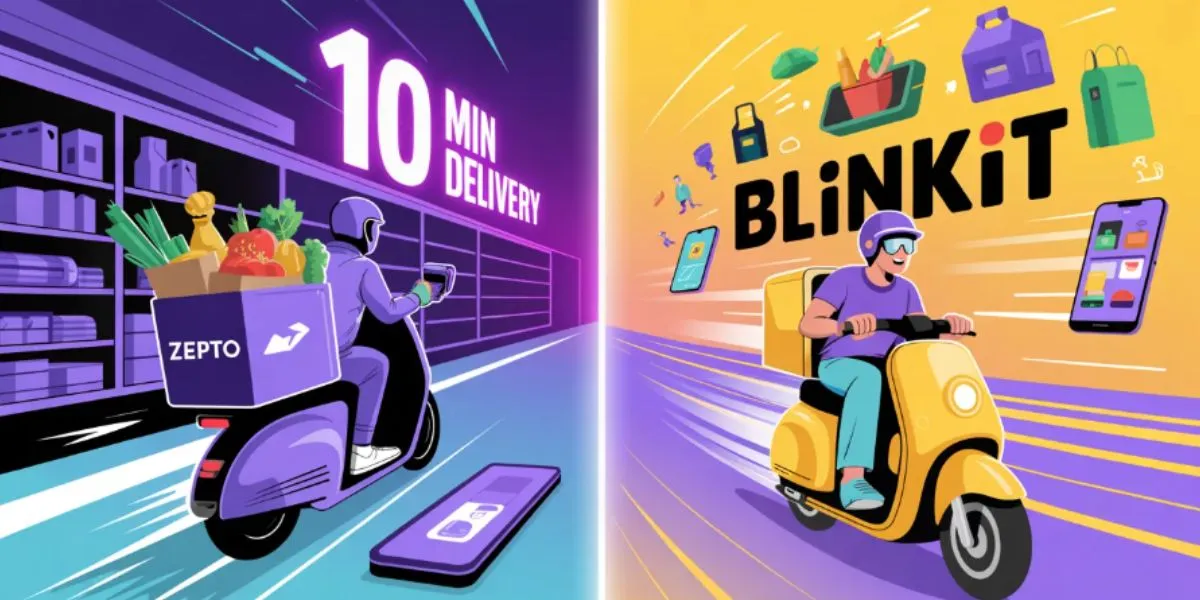
As of January 2026, according to Reuters, India’s quick commerce sector is valued at around $11.5 billion, this is the pace at which this space is growing. And right at the center of all this action are two apps, which millions of Indians use every single day, Zepto vs Blinkit. But, which one is better after all? Which is what gives you faster delivery? Which is cheaper? Which has more products?
In this article, we’re going to break it all down, the good, the bad, and the ugly, if you will with the intent of doing so in a simple way, and hopefully honestly. At the end, you’ll know exactly what app to reach out to for the next time you’re out of something at home.
Rise of Quick Commerce in India
Before we compare these two apps, let’s quickly understand why quick commerce exploded in India in the first place— a context that also helps explain the “Zepto vs Blinkit” battle today.
It all began during the time of the COVID-19 pandemic, when people were not allowed to step outside their homes. Online grocery delivery went from being a convenience to a need. But once people got a taste for the ease of not having to leave their sofa to get things delivered, they didn’t want to go back to standing in queues at the supermarket.
Add to this India’s boom in smartphone usage, the rise of UPI payments, as well as a generation of city-living youngsters who value their time, and you have the perfect formula for quick commerce to take off.
The actual magic in this model is something called a dark store. These are small warehouse-like units that are put inside the residential areas. They are not open to the public. They exist solely for the purpose of packing and dispatching orders in a short time. Because they are located within 2 km of homes, a delivery person can get to your door in a matter of minutes.
Blinkit, Zepto and Swiggy Instamart are all on this model. And with the sector only expected to grow at 40 per cent a year through 2030, the race is only getting more exciting. India’s quick commerce market is set to reach $35 billion by 2030, a number that would have seemed impossible just 5 years ago.
Zepto vs Blinkit – Quick Comparison Table
Here is a snapshot before we go deeper:
| Feature | Zepto | Blinkit |
| Founded | 2021 | 2013 (as Grofers) |
| Parent Company | Independent startup | Eternal Ltd (formerly Zomato) |
| Market Share (Jan 2026) | ~22% | ~48% |
| Dark Stores | 550+ | 700–2,000 (expanding) |
| City Presence | ~35 cities | 153+ cities |
| Avg. Delivery Time | 8–10 minutes | 10–20 minutes |
| App Rating | 4.7/5 | 4.5/5 |
| Valuation | $5–7 billion | $13 billion (via Eternal/Zomato) |
| Platform Fees | Zero handling/surge fees | ₹4 handling + surge fees apply |
| Best For | Speed, freshness, metro cities | Variety, wider city reach |
What is Zepto?
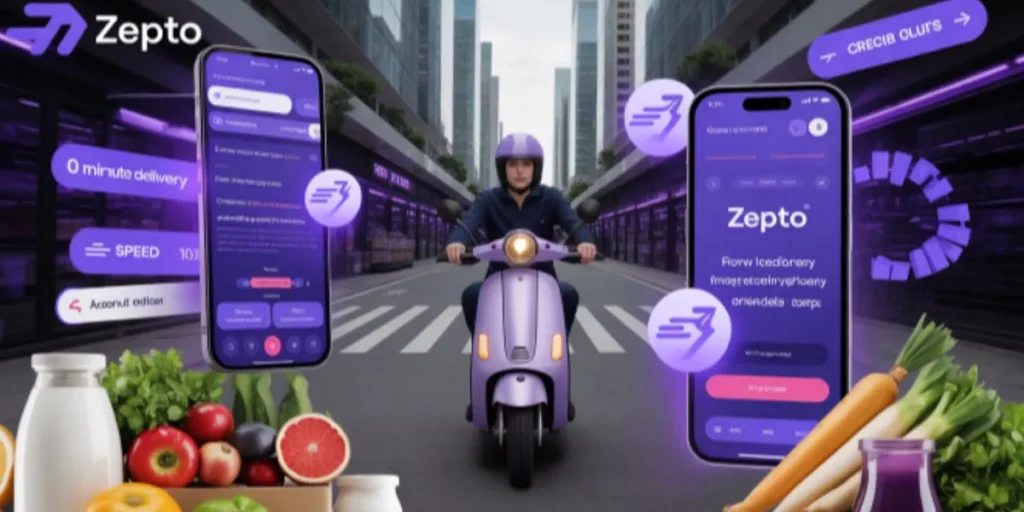
Zepto is one of the greatest startup stories in India, and it only began in 2021.
It was founded by Aadit Palicha and Kaivalya Vohra, two childhood friends who were studying computer science at Stanford University, US. When the pandemic struck in the form of COVID-19, and classes went online, they returned to India. Frustrated with the amount of time it took to deliver their Weekly Boxes from the grocery store, they had an idea that was simple yet straightforward: what if groceries could take 10 minutes to reach you? This idea eventually became a core part of the “Zepto vs Blinkit” rivalry we see today.
They started small. Literally a WhatsApp group to provide their neighbours in Mumbai with fast delivery of groceries. That small experiment developed into one of the largest startups in India.
They dropped out of Stanford and put together a network of dark stores and launched Zepto in April 2021. By the year 2023, they will become a unicorn (valued at over $1 billion). By the end of 2024, Zepto’s franchise cost valuation stood at $5 billion, and it had received more than $1.95 billion in total funding.
Today, Zepto has 550+ dark stores in 35 cities in India. It processes about 1.7 million orders daily. The app is known for its clean design, fast delivery (often less than 10 minutes) and great focus on freshness, particularly for fruits and vegetables.
Zepto has also expanded beyond groceries. It now boasts in medicines, beauty products, and electronics. Zepto Cafe, its new vertical, even delivers freshly made food and beverages in a short amount of time.
Key facts about Zepto:
- Founded: April 2021
- Founders: Aadit Palicha and Kaivalya Vohra (Founders are Stanford Dropouts)
- Valuation: $5 billion (2024)
- Daily orders: ~1.7 million
- Dark stores: 550+
- Cities: ~35
- App Rating: 4.7/5 (23.9 lakh reviews)
- Headquartered in Bengaluru
What is Blinkit?
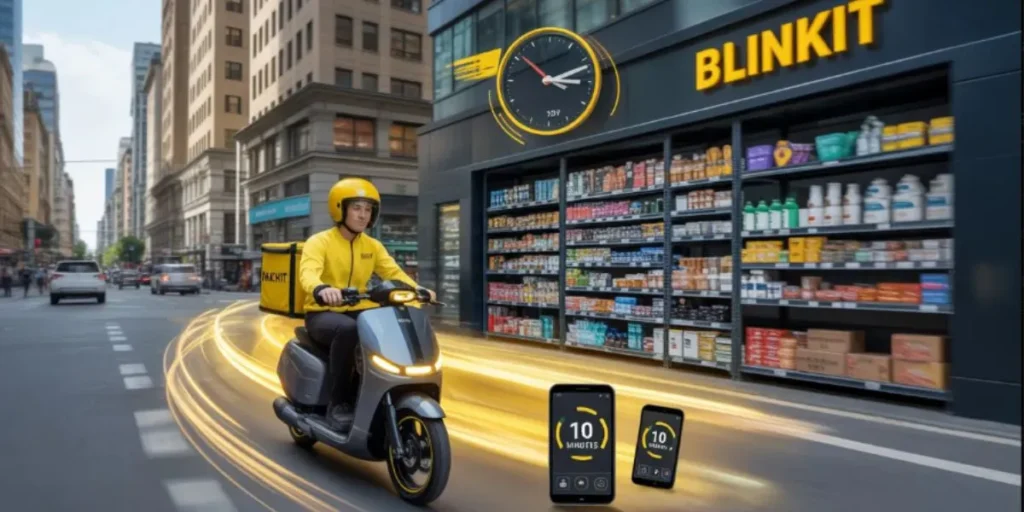
The story of Blinkit is much older, to the point of 2013. It started life as Grofers, which was founded by Albinder Dhindsa and Saurabh Kumar, both IIT graduates. Grofers was a scheduled grocery delivery service originally. You’d put out a list and put out a big order and get it in a day or two. It attracted funds from mega investors such as SoftBank, Tiger Global, and Sequoia Capital to the tune of $1 billion.
But with changes in consumer behaviour and fast delivery becoming the new norm, Grofers took a bold turn. The company rebranded itself as Blinkit on December 13, 2021, promising to deliver “in the blink of an eye.” It was not just a new name. The whole business model was reworked around 10-minute delivery with the dark stores, placing it directly in the Zepto vs Blinkit competition zone.
Then there was a game-changing time. In June 2022, Zomato, India’s biggest food delivery platform, acquired Blinkit for $568 million. This gave Blinkit huge financial support, Zomato’s delivery network and a massive customer base overnight.
Today, Blinkit is present in 153+ cities of India and has a network of 700+ dark stores and 2000+ dark stores planned for them. It is now owned by Eternal Ltd (formerly Zomato) and its valuation is soaring to $13 billion, as estimated by Goldman Sachs.
Key facts about Blinkit:
- Founded: December 2013 (as Grofers)
- Founders: Albinder Dhindsa and Saurabh Kumar IIT (Graduates)
- Now rebranded to Blinkit: December 2021
- Acquired by Zomato: June 2022 ($568m)
- Current valuation: ~$13 billion
- Cities: 153+
- Dark stores: 700+ (targeting 2,000)
- App Rating: 4.5/5 (22.3 lakh reviews)
- Headquartered in: Gurgaon
Zepto vs Blinkit: Key Differences
Now let’s see what is really important when you are considering these two apps.
1. Delivery Speed
This is where Zepto wins out much of the time. In most metro cities, Zepto delivers in 8 to 10 minutes on average. The app’s real-time tracking is also pretty accurate, you get to see where your rider is going in real-time.This speed advantage is a major factor in the Zepto vs Blinkit discussion.
Blinkit’s average delivery time is 10-20 minutes, depending on which area you live in, and what time of day it is. During the high hours such as evening hours or weekend hours, delivery time can sometimes take longer. That said, Blinkit’s delivery is very consistent and very rarely misses orders altogether.
Winner: Zepto (faster in metro some more cities)
2. City Availability
Blinkit wins this one easily. It operates from 153+ cities, including many Tier 2 and Tier 3 towns. If you live out of a large metro area, Blinkit is much more likely to be available in your area.
Zepto is working on ~35 major cities currently, mostly metros such as Mumbai, Delhi, Bengaluru, Hyderabad, Chennai, Pune, etc. It follows a “density-first” approach, take over the top cities before expanding elsewhere.This strategy shapes how the Zepto vs Blinkit battle plays out in terms of reach and expansion.
Winner: Blinkit (far more wide reaching)
3. Product Range
Blinkit has a wider catalogue. Beyond the particulars of groceries, you can order electronics, chargers, toys, beauty products, medicine, pet food, flowers and even party supplies, all from one cart. It has really put itself in the shoes of a “one-stop shop” for daily needs.This gives Blinkit a clear advantage in the Zepto vs Blinkit product range comparison.
Zepto has also grown very large in range. It stocks 45,000+ SKUs (types of products) and has penetrated pharmacy and beauty categories. But Blinkit still has an edge on sheer variety.
Winner: Blinkit (more product categories)
4. App Experience
Zepto’s app is clean, minimalist and fast. It is designed for one thing, getting your order placed in seconds. It is a quick and predictive search. With a 4.7/5 rating from 23.9 lakhs users it is the most rated quick commerce app in India.
Blinkit’s app is good too. It is visually neat and works well with the Zomato app. It rates 4.5/5 from 22.3 lakh reviews. It displays offers and product categories well and the combined experience will be familiar to Zomato users.
Winner: Zepto (little better of an app experience)
5. Freshness and Quality of Product
Zepto has made freshness part of its brand identity. It is especially lauded for the quality of the fruits, vegetables and dairy it produces. Many users claim this to be the primary reason why they stick with Zepto over Blinkit and this becomes a major deciding factor in the Zepto vs Blinkit comparison.
Blinkit also has good quality standards, but freshness is not its best differentiator like it is for Zepto.
Winner: Zepto (for fresh produce especially).
6. Platform fees and Additional Charges
This is where things get interesting though. In late 2025, Zepto made a strong move, it removed all handling, surge and convenience fees across its platform:
- Free delivery for all the orders above the price of Rs 99
- Only delivery fee of Rs30 for orders below Rs99
- Zero handling or rain or surge charges, period
- Blinkit is also using surge pricing in case of rains in the evening, festivals or high demand periods. Zepto no longer does this.
Winner: Zepto (cleaner, less fee structure)
Zepto vs Blinkit Market Share
Here is where Blinkit is obviously the market leader.
According to the data from Reuters, citing Datum Intelligence, as of January 2026:
- Blinkit: ~40-45% market share
- Swiggy Instamart: ~20-25% market share
- Zepto: ~20-25% market share
But here is the exciting part -Zepto has grown incredibly fast. In 2022, it had barely 15% market share. By early 2024, that had increased to around 29%. It has settled around 22% now as Blinkit pushed aggressively with more dark stores and city expansion.
On the financial side:
- Blinkit’s GOV (Gross Order Value): Rs. 9,421 crore in Q4 of FY25, which is a 134% increase year on year
- Zepto’s annualised GOV: Estimated to be around Rs.24,500 Crores ($3 billion)
- Zepto’s FY25 Revenue: 11,110 crore, 150% Year on Year
Both are growing at breathtaking rates. Blinkit is the market share leader. Zepto leads according to some metrics of revenue growth. The competition is fierce, and it is great news for customers.
Zepto vs Blinkit Profitability
Both companies are spending a lot to grow, which means neither is completely profitable yet. But here is how they compare:
- Blinkit is leading the way in the profitability road. It went adjusted EBITDA positive in March 2024, that is, its core operations are making more money than they cost in established markets. Its revenue in Q4 of the fiscal year 2025 was Rs. 1709 crores, which is 122% year on year.
- Zepto has also made good progress. CEO Aadit Palicha has confirmed that more than 70% of Zepto’s individual stores are EBITDA positive, meaning the majority of the stores are making money on their own. The company-level losses are due to Zepto’s continued opening of new stores and expansion expenditures. It also expects to go for an IPO, which means that its financials are getting tighter and more disciplined.
Quick commerce is costly to operate. Dark stores, last-mile delivery, etc., cost money, and customer discounting. But as the orders increase, the cost per order decreases. Both Blinkit and Zepto believe that scale will, in due course, lead to good profitability.
Verdict: Blinkit is closer to hitting full profitability. Zepto is scaling rapidly using healthy store-level economics.
Zepto vs Blinkit vs Instamart, Who’s Better?
Since Zepto and Blinkit, we’re comparing, let’s quickly bring Swiggy Instamart in the picture too.
Swiggy Instamart’s market share is around 24% and is available in 580+ cities, the widest reach among the three. It is built into the main Swiggy app, which is great if you already use Swiggy for food delivery. Its app is rated 4.5/5. However, delivery times can be ever so slightly longer, and the combined food+grocery app is slightly cluttered.
Here is a simple guide:
- And if you’re in a major metro and looking for the fastest delivery, freshest produce, cleanest app and zero extra fees, choose Zepto.
- Choose Blinkit if you want the broadest product range, live in a Tier 2 city or you are already a Zomato user wanting everything in one eco-system.
- Choose Instamart if you’re in a smaller city, love Swiggy, or want the most city coverage in India.
For pure grocery delivery in big cities, you ask? It’s a close competition between Zepto and Blinkit. But for most people who use the metro on a daily basis, Zepto leads on app experience and speed, while Blinkit takes the lead on reach and variety.
Which is Cheaper, Zepto Or Blinkit?
This is one of the most googled questions about these two apps, and the honest answer is: it depends on what you order, and how often. For the actual product prices, milk, bread, vegetables, and snacks, the difference between the two apps is usually a few rupees. Barely noticeable.
Where the real difference in Zepto vs Blinkit is noticeable is in additional fees:
- Zepto: No handling fees, no surge fees, no convenience fees. Free delivery above ₹99. Rs. 30 flat delivery charges for orders less than Rs. 99
- Blinkit: Handling charges are Rs 4 for all orders. 30 for delivery for orders less than 199 INR, and a 20 INR cart fee for very small orders. Surge fees during peak hours.
- So, for a small order below Rs. 99, Blinkit charges up to Rs. 54 of extra charges, and Zepto charges Rs. 30. Over time, and particularly with small orders coming in on a frequent basis, that makes a difference.
Also, Blinkit is known to practice surge pricing on rainy days or festival days. Zepto has publicly pledged not to have any surge fees of any sort.
Overall verdict: Zepto is generally cheaper, particularly for small or frequent orders.
Which Came First – Zepto or Blinkit?
The obvious answer is Blinkit, but it was not always called that.
Blinkit (as Grofers) was founded in Dec 2013 by Albinder Dhindsa and Saurabh Kumar. So, as a company, it is more than a decade old.
Zepto was established in 2021 by Aadit Palicha and Kaivalya Vohra. However, Grofers did not acquire Blinkit until December 2021, the same year Zepto launched, and started in the 10-minute delivery race then. So, in terms of the race of quick commerce, specifically, both jumped in around the same time. Grofers had spent years doing scheduled grocery delivery before that.
Even though Zepto is a much younger company, it has grown to almost on par with Blinkit in a number of metro cities, which tells you a lot about how well-built the Zepto vs Blinkit competitive model really is.
Pros and Cons
Zepto – Pros and Cons
Pros:
- Fastest delivery in metro cities, often below 10 minutes
- Highest rated quick commerce app in india 4.7/5
- Zero handling/surge/convenience fees
- Strong focus on the quality of fresh produce
- Cons:
- Available in cities (less) ~35 (mostly metros)
- Smaller dark store network than Blinkit
- Still in the process of becoming profitable at a company level
- Product variety not as wide as Blinkit
Blinkit – Pros and Cons
Pros:
- Widest city coverage (153+ cities)
- Largest product range (groceries, electronics, gifts, beauty and more)
- Strong financial support from Eternal Ltd (formerly Zomato)
- Largest market share (~48%)
Cons:
- Additional charges (₹4 handling fee small cart fee surge during peak hours)
- Delivery Slightly slower than Zepto during busy times
- App experience somewhat lower rate (4.5/5 vs Zepto’s 4.7/5)
Which App is Better than Zepto?
If you’re looking for something better than Zepto for quick grocery delivery in metro cities, it honestly isn’t much better than it was when it comes to speed and app experience right now.
But here is where you may want to get a different app:
- Blinkit, if you need a more diverse product range, live outside a major metro area, or you want to purchase groceries and other products such as electronics, gifts, etc. in a single order. Blinkit’s ecosystem is very powerful.
- Swiggy Instamart, if you are from a smaller town or already using Swiggy for food delivery. With 580+ Cities, Instamart has the widest reach in India.
- BigBasket, if you want to plan your week’s groceries at a go. BigBasket is not as fast, but has a massive product catalog, subscription (BB Daily for milk and bread every morning) and great prices on bulk orders.
So, depending upon your need, different apps win. But for quick, below 10-minute delivery of groceries in a metro city, Zepto is really hard to beat.
Final Verdict, Zepto vs Blinkit
Having performed our due diligence with all the data available here, our simple, honest verdict is:
Choose Zepto if:
- You live in a major metro (Mumbai, Delhi, Bengaluru, Hyderabad, Chennai, Pune, etc.);
- Speed is your number one priority, you want groceries within 10 minutes
- You hate having to pay extra fees and want to have transparent pricing
- You are interested in fresh fruits and vegetables
Choose Blinkit if:
- You don’t live in a Tier 2 or Tier 3 city where Zepto doesn’t operate
- You want to order more than just groceries, electronics, gifts etc
- You are already a user of Zomato and want everything in one connected app
- You want the most reliable, biggest network with the biggest market share
- You have to have consistent availability in more parts of India
The smartest move? Install both. Use Zepto if you need to get around the city at the speed of lightning. Use Blinkit for variety, or if you’re in a city Zepto doesn’t cover. There is no rule that says that you can only use one.
The competition between these two is great for all of us, it means better service, lower fees and more options for products over time.
Conclusion
India’s quick commerce revolution is among the most thrilling things occurring in the country’s economy at this moment. From a $300 million market in 2022 to a projected $35 billion by 2030, the number of years of growth is genuinely staggering. And Zepto vs Blinkit are at the front and centre of it.
Zepto is a speed champion, founded in 2021, built entirely for fast delivery, loved for its clean app and fresh produce quality, and now trusted by 1.7 million daily orders.
Blinkit is the market leader; they are older, large, have Zomato/Eternal as their backer, are available in 153+ cities, and are expanding to 2000 dark stores. There is no universal solution to this. Which app is best for you will depend on where you live, how often you do your grocery shopping and what you value the most: speed, variety or coverage?
But one thing is certain, be it Zepto vs Blinkit, grocery shopping in India is never going to be the same again. Ten minutes or less. That is the new normal.
Visit for More Information:
FAQs
Is Zepto faster than Blinkit?
Yes, generally. Zepto takes an average of 8 to 10 minutes per delivery in most metro cities, whereas Blinkit takes 10 to 20 minutes. Work in peak hours, Zepto is more consistent when it comes to speed.
Which is more inexpensive, Zepto or Blinkit?
Zepto is a little cheaper all things considered. It has done away with all handling fees, surge fees, and convenience fees. Blinkit still charges a handling fee of INR 4 and additional charges for small orders, which can make up to INR 54 for very small carts below INR 99.
Is Blinkit present in more cities than Zepto?
Yes, by a significant margin. Blinkit works in 153+ cities, including many Tier 2 and Tier 3 towns. Zepto serves around 35 major cities, with a focus on the top cities.
Which came first, Zepto or Blinkit?
Blinkit is older. It was started as Grofers in December 2013 and it rebranded as Blinkit in December 2021. Zepto is a relatively new company, founded in April 2021, but Blinkit is almost a decade older as a company.