If you are looking for a food franchise that does not need a massive investment, does not require cooking skills, and comes with a brand that almost every Indian family already trusts — Baskin Robbins deserves a serious look.
Since its entry into India in 1993, Baskin Robbins has quietly built one of the largest ice cream retail networks in the country. With 800+ outlets across 200+ cities, it is a brand that has scaled significantly without the kind of hype that newer food startups attract. And that quiet reliability is exactly what makes it a solid franchise opportunity.
This guide covers everything you need to know before applying — the different store formats, the real Baskin-Robbins Franchise Cost in India, what you can realistically earn, and how the application process works.
About Baskin-Robbins
Baskin-Robbins was co-founded by ice-cream enthusiasts and brothers-in-law, Burton “Burt” Baskin and Irvine “Irv” Robbins in 1945 in Glendale, California. Irvine Robbins scooped ice-creams in his father’s ice-cream shop in his teen years, whereas Burton Baskin served in the army, where he became well-versed in the art of making ice-cream. Burton Baskin served his delicious ice-cream scoops to his fellow U.S. Navy troops during World War II.
The brothers-in-law merged their names together, upon Burt’s return from the war, to convert their dream of establishing a family-friendly ice-cream parlour into a reality, and Baskin-Robbins came into being. They began experimenting with new flavours and ingredients in 1949 after purchasing their first dairy production factory in Burbank, California.
In 1953, after merging their shops to give birth to “Baskin-Robbins Ice Cream”, they brought the unique concept of 31 different flavours for 31 days of the month into play. Baskin-Robbins has since then been on an exceptional roll and currently has over 8,000 outlets in around 52 countries. The customer count every year exceeds 300 million globally.
Launch of Baskin-Robbins in India
Baskin-Robbins was brought to India in 1993, and since then has managed to capture every Indian’s heart.
Baskin-Robbins was introduced to India through a joint venture with the esteemed Graviss Group which was founded by I.K. Ghai in 1945 and is a pioneer in the F&B industry in India. The group owns and manages Baskin-Robbins in India alongside other brands like The Brooklyn Creamery, Mayfair Banquets, The InterContinental Hotel on Marine Drive, Zaffran etc.
Baskin-Robbins acquires more than 800 exclusive outlets in India in over 230 cities.
Why Baskin Robbins is a Smart Franchise Choice in 2026
India’s ice cream market is growing steadily and is projected to reach ₹43,600 crore by 2026, driven by rising incomes, changing consumption habits, and rapid urbanisation in Tier 2 and Tier 3 cities. Within this market, Baskin Robbins has a distinct advantage:
- 30+ years of local presence: First launched in India in 1993, the brand has over three decades of market presence and consumer trust
- Strong backend infrastructure: Operated through Graviss Foods, which manages manufacturing (at their Pune plant), supply chain, and quality across all outlets
- 100% vegetarian product range: All Baskin Robbins products in India are 100% vegetarian, made with natural ingredients and cow milk — a significant advantage given India’s consumer demographics
- Massive flavour variety: With 1,000+ flavours in its global bank and a rotating ‘flavour of the month’ model, there is always something new to offer
- Year-round demand: Ice cream is not just a summer product in India anymore — festival gifting, birthday parties, and casual outings keep demand steady year-round
- Low operational complexity: Compared to full-service restaurant franchises, an ice cream parlour requires fewer staff, simpler operations, and no complex cooking
- Tech-enabled growth: Digitally-enabled Baskin Robbins stores have seen a 23% increase in average purchase size, driven by POS integration and online ordering
Baskin Robbins Franchise Models Available in India
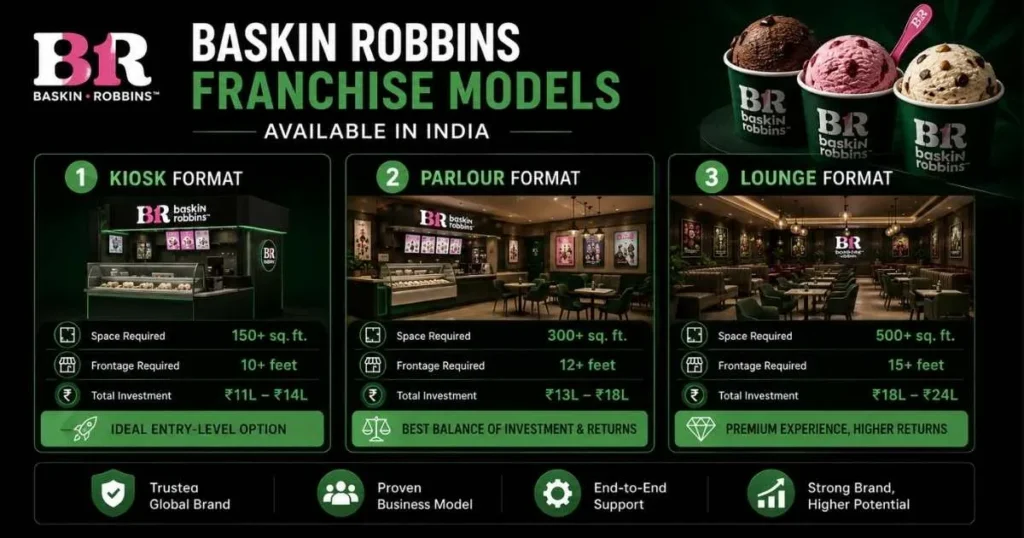
One of the strongest features of the Baskin Robbins franchise system is its flexibility. There are three distinct formats, so you can start with what matches your budget and space:
1. Kiosk Format
This is the entry-level option and ideal for first-time entrepreneurs or those looking to test the market before committing to a larger investment. A kiosk is a compact, front-open cubicle format that can be placed in malls, high streets, or commercial complexes.
- Space required: Minimum 150 sq. ft.
- Frontage requirement: Minimum 10 feet
- Total investment: ₹11 Lakhs to ₹14 Lakhs
The kiosk format is an excellent way to enter the market, build operational experience, and generate early revenue without a large capital outlay.
2. Parlour Format
The parlour is the most common Baskin Robbins outlet type you will see across Indian cities. It includes a small preparation area and seating for customers, creating a proper ice cream parlour experience.
- Space required: Minimum 300 sq. ft.
- Frontage requirement: Minimum 12 feet
- Total investment: ₹13 Lakhs to ₹18 Lakhs
The parlour format strikes the best balance between investment and revenue potential for most Indian markets, including Tier 2 cities.
3. Lounge Format
The lounge is the premium Baskin Robbins format — a larger space with a full seating area, designed for a sit-down dessert experience. It works well in premium malls, busy commercial areas, and high-income residential neighbourhoods.
- Space required: Minimum 500 sq. ft.
- Frontage requirement: Minimum 15 feet
- Total investment: ₹18 Lakhs to ₹24 Lakhs
If you have a larger space and a premium catchment area, the lounge format offers the highest revenue potential within the Baskin Robbins system.
Baskin-Robbins Franchise Cost in India: Complete Cost Breakdown 2026
Here is a detailed look at where your investment actually goes:
| Baskin-Robbins Franchise Cost in India(Componenets) | Kiosk | Parlour | Lounge |
| Branding Fee (One-Time) | ₹4 L – ₹5 L | ₹4 L – ₹5 L | ₹4 L – ₹5 L |
| Security Deposit | ₹50,000 | ₹50,000 | ₹50,000 |
| Interior Design & Fit-Out | ₹2 L – ₹3 L | ₹3 L – ₹5 L | ₹5 L – ₹8 L |
| Refrigeration & Equipment | ₹2 L – ₹3 L | ₹3 L – ₹5 L | ₹4 L – ₹6 L |
| Initial Inventory | ₹1 L – ₹1.5 L | ₹1 L – ₹1.5 L | ₹2 L – ₹2.5 L |
| Signage & Branding Collateral | ₹1 L – ₹1.5 L | ₹1 L – ₹1.5 L | ₹1 L – ₹2 L |
| Total (Excl. Property Cost) | ₹11 L – ₹14 L | ₹13 L – ₹18 L | ₹18 L – ₹24 L |
Important note: The above figures exclude the cost of the property itself (rent, lease deposit, or purchase). Depending on your city and location, rental costs can add ₹30,000 to ₹2 Lakhs per month to your operating expenses. Always factor this in before finalising your investment plan.
Recurring Costs
- Royalty Fee: Baskin-Robbins charges a royalty fee of approximately 5-7% of monthly gross sales.
- Operational Costs: These include salaries, utilities, and raw material procurement, typically amounting to ₹1-3 lakhs per month, depending on the outlet size.
- Marketing Contributions: Franchisees contribute a percentage of their gross sales, usually 1-2%, toward marketing efforts.
Revenue and Profit — What to Realistically Expect
This is where it gets interesting. Ice cream is a high-margin product by nature. The gross margin on ice cream products is typically 60 to 70%, and on other dessert items around 40 to 50%. After accounting for all operational expenses, Baskin Robbins franchisees typically see:
| Format | Monthly Revenue Range | Annual Revenue Range | Net Profit Margin |
| Kiosk | ₹3 L – ₹8 L | ₹36 L – ₹96 L | 20% – 30% |
| Parlour | ₹5 L – ₹15 L | ₹60 L – ₹1.8 Cr | 20% – 30% |
| Lounge | ₹8 L – ₹25 L | ₹96 L – ₹3 Cr | 20% – 25% |
Break-even for a well-managed Baskin Robbins outlet typically happens within 18 to 24 months. Annual ROI for strong-performing locations falls between 25% and 35%. These are not guaranteed figures — location quality, operational efficiency, and seasonal demand all play a role.
Seasonal Revenue Pattern
Summer months (March through June) are peak season and can account for 35 to 40% of annual sales. However, the festive season (October through December) has grown significantly as a revenue period due to gifting, parties, and celebrations. This means Baskin Robbins has a more even revenue distribution than many assume.
Tier 2 and Tier 3 cities are showing a 16.3% year-on-year growth rate for Baskin Robbins outlets, making them the fastest-growing market segment for the brand.
Eligibility Requirements for a Baskin Robbins Franchise
Baskin Robbins does not require prior food industry experience, which makes it accessible to first-time entrepreneurs. However, there are some basic eligibility criteria:
- Financial capacity: Ability to invest the full setup amount without relying entirely on borrowed funds
- Property access: A suitable commercial space in a high-footfall area, either owned or with a long-term lease
- Operational interest: You will be managing staff and daily operations, so a basic understanding of business management helps
- Brand compliance willingness: Baskin Robbins requires franchisees to commit to operational standards, hygiene, and brand guidelines
- Social references: At least two social/professional references are required during the application
Documents Required for the Franchise Application
When you apply, you will need to submit the following documents:
- PAN Card and Aadhaar Card (individual identification)
- Proof of business address (utility bill or rental agreement)
- Bank statements (last 6 months) to demonstrate financial capacity
- Property documents (ownership proof or lease agreement for the proposed location)
- FSSAI food licence (or proof of application)
- GST registration certificate
- Two professional or social references
- Recent passport-size photographs
How to Apply for a Baskin-Robbins Franchise in India
- Visit baskinrobbinsindia.com and go to the Franchise section.
- Fill out the franchise enquiry form with your name, contact details, city, preferred outlet format, and investment capacity.
- A Baskin Robbins franchise development team member will contact you within 5 to 7 working days to discuss your application.
- Initial screening discussion over phone or video call — they will ask about your location, investment readiness, and business background.
- Face-to-face meeting with the franchise team to discuss the format, location, and support structure in detail.
- Location inspection and approval by the Baskin Robbins team.
- Document submission and financial verification.
- Signing of the franchise agreement and payment of the branding fee and security deposit.
- Store design, fit-out, and staff hiring (with Baskin Robbins providing design guidelines and operational support).
- Grand opening with marketing support. Store is typically operational within 45 to 60 days of agreement signing.
What Support Does Baskin Robbins Provide to Franchisees?
One of the reasons Baskin Robbins has retained franchisee loyalty for decades is the support structure it offers. Here is what you get as a franchisee:
Operational Support
The Graviss Foods team (Baskin Robbins’ Indian master franchisee) provides ongoing operational guidance, including store management best practices, inventory management systems, and quality control protocols.
Interior and Design Guidance
Baskin Robbins provides detailed guidelines and support for store interior design, ensuring brand consistency while allowing for some local adaptations.
Cold Chain and Supply Chain
All Baskin Robbins products are manufactured at the brand’s Pune facility and distributed through a temperature-controlled supply chain. You do not need to worry about sourcing ingredients or managing complex supply relationships.
Staff Training
The company provides initial staff training covering product knowledge, service standards, hygiene practices, and daily operations. Ongoing training updates are also provided.
Marketing and Advertising
Both national and local marketing programmes are run by Baskin Robbins India. As a franchisee, you benefit from the brand’s nationwide advertising campaigns, seasonal promotions, and social media presence.
Baskin Robbins vs. Other Ice Cream Franchises in India
| Brand | Investment Range | Formats Available | Royalty | Break-Even |
| Baskin Robbins | ₹11 L – ₹24 L | Kiosk / Parlour / Lounge | Low % on sales | 18–24 months |
| Naturals Ice Cream | ₹20 L – ₹40 L | Store only | Varies | 24–36 months |
| Giani’s | ₹15 L – ₹30 L | Outlet only | Varies | 18–30 months |
| Kwality Wall’s | ₹5 L – ₹15 L | Parlour / Cart | Varies | 12–24 months |
| Havmor | ₹15 L – ₹30 L | Parlour / Lounge | Varies | 18–30 months |
Baskin Robbins stands out in this comparison for its combination of global brand recognition, low investment entry (with the kiosk model), and a proven 30+ year track record in the Indian market.
Funding Your Baskin Robbins Franchise
For most investors, a mix of personal savings and external funding works best. Here are your main options:
- Personal savings: Aim to fund 40 to 50% of the total investment from personal savings to reduce interest burden
- Business loans: Since Baskin Robbins is a Tier-1 established brand, banks are generally willing to extend business loans to its franchisees
- Government schemes (Mudra Loan): For kiosk-format investments under ₹10 Lakhs, the Pradhan Mantri Mudra Yojana (PMMY) scheme offers collateral-free loans
- NBFCs: Non-Banking Financial Companies often process loans faster than traditional banks and may have more flexible eligibility criteria
Conclusion: Is it worth an Investment?
Baskin Robbins is one of the rare franchise opportunities that combines global brand strength, a genuinely accessible investment range, operational simplicity (no cooking required), and a product with year-round demand in India. The 100% vegetarian menu, the deep cold chain infrastructure through Graviss Foods, and the company’s active expansion into Tier 2 cities all add up to a strong opportunity for 2026.
If you have a good location, a realistic investment budget, and the discipline to run daily operations well, a Baskin Robbins franchise gives you a meaningful competitive advantage from day one. The brand does the heavy lifting on awareness and product development. Your job is to pick the right spot and run an excellent store.
In a market where the ice cream category is growing fast and premium dessert culture is becoming mainstream even outside metro cities, that combination is a solid foundation for a profitable business.
Similar Blogs:
FAQs
What is the minimum investment for a Baskin Robbins franchise in India?
The minimum investment starts at ₹11 Lakhs for a Kiosk format, excluding property rental costs. This makes it one of the more accessible premium international food franchises in India.
Is the franchise fee refundable?
No. The branding fee paid to Baskin Robbins is a one-time, non-refundable fee. The security deposit of ₹50,000 may be refundable upon completion of the franchise term, subject to conditions.
How long does it take to open after signing the agreement?
Typically 45 to 60 days after the agreement is signed, depending on how quickly the store fit-out is completed and local licences are obtained.
Can I own multiple Baskin Robbins outlets?
Absolutely. Baskin Robbins actively encourages multi-unit ownership. Several franchisees in India own 5 to 20+ outlets. The company provides dedicated support for multi-location operators.
Is a Baskin Robbins franchise profitable in Tier 2 cities?
Yes — and this is one of the brand’s biggest growth stories right now. Tier 2 and Tier 3 cities are showing 16.3% year-on-year growth for Baskin Robbins outlets. Lower rent costs and a growing middle class make these markets particularly attractive.
Do I need prior food business experience?
No prior food industry experience is required. Basic business management skills are helpful, but the brand’s training and support system is designed to bring in first-time entrepreneurs successfully.