This growth is driven by changing consumer preferences, increasing urbanization, rising disposable incomes, and the rapid expansion of online food delivery, all of which are fueling demand for convenient and affordable food options. As a result, India’s QSR market has reached around $30 billion in 2026 and is expected to grow steadily at 8–10% annually, crossing $45 billion by 2030–31. Amid this expansion, food franchises have become an attractive opportunity for business entrepreneurs.
Samosa Singh is one of the fastest-growing food franchises in this booming market. It reinvents traditional samosas with innovative flavors and consistent product quality. Launched in 2016 by founders Shikhar Veer Singh and Nidhi Singh, the brand quickly expanded to multiple locations across India, backed by venture capital investments from major firms.
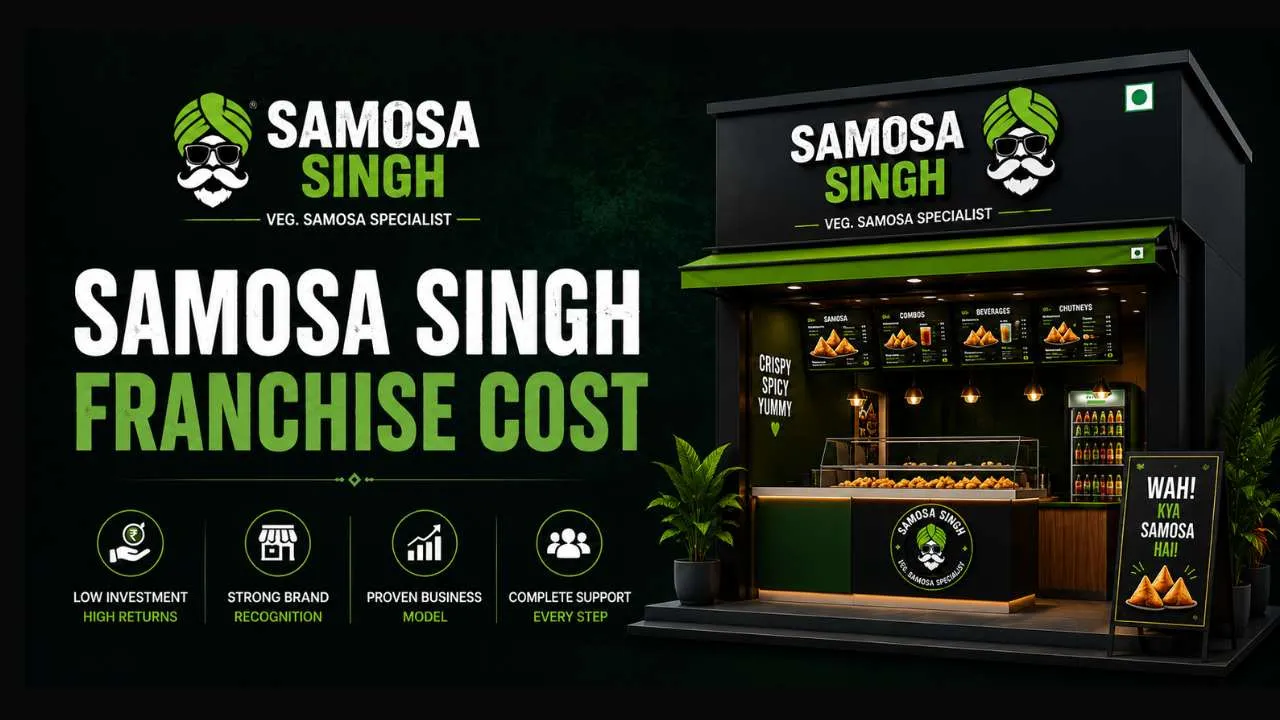
Understanding the Samosa Singh Franchise Cost, investment requirements, ongoing expenses, and earning potential is crucial for aspiring franchise partners. This guide provides comprehensive insights into Samosa Singh’s franchising process, offering a roadmap for entrepreneurs looking to join one of India’s most promising QSR brands.
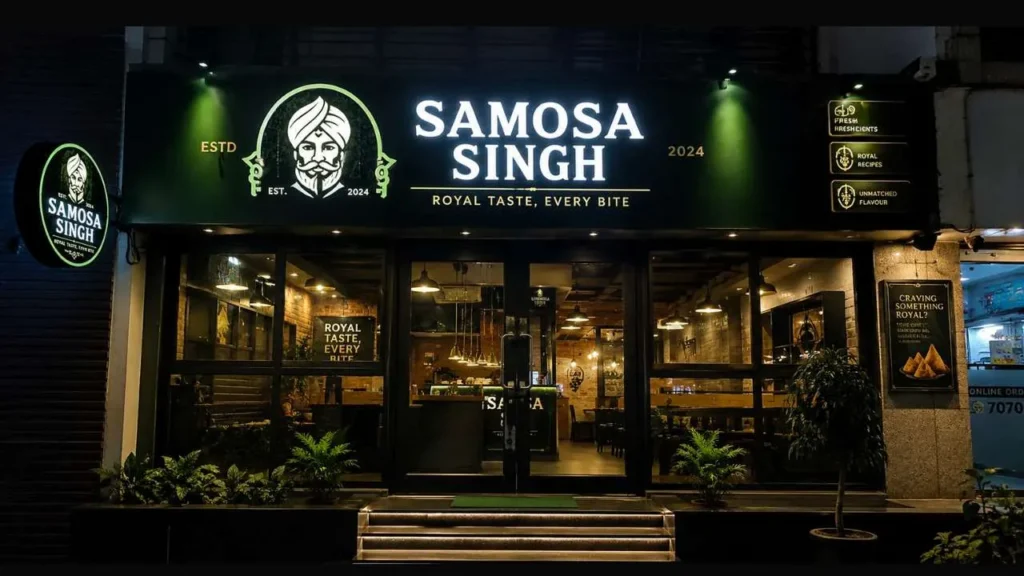
About the Samosa Singh Brand
| Category | Details |
| Founders | Shikhar Veer Singh and Nidhi Singh |
| Founded In | 2015 (Operations began in 2016) |
| Corporate Entity | Woknstove Foodworks Private Limited |
| Products Offered | Variety of innovative samosas (Masala Corn, Kadai Paneer, Chocolate, Pizza Samosas), chaats, kachoris, pav meals, desserts, and traditional beverages. |
| Number of Franchises | 60+ Outlets across 8+ major cities |
| Annual Revenue Base | ₹45 Crores+ |
| Franchise Cost (2026) | ₹15 Lakhs – ₹40 Lakhs (Varies by outlet format) |
| Royalty Fee | 5% – 7% of Monthly Net Sales |
| Space Requirement | 100 sq. ft. to 1200 sq. ft. depending on the model |
| Target Audience | Primarily urban working professionals, college students, malls goers, and families |
Samosa Singh was founded in 2015 and commercially launched in February 2016 by co-founders Shikhar Veer Singh and Nidhi Singh. The couple left their successful careers at Biocon and the IT sector, investing their personal savings and selling assets to build the brand with a vision to transform India’s traditional street snack into a hygienic and premium food experience.
The company introduced innovative interlocked triangular samosas using advanced low-oil cooking technology, reducing fat by 56% and lowering calorie content by 32% to 43% compared to regular street samosas.
Its central manufacturing facility can produce up to 1 lakh samosas daily, using blast-freezing technology to maintain hygiene, consistency, and flavor across outlets.
Today brand currently runs 50+ outlets across 25+ cities and is growing quickly across India. Its samosas are made using advanced cooking methods that reduce fat by up to 56%, making them a healthier option than regular street samosas.
The company has a large central kitchen that can produce up to 1 lakh samosas every day, helping maintain quality and hygiene across all outlets. Samosa Singh offers different franchise models, with investment starting from ₹5 lakh and going up to ₹20 lakh+, depending on the outlet type. Popular locations include malls, busy markets, and transit hubs, with expected returns usually within 14–18 months. With strong customer demand and rapid expansion plans, Samosa Singh is becoming a fast-growing food franchise opportunity in India for 2026.
Why Choose the Samosa Singh Franchise?
1. Reputed Brand Name
Samosa Singh has created its niche within the Indian snacking market. The brand’s quality and innovation ensure that customers stick around, and thus, business will follow the franchisee more effortlessly.
2. Variety Menu
The brand doesn’t sell just samosas; the menu includes other snacking items like kachories, chaat, drinks, and sweets. This variety draws a larger audience and retains good footfalls.
Samosas & Kachori
- Soya Keema Samosa
- Veggie Spice Samosa
- Kadai Paneer Samosa
- Masala Corn Samosa
- Cheese Chilli Samosa
- Manchurian Samosa
- Cheese n Corn Samosa
- Punjabi Aloo Samosa
- Aloo Pyaaz Kachori
- Dal Kachori
- Make Your Own Bucket
- Onion Samosa
- Achaari Paneer Samosa
All Day Breakfast
- Vada Pav
- Aloo Tikki Pav
- Aaloo Samosa Pav
Chaat
- Samosa Chole Chaat
- Tikki Chole Chaat
- Ragada Pateez
- Dahi Bhalla
- Dahi Papdi Chaat
- Aloo Pyaaz Kachori Chole Chaat
- Dahi Samosa Chaat
- Bhalla Papdi Chaat
- Pyaaz Kachori Dahi Chaat
Mini Meals
- Pav Bhaji
- Chole Kulcha
- Dal Kachori & Aaloo Subzi
- Chole Bhature
- Mattar Kulcha
- Chatpata Aloo Kulcha
- Paneer Kulcha
Desserts
- Gulab Jamun
- Moong Dal Halwa
- Rabri
- Rasmalai
3. Business Model Set Well
Samosa Singh operates on a franchise-friendly business model with standardized processes, including efficient supply chain management, to avoid probable risks for franchisees and smooth operations.
4. Low Franchise Cost
Even though the cost of this brand outlet at a particular location and of a specific size may differ, the Samosa Singh franchise cost is relatively low compared to that of other QSR franchises. A franchisee would typically pay an investment amount between ₹15–₹15 lakhs towards the infrastructure and equipment, training and branding, among others.
5. Support and Training
Extensive training programs, operational support, and marketing assistance deliver a brand that enables first-time entrepreneurs to be successful.
6. High ROI Potential
Rising demand for branded snacks and competitive pricing at the Samosa Singh franchise will provide a healthy return in a few years.
Samosa Singh Franchise Models (2026)
Samosa Singh offers flexible business formats to match varied investor budgets, spatial availability, and regional market demands.
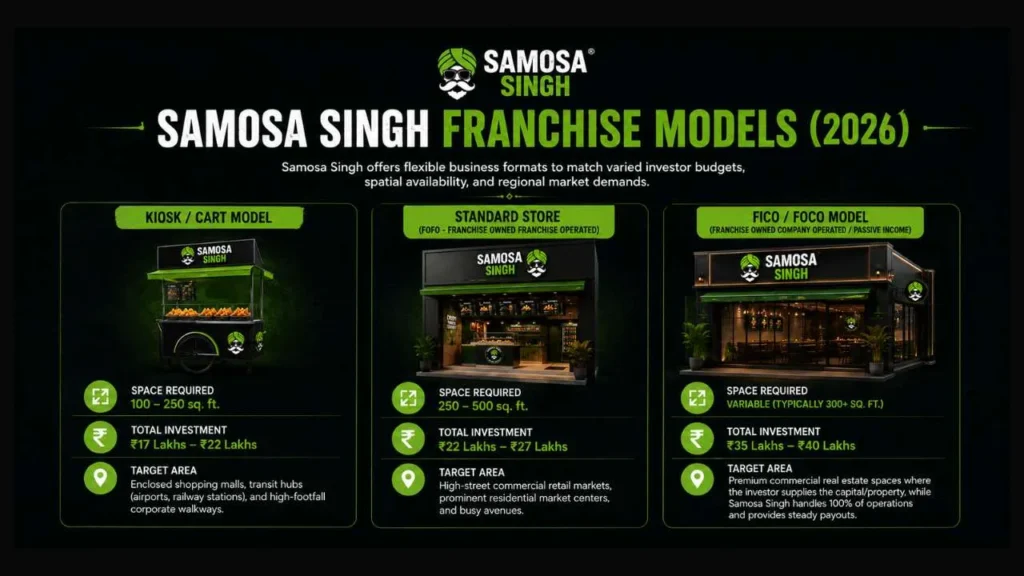
Kiosk / Cart Model
- Space Required: 100 – 250 sq. ft.
- Total Investment: ₹17 Lakhs – ₹22 Lakhs
- Target Area: Enclosed shopping malls, transit hubs (airports, railway stations), and high-footfall corporate walkways.
Standard Store (FOFO – Franchise Owned Franchise Operated)
- Space Required: 250 – 500 sq. ft.
- Total Investment: ₹22 Lakhs – ₹27 Lakhs
- Target Area: High-street commercial retail markets, prominent residential market centers, and busy avenues.
FICO / FOCO Model (Franchise Owned Company Operated / Passive Income)
- Space Required: Variable (Typically 300+ sq. ft.)
- Total Investment: ₹35 Lakhs – ₹40 Lakhs
- Target Area: Premium commercial real estate spaces where the investor supplies the capital/property, while Samosa Singh handles 100% of the day-to-day operations and provides steady payouts.
Samosa Singh Franchise Cost Breakdown
All prospective entrepreneurs who want to start a Samosa Singh franchise must understand the complete cost structure to establish proper financial strategies. Here’s a comprehensive breakdown:
Table Breakdown:
| Component | Estimated Cost (INR) |
| Franchise Fee | ₹4,00,000 |
| Interior & Furnishing | ₹5,00,000 |
| Kitchen Equipment & Machinery | ₹4,00,000 |
| Licenses & Marketing | ₹50,000 |
| Raw Materials (Initial) | ₹50,000 |
| Staff Training & Other Exp. | ₹2,00,000 |
| Total Project Cost | ₹15,00,000 – ₹22,00,000 |
Disclaimer: The figures mentioned are approximate and based on typical startup costs. GST (18%) and property security advances are extra.
Franchise Fee: The franchise fee requires a payment of ₹4 lakhs where the fee remains non-refundable and provides brand rights and initial business support.
Store Setup Costs:
- Kiosk format (100-150 sq ft): ₹6-8 lakhs
- QSR format (300-500 sq ft): ₹10-12 lakhs
- Cloud kitchen model: ₹8-10 lakhs
Equipment Investment: The equipment expense for Samosa Singh franchise operations amounts to ₹3-4 lakhs, which covers commercial deep fryers, refrigeration units, storage equipment, and POS systems.
Interior and Branding: The costs for interior and branding range from ₹5-7 lakhs but differ depending on the location and selected store format.
Legal and Licensing: ₹50,000-1 lakh (FSSAI registration, local municipal permissions, GST registration)
Initial Inventory: The initial inventory for raw materials, packaging materials, and consumables amounts to ₹75,000 to ₹1 lakh.
Working Capital: Working Capital should amount to ₹3-4 lakhs because it ensures operational stability during the initial three months.
Royalty Fee: 6-8% of monthly gross sales (ongoing)
Marketing Fee: The Marketing Fee consists of a 2-3% percentage fee that is applied to monthly gross sales for national and regional marketing campaigns.
The total investment costs for a Dairy Cake House franchise range from ₹ 15 to 22 lakhs and depend on the business site selection, format type, and market characteristics. Metro locations with prime positions require extra initial capital investment, yet they deliver elevated sales amounts. Bank loans and specific funding programs through the franchisor provide financing options to eligible applicants.
Samosa Singh Franchise Profit Per Month
Operating a Samosa Singh franchise has its merits, and is a potentially profitable business, thanks to its robust supply chain and consumer appeal. An outlet with a moderate turnover can earn as mentioned below:
- Gross Margin: This franchise boasts a healthy 70% gross profit margin on most of the items, giving franchise operators immense flexibility in pricing.
- Monthly Sales: With good visibility, an outlet could potentially sell 4.2 lakhs to 5 lakhs of worth per month.
- Net Profit: Based on the overall cost management, an outlet would see a profit margin of 1.5 lakhs – 2 lakhs per month.
- EBITDA Range: The operational profit (EBITDA) typically fluctuates between 15% and 25% depending on local rent and labor costs.
- Breakeven Timeline: Most stores reach operational breakeven in 1-2 months, while capital payback comes in 12-24 months.
Sample Monthly Revenue & P&L Statement (Estimated)
To visualize how these percentages function in day-to-day operations, here is a breakdown of a standard monthly profit and loss account based on an average monthly store sales revenue of ₹4,20,000.
| Financial Component | Amount (₹) | Percentage of Revenue / Notes |
| Total Monthly Revenue | ₹4,20,000 | 100% (Baseline Sales) |
| (-) Cost of Goods Sold (COGS) | ₹1,26,000 | 30% (Food & Raw Materials) |
| (-) Commercial Property Rental Cost | ₹50,000 | Fixed Monthly Rent Estimate |
| (-) Staff Salaries | ₹35,000 | Kitchen & Service Crew Wages |
| (-) Monthly Royalty Fee | ₹21,000 | Calculated at 5% of Net Sales |
| (-) Utilities & Other Misc Expenses | ₹38,000 | Electricity, Water, Internet, & Aggregator Commissions |
| Net Monthly Profit | ₹1,50,000 | ~35.7% Net Profit Margin |
Ideal Locations
- Commercial Hubs & Office Areas: High footfall zones catering to professionals seeking quick snacks.
- Malls & Shopping Centers: Busy food courts with diverse audiences, from families to shoppers.
- Educational Institutions: Near schools/colleges for affordable, student-friendly options.
- Transit Points: Railway stations, bus terminals, and metro hubs attract travelers seeking portable snacks.
- Residential Areas: Proximity to housing complexes ensures steady demand for delivery and family snacks.
Factors to Consider
- Foot Traffic: Ensure consistent, high footfall.
- Accessibility: Easy access and parking for dine-in and takeaway customers.
- Competitor Analysis: Limited direct competition from other snack outlets.
- Target Audience: Proximity to your ideal customers (office-goers, families, students).
- Delivery Potential: Locations that support high online delivery demand.
By choosing the right location, franchise owners can maximize footfall, brand recognition, and profits.
Requirements of Samosa Singh Franchise
Before joining a franchise of Samosa Singh, you must satisfy all of the following requirements:
1. Location
To be very brief, a location that is sought after is essential for success at your outlet. Preferred locations include malls, shopping centers, high-street areas, and near educational institutions or IT hubs. It depends upon the type of outlet, which varies between 250-500 sq. ft.
2. Investment Capability
The total investment to begin a Samosa Singh franchise cost is ₹30-₹50 lakhs, which would be a total package for the franchise fee, infrastructure setup, equipment, and working capital.
Documents Required to Apply
Establishing yourself in a commercial franchise business demands rigorous legal compliance. In order to register for a Samosa Singh franchise in 2026, you will need to provide the following identity proofs and business documents as per requirements:
- Identity and Address Proofs: Copies of the Pan card, Aadhaar card, and voter ID of the interested individual.
- Registration Documents: Valid GST certification and Shop & Establishment Act license certificate applicable for the selected state.
- Certificates of Food Safety and Security: Necessary certification of Food Safety and Standards Authority of India (FSSAI) accompanied by a no-objection fire safety certificate from the local municipality office.
- Property Documents for Commercial Business Space: Proof of leasing or renting the property along with title deeds of ownership if any.
3. Passion for Food and Business
As a franchisee, the company should be interested in the food industry and willing to follow the brand’s standardized procedures.
4. Staffing and Training
Hiring the best staff by the brands with proper training ensures smooth operations and delivers true customer service.
5. Compliance
The business needs to comply with the laws of food hygiene and safety, as well as neighborhood business permits and licenses.
How to Apply for Samosa Singh Franchise
The application process is structured to ensure that only dedicated partners join the brand’s growing network. This process is as follows:
Step #1: Website Application Form
Visit the website of Samosa Singh and navigate to the ‘Franchise’ or ‘Partnership’ section of the site. You will see a basic form that asks about your background, investment capabilities and the city you plan to work in.
Step #2: Preliminary Review
Your application form will be reviewed to determine whether there is any need for more information. This is important because only those passionate about the food industry and who have the financial stability to maintain high standards get selected.
Step #3: Detailed Presentation and Financial Projections
Once you are selected, Samosa Singh sets up a detailed meeting where you will discuss all options and even sign off on the FOFO / FOCO model. It is important to know what kind of partnership works for you.
Step #4: Selection of the Right Location
The brand guides you in selecting the best possible site after thorough demographic research. After securing the land and signing the franchise agreement, all the legal and financial processes follow.
Step #5: Setting Up the Restaurant
Samosa Singh supports investors in designing kitchens and setting interiors. Training is also provided to all employees so that the restaurant operates according to global standards.
Samosa Singh Franchise Contact & Inquiry Details
To partner with India’s most scalable samosa brand, you can use the following official contact channels. These are specifically for franchise inquiries, investor relations, and business partnerships.
Official Contact Information
- Franchise Inquiry Hotline: +91 70425 98882
- Official Website: http://samosasingh.com/
Support and Training Provided by the Brand
One of the most important advantages of this franchise is that they provides full training and support to their franchisees. Here’s what you can expect from Samosa Singh as a franchisee:
1. Pre-launch Support
- They help you choose the site and its evaluation so that the outlet you take up would be at an ideal location.
- Brand standard guidance on design and infrastructure.
- Facilitates procurement of equipment, raw materials, and all kitchen essentials.
2. Complete Training
- Technical training to employees on food preparation, handling, and all aspects of service in the restaurant
- Management education for franchisees about easing their operations for profitability.
- Technology education on using POS systems and tools for managing its stock level.
3. Continual Operational Support
- Continuity in managing the supply chain for raw materials as well as packaging material
- Regular quality checks and audits to maintain standard
- Marketing and promotional activities to increase visibility and sales
4. Marketing Support
- Samosa Singh will support digital marketing, social media promotion, and local advertising to attract customer traffic.
5. Technical Support
- A dedicated team for the resolution of operational and technical issues. Such support will help first-time entrepreneurs to run a successful franchise as well.
Is Samosa Singh Franchise a Good Business Opportunity?
The Samosa Singh franchise model offers investors a favorable business opportunity requiring lower startup costs than other food franchises. The Samosa Singh Franchise Cost for establishing a Samosa Singh outlet falls between ₹15-25 lakhs, yet changes according to location choice and store dimensions as well as kiosk, QSR, or cloud kitchen format.
Various elements determine the profitability of Samosa Singh franchise businesses:
- The quality of the location drives rental costs upward because busy commercial zones enable higher sales volumes.
- Kiosks need lower initial investment, yet their capacity remains restricted.
- The level of market competition changes according to local conditions as well as customer response to pricing decisions.
- Operational efficiency and inventory management.
The financial model shows Samosa Singh franchisees reach financial stability within 1 to 1.5 years. The revenue from each Samosa Singh outlet reaches between ₹4-8 lakhs per month, while delivering profit margins of 20-25% once all operational costs have been paid. The brand’s recognition, combined with its broadening product range, enables Samosa Singh franchisees to sustain consumer engagement and repeated purchases, which supports everlasting profitability in the competitive QSR sector.
Pros & Cons of Samosa Singh Franchise Business
Pros:
- Brand Positioning: Good presence in the consumer confidence market. Having an outstanding level of market presence.
- Low Investment: The fee paid to franchises is relatively very moderate as against other quick service restaurants.
- Product Offers: New taste and hygienic preparation Differentiates the company in the market.
- Framing Support System: The company’s elaborate hand-holding helps first-time entrepreneurs run their businesses well.
- Scalability: The superior performers may multiply at different locations.
Cons:
- Highly competitive industry: The food and snack industry is one of the most competitive, especially in urban areas.
- Highly dependent on location: Success highly depends on the outlet’s location and footfall.
- Rigid operational instructions: Only as much flexibility as the outlets need to be run according to the brand’s standardized processes.
- Recurring Royalty Fees: Although these are required for support and branding, they do reduce profit margins.
Who Should Invest in This Franchise?
The Samosa Singh model is tailored for specific types of investors looking for a balance of risk and reward. Here are few category of people who should invest in this franchise:
- Passive Investors: Passive investors seeking consistent, fixed monthly income without the usual operational hassle, would be delighted to take advantage of the FOCO model which would fit their investment profile very well.
- Food Entrepreneurs: Passionate food industry professionals seeking to build a consistent and low-wastage business would be pleased to invest in the FOFO model of this franchise, enabling them hands-on business experience.
- Portfolio Diversifiers: Current business owners wanting to make a foray into the gigantic $41 Billion Indian snack industry with an established and scalable brand, will find this opportunity highly desirable.
- Real Estate Owners: Owners of high-footfall real estate property in malls, metros and offices would gain considerable from this franchise, leveraging their property to fetch maximum rental returns.
- Quality Enthusiasts: Business leaders committed to a modern and ethical approach to traditional Indian street food by ensuring hygiene, quality, and a premium brand identity.
Samosa Singh vs Other Food Franchises
Choosing the right brand requires a comparison of costs, support, and product uniqueness in the competitive Indian QSR market. The following is a breakdown:
| Feature | Samosa Singh | Regular Snack Franchise |
| Investment | ₹15L – ₹22L | ₹10L – ₹30L |
| Product USP | Low-fat, 32% less calories | Standard deep-fried snacks |
| Technology | Blast-frozen standardization | Manual preparation (Inconsistent) |
| Net Profit | Up to 35% – 40% | 15% – 25% |
| Supply Chain | Centralized manufacturing | Local sourcing (Quality varies) |
Conclusion
The Samosa Singh franchise is undoubtedly an excellent low-cost food franchise business proposition for any entrepreneur interested in entering the fast food industry. It offers the advantage of an existing brand, a unique product offering, and a comprehensive support system that propels franchisees toward success. Of course, such competition and strictness in operations would be the two biggest challenges, but the great potential for returns would indeed make it a very smart investment.
Discover More Topics Like This:
- Subway franchise cost in india
- Haldiram franchise cost in India
- Mcdonalds franchise cost in india
- Pizza hut franchise cost in india
FAQs
What is the initial investment needed for a Samosa Singh franchise business?
The total initial investment varies from ₹15 lakhs to ₹40 lakhs. The amount may vary entirely depending upon your choice of either Compact Kiosk, standard FOFO outlet, or passive FOCO business investment mode.
What is the Net Profit Margin of the Samosa Singh brand?
The Samosa Singh brand provides an impressive Gross Profit Margin up to 70%. On average, Franchisees earn a Net Profit Margin between 15% to 36%.
Does Samosa Singh ask for royalty fees?
Yes, Samosa Singh collects royalty fees in the range of 5% to 7% of total sales in-store on monthly bases.
How soon can I recover my total cost of initial business setup?
On an average, most outlets manage to get a complete return on initial investment and recover all costs within 12 to 24 months from opening.
Who founded Samosa Singh?
The brand was founded by Mr. Shikhar Veer Singh and Ms. Nidhi Singh, both former corporate workers now turned successful entrepreneurs.
How do I apply for a Samosa Singh franchise business?
You can fill the online application form available on Samosa Singh’s website, contact franchising firms such as Franchise India or directly contact the investor inquiry hotline.