
Content creators in today’s digital world are always looking for simple and effective ways to improve their online visibility and bring more traffic to their websites. Blog submission sites are useful tools that help bloggers and marketers reach a larger audience, build quality backlinks, and improve search engine rankings over time. They also help build brand awareness and gain readers’ trust.
This guide explains everything you need to know about blog submission sites, including what they are, how they work, and practical strategies to use them effectively in 2026. It will also help you understand how to choose the right platforms and get the best results from your efforts.
What Are Blog Submission Sites?
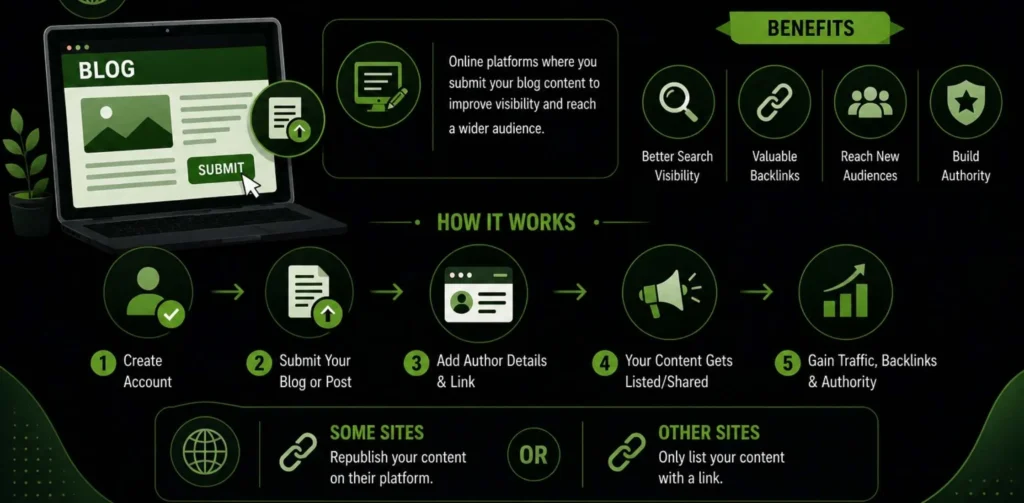
The online space features submission sites that enable content creators to list blog content in order to establish better search engine reach and distribute content across wider platforms. Web platforms operate as content directories or aggregators for different niches which enables them to display blogs making them accessible to wider user bases.
These sites serve multiple purposes:
- The platforms speed up the discovery and indexing process of search engines for your content.
- Your original website receives useful backlinks through their services
- New audiences experience your content which otherwise would remain hidden from them
- Your authoritativeness in your subject area grows through their utilization
Blog sites serve users by letting them establish accounts followed by the submission of either their blog pages or individual posts that include author credentials with original web page connections. Some sites transfer your content directly to their platform but other platforms only list your site with links directing users to your content.
Types of Blog Submission Sites
The various types of blog submission platforms require knowledge for users to build effective content distribution strategies.
General Content Platforms
Medium, WordPress.com, and Blogger let users from any topic share their content because they operate as general content platforms serving broad audiences. Users can gain instant content acceptance, which results in fast publishing combined with easy submission processes. Such Article platforms boost content SEO performance because of their high domain position and enable readers to connect through community features that raise visibility.
Niche-Oriented Platforms
Platform networks like DEV.to specialize in programming while Seeking Alpha focuses on financial content to deliver concentrated audiences who want to see your material. The audience of targeted digital platforms allows you to establish better conversions and enhance your professional credibility while connecting with important experts from your industry.
Guest Post Sites
Several established, powerful websites allow guest contributors who are professionals to demonstrate their expertise on authoritative websites. The Blog Submission Sites let you establish high-quality backlinks while building industry recognition with established audiences and obtaining credibility through these associations and allowing networking opportunities with authority figures in your field.
Social Blogging Networks
You can use LinkedIn articles together with Facebook Notes and Quora Spaces to create direct blog content in your social network so you reach out to your current contacts as well as attract new user attention. Your network benefits from this approach because the platform provides easy sharing functions while enhancing personal brand identity and automatic sharing to your audience, which leads to greater authority expansion.
News Aggregator Sites
The news aggregation platforms Flipboard and Apple News along with Google News unite content from diverse sources including blogs thereby providing users a strong tool to boost exposure. Your content gains access to major public audiences through these platforms while maintaining mobile accessibility and draws links to other respected publishers and potentially generates viral spread.
Industry-Specific Publishing Platforms
Many professional industries have established specialized publishing sites which accept submissions from their own members like legal blogs serving attorneys and medical journals serving healthcare professionals and sites serving teachers. The publication of your work on focused platforms offers two-fold advantages because it strengthens your professional standing and allows you to network with colleagues and potential customers while serving practitioners from your specialty area and offering you opportunities for ongoing learning.
Regional or Local Blogging Platforms
Some websites focus exclusively on regional content, so they become ideal platforms for companies that target specific geographical markets. Using such platforms gives businesses the advantage of improved local SEO performance alongside community engagement possibilities and local authority development and local business collaboration potential.
Benefits of Blog Submission Sites for SEO
- Backlinks from Authority Sites – Publishing on high Domain Authority (DA) sites earns you quality backlinks that enhance your DA and Google trust signals.
- Faster Indexing – Google (and other search engines) crawls the bigger submission platforms often, accelerating the indexing of your content.
- Referral Traffic – Popular sites such as Medium and LinkedIn Pulse are real communities; with the right article you can expect steady targeted traffic.
- Brand Authority & Awareness – Guest posts on trusted third-party sites solidify your brand’s position as an authority and boost brand awareness.
- Natural Link Profile – DoFollow and NoFollow links from a range of sources look organic to Google and minimise penalty exposure.
- Keyword Authority – Anchor text links in your submitted articles support your target keywords and enhance topical authority.
- SEO Evergreen Content – An article on a DA 80+ site, written for the target audience, delivers traffic and link juice for many months or years.
- Low Cost – Most high-quality blog submission sites are free; this is one of the most cost-effective off-page SEO techniques.
70+ High DA Blog Submission Sites List
Top Blog Submission Sites with Instant Approval
130 Free Blog Submission Sites List
Top Blog Submission Sites That Pay
DoFollow vs NoFollow Blog Submission Sites
Feature | DoFollow Links | NoFollow Links |
SEO Link Juice | Passes PageRank and authority to your site | Does not pass PageRank directly |
Google Treatment | Counted as a ranking signal | Treated as a hint, not a directive (since 2019) |
Impact on DA | Directly helps increase Domain Authority | Minimal direct impact on DA |
Penalty Risk | Higher risk if obtained from spammy sites | Lower penalty risk overall |
Natural Link Profile | Needs balance; too many looks manipulative | Adds naturalness to your backlink profile |
Referral Traffic | Can drive traffic regardless of link type | Can drive equal or more traffic |
Best Sources | HubPages, Dev.to, Hashnode, EzineArticles | Medium, LinkedIn, Quora, Flipboard |
Ideal Usage | Primary strategy for authority building | Complement DoFollow for a balanced profile |
Example Platforms | HubPages (DA 90), Dev.to (DA 78), Tumblr (DA 89) | Medium (DA 95), LinkedIn (DA 98), Quora (DA 93) |
2026 Recommendation | Focus on DA 70+ DoFollow platforms only | Use high-DA NoFollow sites for brand visibility |
How to Choose the Best Blog Submission Sites
- Use Domain Authority (DA) – The higher the DA (use Moz or Ahrefs), the better; in 2016, links from low-DA platforms were worthless for SEO.
- Check if the Site Has Traffic – Use SimilarWeb to ensure it receives human traffic; high DA without traffic means no referral value for you.
- Match Your Niche — List with sites in your niche; unrelated sites are confusing and water down topicality.
- Confirm Link Type – Dofollow links are best for passing link juice, but having nofollow links from quality sites also boosts your profile.
- Evaluate Editorial Process – Sites that have an editorial review process indicate authority to Google; steer clear of directories accepting all submissions.
- Evaluate Review Process – Instant approval sites are best for immediate indexing; use editorial sites for top authority.
- Check Guidelines – Every site has content standards for minimum word count, exclusivity, number of links, and more; breaches result in denial or expulsion.
- Check for User Interaction – A platform with comments, shares and user engagement signals to Google that there’s an established audience, so your content will reach more people.
- Stay Away from Spammy Sites – Avoid sites with auto-generated content or “instant approval for $5” – these can land you in hot water with Google.
- Look for Duplicate Content Rules – Some sites insist on exclusive content; using the same article for multiple sites may result in duplicate content.
How to Write a High Quality Blog?
1. Choose the Right Topic
Start with:
- What your audience cares about
- High Volume low DF Keywords people are searching for (use tools like Google Trends, Ubersuggest, or Ahrefs)
- Your expertise or experience
Tip: Focus on solving a problem, answering a question, or teaching something valuable.
2. Create a Strong Outline
Structure matters. Use this format:
- Title (catchy, keyword-rich)
- Intro (hook + what the blog will cover)
- Body:
- Subheadings (H2, H3)
- Bullets, numbered lists
- Short paragraphs
- Conclusion (summary + CTA)
3. Write With Clarity & Authority
Keep it:
- Conversational but informative
- Free from fluff
- Easy to skim (bold key phrases, use white space)
Use data, quotes, images, or stats to back your claims and add credibility.
4. Craft an Irresistible Title
A good blog title should be:
- Specific (“10 Proven Ways to…”)
- Keyword-focused
- Emotionally compelling (“…You Won’t Believe #7!”)
Example:
- Bad: Blog Submission Sites
- Better: 77 High DA Blog Submission Sites to Boost Your SEO in 2024
5. Add Visuals
People retain visuals 6x better than text.
Add:
- Images
- Infographics
- Screenshots
- Videos (if possible)
Tools: Canva, Unsplash, Pexels, or even AI-generated visuals.
6. Optimize for SEO
On-page SEO basics:
- Keyword in title, URL, first paragraph, subheadings
- Meta description (under 160 characters)
- Image alt tags
- Internal linking to your other posts
- External links to authority sources
Tools: Yoast SEO (WordPress), SurferSEO, Clearscope
7. Include a Clear Call to Action (CTA)
End your blog with a goal:
- Comment below
- Share on social
- Subscribe
- Download free guide
Don’t leave the reader hanging.
8. Edit Ruthlessly
Before publishing:
- Check for grammar, typos, and flow
- Read aloud to spot awkward phrases
- Use tools like Grammarly or Hemingway Editor
9. Promote Your Blog
- Share on social media
- Submit to relevant blog directories
- Build backlinks
- Email it to your list
- Repurpose into reels, tweets, or carousels
How to Effectively Submit Your Blogs on a Blog Submission Sites: Step By Step Guide
Follow this comprehensive process to maximize the impact of your blog submissions:
Step 1: Research and Select Appropriate Platforms
Begin your content promotion by finding websites that fulfil your topic requirements and alignment with your business aims. A spreadsheet should track your potential platform submissions together with domain authority (DA), estimated traffic and niche-relevance score tracking. Develop your submission plan by ranking target platforms based on your business goals while creating a schedule which suits the criteria and posting dates of each site.
Step 2: Optimize Your Content for Submission
Before uploading content, check that your work fulfills reader demands and SEO requirements while utilizing an optimization review process. Begin by creating attention-grabbing headers with strategic keywords, followed by an appropriate H1-H4 division of content, and completion with suitable image files with optimized alt description text. Your content submission should include purposeful internal and external links, readable design elements that use short paragraphs and bullet points, and a compelling author biography that contains useful links and possibly meta description optimization when available.
Step 3: Register and Complete Your Profile
Account creation with detailed profile completion becomes mandatory on submission platforms, so optimization ensures higher credibility while enhancing visibility. The profile needs a professional photograph and a bio containing natural keywords about you, your educational achievements, and work history. Including your website and social profile links will be essential while you demonstrate your expertise through an original point of view that will attract your target audience.
Step 4: Follow Platform-Specific Guidelines
Newbie writers must understand that each submission platform sets particular guidelines that need strict adherence for getting their work accepted. The submission guidelines typically require detailed information about content length, formatting rules, recommended image dimensions or formats, allowed link numbers and types, strict rules about original content, and posting frequency. Damaging credibility while reducing visibility will occur if you fail to follow site-specific guidelines.
Step 5: Submit Your Content Strategically
The time when you submit content along with your submission approach determines the ultimate success of your content achievements. Your content success will increase by posting at peak hours while creating Blog Submission Sites-specific versions and applying platform-specific elements like tagging on Medium. Send your original works to premium platforms because they attract more readers, and then regularly publish short content that introduces readers to visit your central website.
Step 6: Engage With the Community
The process of successful blog submission requires more than just providing content because readers expect active engagement with authors. To build credibility you should react quickly to platform comments on your work as well as participate in writer communities and take part in community-driven discussions. Supply useful information in your discussions while developing authentic relationships with editors and top contributors to achieve credibility and better visibility.
Step 7: Promote Your Published Submissions
The reach of your published content grows when you promote it through linking across your social networks and email updates while referencing your submissions in relevant main website content. Aimed promotion of your top-performing work becomes advisable to reach expanded audiences once your content finds traction among readers.
Step 8: Track Performance and Refine Strategy
Track and improve your submission method through continuous monitoring of referral traffic, engagement indicators such as reads and comments, and the conversion rates from submission traffic. Backlink quality assessments, along with search engine ranking improvements, will help you determine the value of your efforts after measuring the time spent with measured results.
Free vs. Paid Blog Syndication Platforms
Understanding the distinctions between free and paid options can help you allocate resources effectively:
Free Blog Submission Sites
Advantages:
- No financial investment required
- Accessible to bloggers at any level
- Often have large, established audiences
- Provide valuable backlinks and exposure
- Good for testing different content types
Limitations:
- May have stricter content guidelines
- Limited customization options
- Potentially longer review processes
- Less promotional support
- May use no-follow links
Paid Blog Submission sites
Advantages:
- Priority review and faster publishing
- Enhanced visibility features
- Better analytics and reporting
- Premium placement options
- Additional promotional support
- More customization possibilities
Limitations:
- Requires financial investment
- ROI not guaranteed
- Some platforms charge without delivering quality exposure
- May still have content restrictions
Finding the Right Balance
A successful content distribution approach combines both free and paid distribution methods where content is first distributed free before evaluating performance on those channels so specific paid methods can be implemented specifically. When you identify high-performing content look for paid promotional channels which support your corporate targets. Evaluate the ROI of your content and expand paid distribution expenses for materials producing consistent positive results.
Blog Submission Strategy (2026 SEO)
- Less is More – 2 quality articles on DA 80+ sites are better than 50 on low-DA sites; aim for directories with human visitors.
- Build Relevant DA 60+ Links – After the Helpful Content Update, even directories with low DA have minimal impact; use only sites with DA 60+ for link building.
- Publish Original Content – Don’t spin or duplicate articles; Google can identify duplicate content and even penalize your home site.
- Use Attractive Author Bio and Anchor Text Linking to Your Target Page – Include an attractive bio and a natural, keyword-rich anchor text link to your target page.
- Use Relevant Sites – Pitch to sites relevant to your niche; a technology article on a travel website is confusing for search engines and a poor relevance signal.
- Anchor Text Diversity – Use a combination of branded, naked URL, exact-match and generic anchor text links to look natural.
- Build Authority Slowly – Submit 2-4 quality pieces per month instead of a one-off large quantity; steady publishing shows search engines you’re an authority.
- Prioritise Medium & LinkedIn – The two most authoritative sites (DA 95 & 98) with the biggest audiences, and quickest indexing times for new articles.
- Monitor Indexing & Referrals – Verify articles were indexed in Google Search Console, and check referral traffic in Google Analytics 4.
- Don’t Use Submission Tools – Software that simultaneously submits content to hundreds of websites is suspicious to Google and may attract manual actions.
- Transform, Not Repost – Change the focus of your blog articles (how-to, listicle, opinion) to avoid duplicates and submit to the right platforms.
- Pair With Internal Links – Once your article has been published, link to it from your own site for a mutual authority boost.
- Track Competitor Submissions- Use Ahrefs or SEMrush to find where your competitors obtain links via article submission, and target the same successful sites.
Conclusion
Blog submission sites are still very useful for digital marketing in 2026. They help you increase your website visibility and build good quality backlinks. You can also reach a wider audience and improve your search rankings. To get better results, choose the right platforms and submit well-optimized content. Stay active on these platforms and track your performance regularly.
Posting good content regularly gives better results than posting occasionally. Start with a few platforms and learn the process step by step. Once you see results, you can expand to more sites. With patience and consistency, these platforms can help you grow your content reach and build strong authority in your niche.
FAQs
1. Does the blog posting protocol enable submission to multiple websites with high Domain Authority rankings?
The presence of duplicate content will generate negative effects on your SEO performance. Each submission should receive distinct branding because you’ll adapt content for every platform using different opening sections and ending segments and sample displays with individual styles. Every article submission needs at least 30% original content to prevent acquiring duplicate content penalties from search engines.
2. Can every submission service that belongs to high-DA websites offer free usage without charge?
Free basic offerings from submission sites exist, but premium features along with better visibility need additional payment to access them. Read the terms of service before submission and analyze paid upgrades to guarantee they will bring adequate return on investment for your individual goals.
3. What duration of time should one anticipate before observing SEO advantages from blog submissions?
Search engines need 3-6 months to process new backlinks; thus, search engine optimization benefits emerge, while the first traffic from referrals can show up immediately. Consistency stands as the vital factor since a single distribution produces little impact compared to a sustained submission strategy.
4. What should be my priority - submitting to many sites or targeting select high-quality submission websites?
Quality always trumps quantity. Highly relevant authority platforms show superior results when receiving five posted links compared to spread-out submissions on platforms of low quality or little relevance. Initiate with an essential group of high-value platforms and conduct expansion in a methodical manner.
5. Which methods do I use to measure the performance of my blog submissions?
To monitor referral traffic in Google Analytics you should embed UTM parameters into your links. Performance assessment requires 3-part analysis which combines monitoring platform engagement metrics alongside backlink data from tools like Ahrefs or Semrush and conversion rates from different referral sources.
6. Are blog submission sites still efficient?
Yes, blog submission sites still work in 2026, yet you need to select highly reputable and quality, high DA platforms. Otherwise, low-quality platforms can negatively impact your SEO.
7. How many submissions per day?
5-10 quality blog submissions should be made daily. Don’t pay much attention to link quantity – focus on relevancy.
8. Is it SEO friendly?
Yes, as long as you select trustworthy, quality, and relevant websites for blog submissions. Do not use duplicate content and low-quality spammy directories.