Quick note before you read: Most Safal outlets are operated by ex-servicemen (ESM) through AWPO. General applicants can apply too, but the ESM route gets priority. We cover both clearly below.
Mother Dairy’s Safal franchise, launched under the NDDB in 1988, has played a key role in modernising India’s organised fresh produce retail by directly linking farmers to consumers and reducing middlemen. Over time, Safal expanded beyond fruits and vegetables into frozen foods, pulps, and beverages, supported by stronger processing and retail infrastructure that improved quality and reduced wastage.
Today, Mother Dairy Safal Franchise remains a major player in India’s organised dairy and horticulture market, aligned with a fast-growing sector expected to reach USD 227.53 billion by 2030. With rising demand and increasing milk production targets, the brand continues to strengthen its position through expansion, modernization, and supply-chain efficiency while supporting farmers and ensuring fresh, affordable produce for consumers.
If you’ve been wondering whether owning one of these could be a good business, this guide gives you everything you need to actually decide. Real investment numbers, honest profit expectations, who can apply, and what nobody else tells you.
What Is Safal? (And Why It’s Different From a Typical Franchise)
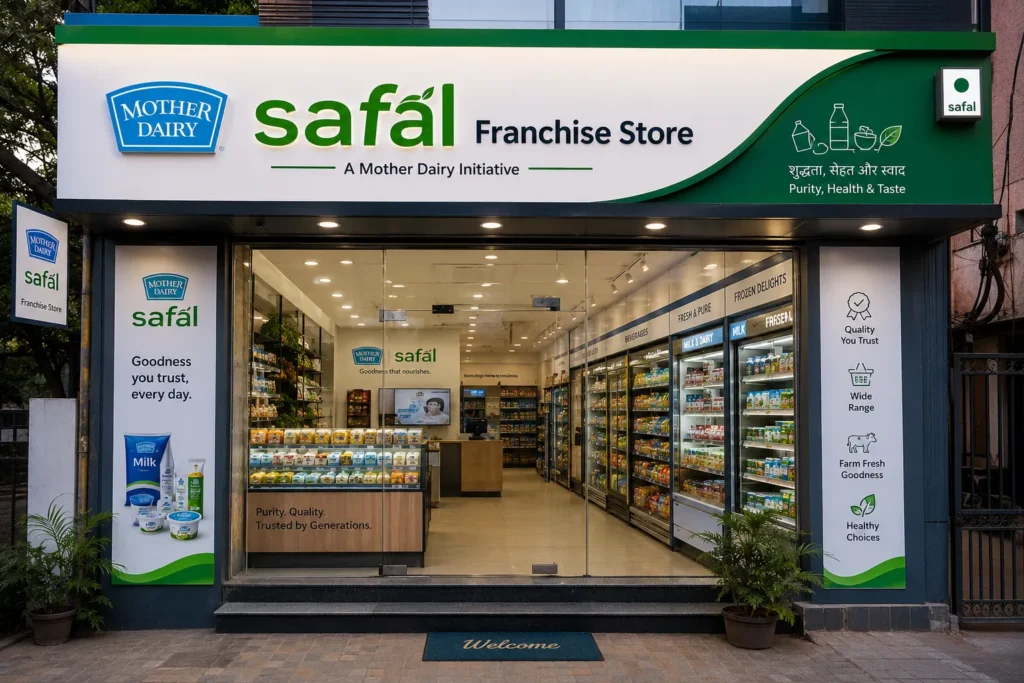
Safal is not a private franchise brand chasing quarterly profits. It is a government-backed initiative launched in 1988 under the National Dairy Development Board (NDDB) — the same body that created Amul.
The idea was simple: remove middlemen between farmers and urban buyers. Farmers get fair prices. Consumers get fresh produce at lower rates. That mission is still at the core of how Safal operates in 2026.
Mother Dairy Fruit & Vegetable Pvt. Ltd. — a 100% subsidiary of NDDB — runs Safal. In FY2025, Mother Dairy’s total revenue crossed ₹17,400 crore, growing at 16% year-on-year. The company is targeting ₹20,000 crore in FY2026. That’s the scale of the organization behind this franchise.
Safal By the Numbers (2026)
| Metric | Number |
| Safal retail outlets (Delhi NCR + Bengaluru) | 400+ in Delhi NCR, 23 in Bengaluru |
| Daily customers served | 1.5 lakh+ |
| Fresh produce SKUs available | 120+ (fruits, vegetables, pulses, frozen, processed) |
| Farmers connected across India | 50,000 across 16 states |
| Fresh produce sourced daily | 350 MT from 8,000 farmers across 20 states |
| New processing plants (2025 investment) | ₹600 crore investment in Gujarat & Andhra Pradesh |
| Mother Dairy FY2025 total revenue | ₹17,400 crore (16% growth) |
Types of Mother Dairy Franchise You Can Open
Mother Dairy isn’t one-size-fits-all. There are a few formats depending on what you want to sell and how much space you have:
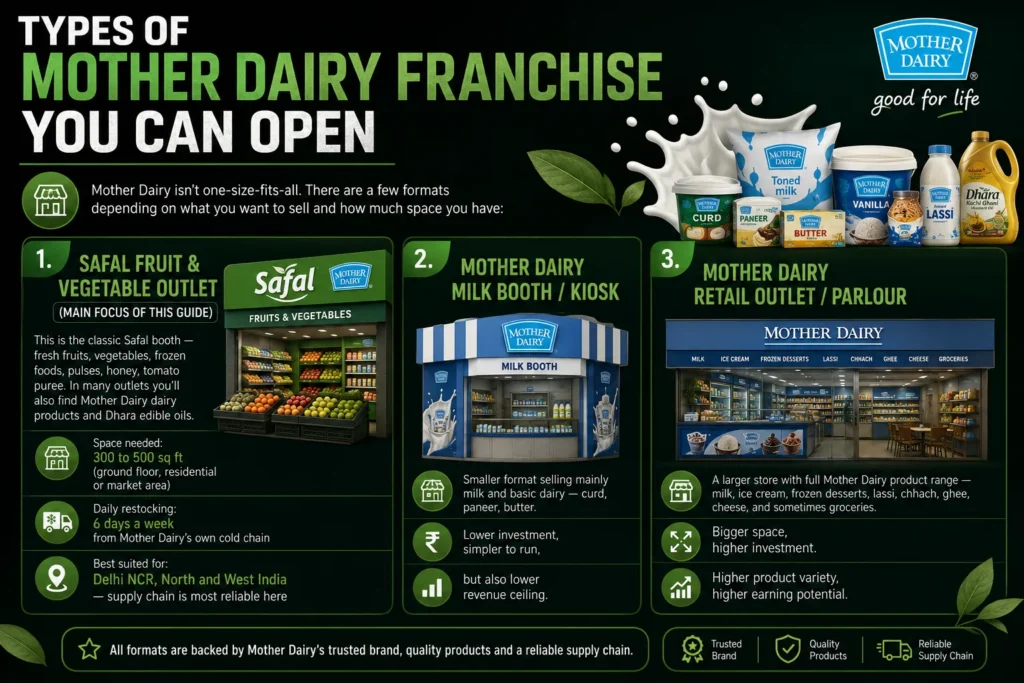
1. Safal Fruit & Vegetable Outlet (Main Focus of This Guide)
This is the classic Safal booth — fresh fruits, vegetables, frozen foods, pulses, honey, tomato puree. In many outlets you’ll also find Mother Dairy dairy products and Dhara edible oils.
- Space needed: 300 to 500 sq ft (ground floor, residential or market area)
- Daily restocking: 6 days a week from Mother Dairy’s own cold chain
- Best suited for: Delhi NCR, North and West India — supply chain is most reliable here
2. Mother Dairy Milk Booth / Kiosk
A smaller format selling mainly milk and basic dairy — curd, paneer, butter. Lower investment, simpler to run, but also lower revenue ceiling.
3. Mother Dairy Retail Outlet / Parlour
A larger store with full Mother Dairy product range — milk, ice cream, frozen desserts, lassi, chhach, ghee, cheese, and sometimes groceries. Bigger space, more investment, higher revenue potential.
This guide focuses mainly on the Safal Fruit & Vegetable franchise since that’s what most people search for — and it’s the most complete franchise model Mother Dairy offers.
Mother Dairy Safal Franchise Cost in India — 2026 Breakdown
This is what people get most confused about, because numbers vary a lot depending on who you ask. Here’s an honest breakdown:
The ESM (Ex-Serviceman) Route — Lowest Investment
If you are an ex-serviceman (Rank Naik to JCO, below 50 years, 10th pass), you get a massively subsidized deal. Mother Dairy provides the outlet, all equipment, and covers rent and utility bills. Your cost is just the security deposit + working capital.
| Cost Head (ESM Route) | Amount |
| Refundable Security Deposit | ₹1 lakh |
| Working Capital | ₹1 lakh |
| Franchise Fee | ₹50,000 to ₹1 lakh |
| Outlet + Equipment (provided by Safal) | ₹0 — covered by Mother Dairy |
| Rent & Utility Bills (covered by Safal) | ₹0 — covered by Mother Dairy |
| TOTAL MINIMUM INVESTMENT | ~₹2 to ₹3 lakh |
Equipment provided at no cost: display racks, electronic weighing machines, deep freezer, visi cooler, crates, and promotional material.
Agreement duration is 2 years, renewable based on performance.
The General Applicant Route — Higher Investment
If you’re not an ex-serviceman, the deal is different. You’ll need to arrange your own space and cover setup costs. Here’s what that looks like:
| Cost Head | Amount (₹) | Notes |
| Franchise Fee | ₹50,000 – ₹1 lakh | Brand licence |
| Refundable Security Deposit | ₹1 lakh | Returned on exit |
| Shop Interior / Setup | ₹1 – ₹2 lakh | Shelves, counters, flooring |
| Equipment (if not provided) | ₹1 – ₹2 lakh | Deep freezer, weighing scale, crates |
| Initial Inventory | ₹50,000 – ₹1 lakh | First stock of fresh produce + dairy |
| Working Capital (buffer) | ₹1 – ₹2 lakh | For salaries, bills, restocking |
| TOTAL ESTIMATED RANGE | ₹5 – ₹8 lakh | For a 300-500 sq ft outlet |
Important: Some sources quote ₹2 lakh as total investment — that’s the ESM route only. For general applicants arranging their own shop space, budget ₹5 to ₹8 lakh to be safe. Always verify current terms directly with Mother Dairy before committing.
Monthly Running Costs — What to Expect
Whether you’re on the ESM route or general route, you’ll have some monthly costs:
| Monthly Cost Head | Estimated Amount |
| Staff salaries (1-2 people) | ₹15,000 – ₹30,000 |
| Electricity & water (if not ESM) | ₹5,000 – ₹10,000 |
| Wastage (fresh produce spoilage) | 3 – 8% of revenue depending on management |
| Rent (if you lease your own space) | ₹8,000 – ₹25,000 depending on location |
| Replenishment / restocking | Daily from Safal supply chain |
For ESM franchisees: rent and utility bills are zero — a huge advantage. This is why ESM outlets tend to reach break-even faster.
Profit Margins and ROI — The Honest Picture
What You Can Earn
| Scenario | Monthly Revenue | Monthly Net Profit |
| Slow outlet, low footfall | ₹2 – ₹3 lakh | ₹8,000 – ₹15,000 |
| Average outlet, decent location | ₹3 – ₹5 lakh | ₹20,000 – ₹35,000 |
| Good outlet, high-footfall area | ₹5 – ₹8 lakh | ₹40,000 – ₹60,000+ |
Margin Breakdown by Product
| Product Category | Gross Margin (%) |
| Fresh fruits & vegetables | 15% – 20% |
| Dairy products (curd, paneer, butter) | 10% – 15% |
| Frozen vegetables & snacks | 20% – 25%+ |
| Pulses, honey, processed items | 18% – 25% |
| Net Profit (after all costs) | 10% – 15% of total revenue |
Break-Even Period
- ESM route: 12 – 18 months (zero rent and utility bills make a big difference)
- General applicant route: 18 – 30 months depending on location and monthly revenue
- Annual ROI (once break-even is crossed): 30% – 40% on invested capital
Honest note: Wastage management is the biggest profit killer in this business. Fresh produce that doesn’t sell has to be discarded. Operators who manage inventory tightly — ordering based on demand patterns, rotating stock daily — consistently outperform those who don’t.
Location Matters More Than Anything
Safal outlets work best in specific kinds of places. Location is the single biggest factor separating profitable outlets from struggling ones.
Good Locations for a Safal Outlet
- Dense residential areas: Colonies, housing societies, apartment clusters where people buy produce daily
- Near RWA markets: Resident Welfare Association markets with regular morning traffic
- Near bus stops or metro exits: Daily commuters often pick up vegetables on their way home
- Market areas without a strong BigBasket or Zepto presence: If your area has high quick commerce usage, conversion to walk-in buyers is harder
Where Safal Outlets Struggle
- Areas dominated by quick commerce: If customers already order from Blinkit or Zepto, a physical booth is a harder sell
- Outside Delhi NCR and major North Indian cities: Supply chain reliability drops significantly outside core markets
- Malls or commercial complexes: Safal works better in neighbourhood settings, not premium retail environments
Geography check before applying: Safal’s supply chain is strongest in Delhi, Noida, Ghaziabad, Faridabad, Gurgaon, and Bengaluru. Outside these cities, restocking frequency and quality can be inconsistent. Verify supply availability in your specific area before you invest.
What Support Does Mother Dairy Actually Provide?
This is where Safal genuinely stands out from many franchise options in this price range.
Before You Open
- Store setup assistance: Branding, layout guidance, installation of equipment
- Franchisee training: Product knowledge, inventory management, customer handling, shop-keeping practices
- Initial stock supply: First inventory organized by Mother Dairy’s distribution team
After You Open
- Daily supply: Fresh produce restocked 6 days a week through Safal’s cold chain
- Marketing support: National campaigns, banners, posters, and promotional material provided
- Regular quality audits: Mother Dairy conducts periodic checks for food safety and service standards
- Sales team visits: Safal’s team visits franchisees for operational assistance and performance review
One thing that works in your favour: Mother Dairy manages the supply chain end-to-end — procurement from 50,000 farmers across 16 states, cold chain logistics, processing at their own facilities. You don’t need to worry about sourcing. Your job is retail operations.
How to Apply for Mother Dairy Safal Franchise — Step by Step
Route 1: ESM (Ex-Serviceman) Route — Through AWPO
This is the primary route for Safal outlets. AWPO (Army Welfare Placement Organisation) handles applications jointly with Safal.
- Check eligibility: Rank Naik to JCO, age below 50, minimum 10th pass, Indian citizen
- Contact AWPO or visit Mother Dairy’s official website to get the application form
- Submit your application with: Aadhaar, PAN, discharge papers, bank statements, location details
- Joint interview conducted by AWPO and Safal to assess suitability
- Outlet allotted within 10 km radius of your residence (based on availability)
- Sign 2-year agreement with two government officials as guarantors
- Pay ₹1 lakh refundable security deposit
- Safal sets up outlet, installs equipment, provides initial training
- Store launches — typically 4 to 6 weeks from approval
Route 2: General Applicant Route — Direct With Mother Dairy
If you’re not an ex-serviceman, you can still apply directly through Mother Dairy:
- Visit the official Mother Dairy website (motherdairy.com) and fill in the franchise enquiry form
- Submit details: your name, contact info, proposed location, and business experience
- Mother Dairy team reviews and calls you for a discussion
- Site inspection conducted to verify location suitability
- Financial verification — they check your investment capacity
- Agreement signing, security deposit payment
- Infrastructure setup, training, and stock initiation
- Outlet opens — 4 to 8 weeks from approval
Important: Always apply through the official Mother Dairy website or AWPO only. Do not pay any third party claiming to offer Safal franchises — Mother Dairy does not charge any upfront registration fee before the official process.
Things Nobody Tells You
Most blogs about Safal franchises just repeat investment numbers and ROI figures. Here’s what they don’t say:
1. Quick Commerce Is the Real Competition
Blinkit, Zepto, and Swiggy Instamart now deliver fruits and vegetables in 10 minutes in most Delhi NCR areas. This directly affects Safal’s walk-in footfall in dense urban zones. The outlets doing well are those in residential neighbourhoods where older residents and daily-use buyers still prefer physical shopping — not areas where the 25-30 age group relies heavily on apps.
2. Wastage Can Eat Your Profits
Fresh produce has a very short shelf life. If you order too much and don’t sell it in time, you absorb the loss. This is the number one operational challenge franchisees face. You have no pricing flexibility — you can’t discount to clear stock. You just lose unsold inventory. Good operators develop an instinct for daily ordering quantities based on seasons, local demand, and even weather patterns.
3. You Cannot Change the Prices
Mother Dairy sets retail prices. You can’t run your own promotions or adjust prices to compete with a local vendor selling the same tomatoes cheaper. This protects the brand but limits your ability to respond to local competition.
4. ESM Priority Means Limited General Openings
Safal gives priority to ex-servicemen for new outlet allotments. General applicants often find that outlets in their preferred areas are already allocated or on a waitlist. This is not widely mentioned in most franchise guides.
5. Supply Outside Delhi NCR Can Be Unpredictable
The 23 Bengaluru outlets are functioning, but operators outside core markets report restocking gaps and quality variation during peak seasons. If you’re planning outside Delhi NCR or Bengaluru, do a ground-level check on supply reliability before committing.
6. Agreement Is Only 2 Years — Renewal Is Not Guaranteed
The franchise agreement runs for 2 years. Renewal happens based on performance. If sales are below expectations, the outlet can be reassigned. This is a real operational risk that people often overlook.
Pros and Cons — Let’s Be Real
The Good Parts
- Government-backed brand: NDDB backing gives consumer trust that most private franchise brands can’t match
- Very low entry cost (ESM): At ₹2 – ₹3 lakh with zero rent, it’s hard to find a comparable business opportunity
- Mother Dairy handles supply: You don’t source anything — it all comes through their system
- Daily necessity products: People need vegetables and dairy every day — footfall doesn’t disappear
- 120+ SKUs across fresh, frozen, processed: More product variety = more revenue per customer visit
- ₹600 crore infrastructure investment underway: New processing plants in Gujarat and AP = better quality and supply reliability ahead
The Not-So-Good Parts
- Zero pricing control: You can’t discount, can’t run promotions, can’t adjust to local competition
- Wastage risk: Unsold fresh produce is your loss — requires tight daily inventory management
- Quick commerce competition: In dense urban areas, Blinkit and Zepto are eating into walk-in customers
- ESM priority: General applicants may face limited availability in premium locations
- Geography dependent: Works best in Delhi NCR and North India — other regions are less reliable
- 2-year renewal model: No long-term security unless you consistently perform
Final Thoughts
The Mother Dairy Safal franchise is one of the most accessible and genuinely well-supported small business options in India — especially for ex-servicemen. For general applicants, it still makes sense if you have the right location, understand the operational demands of a fresh produce business, and are comfortable with the daily hands-on involvement this requires.
It is not a passive income business. You — or a trusted person — need to be present daily. Stock needs to be inspected, rotated, and managed carefully. Wastage control is not optional.
But if you get those things right, and you pick a location with genuine daily footfall, this is a solid, low-risk business backed by a brand that has been trusted in Indian homes since 1974.
Apply only through the official Mother Dairy website (motherdairy.com) or AWPO. Do not pay any agent or third party claiming to facilitate this.
Discover More Franchise Opportunities:
- Haldiram Franchise Cost in India
- Wow Momo Franchise Cost
- Starbucks Franchise Cost in India
- Kidzee Franchise Cost
FAQs
What is the minimum investment for a Mother Dairy Safal franchise?
For ex-servicemen through the AWPO route: around ₹2 – ₹3 lakh (₹1 lakh refundable security + ₹1 lakh working capital + franchise fee). For general applicants arranging their own space: ₹5 – ₹8 lakh including setup, equipment, and working capital.
Is Mother Dairy Safal profitable?
Yes, if the location has good daily footfall. Average outlets in residential areas generate monthly net profits of ₹20,000 – ₹35,000. Well-run outlets in high-traffic spots can reach ₹50,000 – ₹60,000 per month. The key variables are location, wastage control, and how consistently you manage daily inventory.
Who can apply for a Safal franchise?
Ex-servicemen (Rank Naik to JCO, under 50, 10th pass) get priority through the AWPO route. General applicants — anyone with retail interest and the required investment capacity — can apply directly through the Mother Dairy website.
Does Safal charge rent or utility bills?
For ESM franchisees: No. Mother Dairy covers rent, electricity, water, and maintenance. For general applicants who arrange their own space: you pay your own rent and utilities, which is why the general route needs a higher investment and takes longer to break even.
How long does it take to get approval?
From application to outlet opening typically takes 4 to 8 weeks — depending on site approval, documentation completion, and store setup. The process is well-structured and doesn’t drag on for months.
Can I open a Safal franchise outside Delhi NCR?
Mother Dairy has 23 outlets in Bengaluru and is slowly expanding to other cities. But the supply chain is strongest in Delhi NCR. Outside these areas, verify supply reliability directly with Mother Dairy before committing your investment.
What is the ROI on a Safal franchise?
Once the outlet breaks even (18-24 months for ESM; up to 30 months for general applicants), annual ROI typically ranges from 30% to 40% on invested capital. These numbers depend heavily on daily sales volumes and how well you manage perishable inventory.