The love for pizzas in India is not a fleeting craze but an entire revolution. Be it studying until midnight or partying in the office after work, a box from the Domino’s kitchen is always right in the middle of the action. By 2026, Domino’s is well established in India as the largest market for the brand after the United States. With more than 2,200 stores operating in over 450+ cities, the strategy of fortressing by establishing stores in tight clusters within small areas to reduce delivery time below 20 minutes has led to an overwhelming interest in more franchises.
Also, with the food services industry set to witness a growth of 10-12% per annum through 2030, this is undoubtedly the best time to make an investment worth crores into a successful brand. In this article, we will break down the Domino’s franchise cost in India, the hidden application truths, and how you can get started in 2026.
Domino’s India Franchise Structure – What Most Investors Don’t Know
As opposed to the regular franchising structure, Domino’s India is not your regular “Mom-and-Pop” franchising entity. This is how it works:
- Master Franchisee: The Master Franchise for India, Nepal, Sri Lanka, and Bangladesh is owned by Jubilant FoodWorks Limited.
- Corporate Controlled: The majority of outlets operated in India are run as corporations with all processes controlled by Jubilant to guarantee the highest standards of quality.
- Selection Criteria: Selection criteria are incredibly rigorous. Only candidates who can prove huge experience and substantial capital investment are considered.
- Operational Guidelines: Even as a franchise, you must strictly adhere to the global rules of delivering pizza and drinks “within 30 minutes, or it’s FREE”. Or the revised one – delivering it within 20 minutes.
- Agreement Periods: Most agreements have long terms of operation, usually lasting for 10 years for traditional stores.
Jubilant FoodWorks: The Real Entity Behind Domino’s India Franchise
To talk business, speak with Jubilant FoodWorks Limited – the company listed on both the NSE and BSE which revolutionized the Domino’s concept in India. By 2026, their business will have evolved a lot and will be almost fully automated, with about 95% of orders placed using the proprietary app they developed. Their revenues have grown steadily to surpass the mark of ₹5,500 crores a year in recent times.
If you apply for an evaluation regarding Domino’s Franchise Cost in India, you should note that you are entering into a business agreement with the retail giant that is responsible for many other brands, such as Dunkin’ and Popeye.
Can You Directly Buy a Domino’s Franchise in India?
It is quite difficult to purchase Domino’s outlets in India due to strict selection criteria and rigorous application procedures. Unlike other local pizza chains, it is practically impossible to “purchase” an existing store; you would still have to approach the master franchise and submit an application.
Types of Domino’s Outlets Available in India
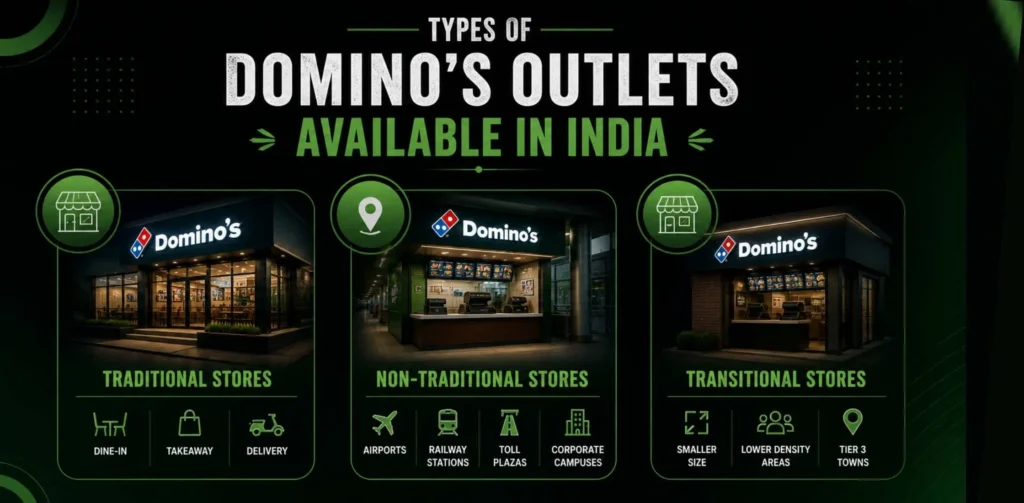
Based on your budget and the kind of area where you plan to establish your outlet, consider the following options:
- Traditional Stores: Traditional stores are full-service outlets, generally located on high streets or in shopping malls. These outlets offer the whole range of experiences, starting from dine-ins to takeaways and delivery to wide areas around the store.
- Non-Traditional Stores: Non-traditional outlets are typically found in unique locations such as airports, railway stations, toll plazas, or even corporate campuses. These stores have a reduced menu to facilitate quick orders.
- Transitional Stores: These are smaller in size and designed to cater to lower-density areas and Tier 3 towns, helping the brand cover all corners of India at a relatively cheaper Domino’s Franchise Cost in India.
Domino’s Franchise Cost in India 2026 – Detailed Breakdown
The financial plan to open a Domino’s outlet is relatively complex and requires a combination of licensing fees as well as significant funding for high-end infrastructure. In order to understand the true Domino’s franchise cost in India, we will have to consider the following areas into which your capital will be spent as per the brand guidelines in 2026.
Initial Franchise Fee (Franchise License Cost)
- One-Time Charge: It is the one-time cost of becoming part of the Jubilant FoodWorks franchisee pool, and the cost lies somewhere between ₹10 Lakhs and ₹50 Lakhs.
- Type-Based Dependent: The lower figure is reserved for non-traditional or express outlet formats, whereas flagship stores have to pay a range of ₹30 Lakhs to ₹50 Lakhs.
- License Period: This allows the franchisee exclusive rights for 5–10 years, with renewal fees typically ranging from ₹5 Lakhs to ₹15 Lakhs, depending on the term extension.
- Intellectual Property: It allows you access to all intellectual property, including secret spices and proprietary recipes, valued as part of the initial ₹10 Lakhs to ₹50 Lakhs entry fee.
- Training Fee: Some portion of the fee, usually between ₹2 Lakhs and ₹5 Lakhs, is used to train you for certification by the corporation as a franchisee of Domino’s.
Store Setup & Fit-Out Costs (Kitchen, Signage, Tech)
- Civil Engineering: You will have to invest ₹20 Lakhs to ₹30 Lakhs on moisture-proof floors, specially designed walls, and plumbing.
- Air Flow Management: An industrial-scale HVAC system is required, with installation costs typically ranging from ₹5 Lakhs to ₹12 Lakhs to maintain a moderate temperature.
- Branding & Signage: LED signage and external branding packages cost between ₹2 Lakhs and ₹5 Lakhs to enhance visibility 24/7.
- Dine-In Aesthetics: In the case of traditional stores, it includes the cost of ergonomic furniture and stylish lighting, ranging from ₹10 Lakhs to ₹20 Lakhs.
- Electrical Work: Most locations will require robust electrical panels and wiring, costing between ₹3 Lakhs and ₹7 Lakhs to support high-voltage equipment.
Equipment & POS System Investment
- Pizza Oven: The heart of any pizza kitchen is a professional conveyor pizza oven, costing between ₹15 Lakhs and ₹40 Lakhs per unit.
- Refrigeration: Walk-in refrigerators and industrial cooling equipment are needed, with investment requirements of ₹8 Lakhs to ₹15 Lakhs.
- POS & KDS: This includes the cost of installing Point-of-Sale and Kitchen Display Systems, ranging from ₹3 Lakhs to ₹8 Lakhs for full app integration.
- Preparation Equipment: Purchase of dough preparation machines, cutting machinery, and scales costs between ₹5 Lakhs and ₹10 Lakhs to ensure uniform taste.
- Vehicle Fleet: While this is an independent cost, it includes branded baggage and special storage racks, averaging ₹2 Lakhs to ₹6 Lakhs depending on fleet size.
Working Capital Requirement for First 6 Months
- Cash Reserve: A liquidity reserve of ₹15 Lakhs to ₹25 Lakhs is necessary to cover the gestation period for maximizing sales.
- Salaries: This helps cover salaries of 15-25 people, including kitchen crew members and delivery guys, irrespective of initial sales.
- Royalty Reserve: The monthly royalty of 5.5% and 4% marketing fee payable to the corporation have to be taken care of.
- Utility Bills: High-energy bills are normal for pizza restaurants, and the capital covers these recurring costs at the initial stage.
- Marketing Costs: While the corporation takes care of national advertisement, you will need capital for local advertising.
Total Investment Range: Realistic Number for 2026
- Traditional Stores: For regular metro-city outlets with dine-in, estimated cost is around ₹1.5-3 Crores.
- Express Stores: Smaller kiosk or delivery-only franchises in airport or mall locations require ₹60-90 Lakhs.
- Cloud Kitchens: The most lean model available in 2026 typically starts at ₹30 Lakhs to ₹50 Lakhs, focusing purely on delivery with no seating.
- Contingency Reserve: Savvy investors allocate an extra 10% budget for unexpected costs such as licensing delays or permits.
- Real Estate Budget: Remember, these costs usually do not include security deposits on real estate (1500 – 2000 sq. ft.).
Breakdown of Domino’s Franchise Cost in India (2026)
| Expense Category | Estimated Cost (INR) |
| Initial Franchise License Fee | ₹10 Lakhs – ₹50 Lakhs |
| Interior, Fit-outs, & Construction | ₹20 Lakhs – ₹30 Lakhs |
| Kitchen Equipment & IT Systems | ₹15 Lakhs – ₹80 Lakhs |
| Licenses & Legal Fees | ₹2 Lakhs – ₹3 Lakhs |
| Working Capital (6 Months) | ₹10 Lakhs – ₹25 Lakhs |
| Total Estimated Investment | ₹60 Lakhs – ₹3 Crore+ |
Note: All financial figures are provided in Indian Currency (INR). Actual costs may vary based on city tier and real estate market conditions in 2026.
Domino’s Franchise vs Pizza Hut Franchise — Which Wins in India?
They both are market leaders in the pizza industry; however, they cater to two different niches. Domino’s leads in food delivery, whereas the Pizza Hut franchise has traditionally followed the trend of casual dining. Below is the comprehensive comparison of these two franchise options.
| Feature | Domino’s Pizza (Jubilant FoodWorks) | Pizza Hut (Devyani International) |
| Market Winner | Winner (Dominant Share) | Runner-Up (Struggling) |
| Store Presence | >1,000 locations | ~360 locations |
| Store Strategy | Small footprint (800-1200 sq ft) Kitchens | Larger restaurants (2000+ sq ft) Dine-in |
| Primary Strength | 30-min Delivery & Tech (Own App) | Dining Experience |
| Revenue/Store | Higher (₹79,000+ daily) | Lower (₹42,000 daily) |
| EBITDA Margin | Very High (20.5%) | Low/Loss-making (-2.4%) |
| Expansion Rate | High (~15 stores/month) | Slower (~5 stores/month) |
| Delivery Model | 72% Own App/73% Delivery | Heavily Dependent on Zomato/Swiggy |
Investment Comparison: Domino’s vs Pizza Hut
The Domino’s franchise cost in India is primarily determined by factors related to kitchen operations and deliveries. For Pizza Hut, store investments are usually higher due to higher front-of-the-house costs.
Market Reach: Which Brand Has More Outlets & Growth?
Here, too, Domino’s wins with flying colors! Not only do they have twice as many outlets (over 2,000) as Pizza Hut, but they also operate in markets Pizza Hut has not even entered. Also, their Indian distribution network is very developed, so sourcing ingredients is less problematic, especially for remote outlets.
ROI Comparison: Which Franchise Pays Back Faster?
Thanks to high-order volumes on the Domino’s app, the ROI is usually realized within 2-3 years. Pizza Hut takes a little longer (3-4 years) to return the initial capital since it depends heavily on foot traffic and dine-in customers.
Customer Loyalty & Brand Recall — Data-Backed Analysis
Domino’s leads in this segment as well! Not only do they offer personalized ordering through their popular mobile app, but they also feature dishes specially curated for Indian taste. For instance, Domino’s Cheesy Rewards has millions of members, and items such as Peppy Paneer and Chicken Dominator are among the most sought-after in the country.
Royalty Fees, Revenue Share & Ongoing Operational Costs
While buying the store is one thing, you still have to deal with the following Domino’s franchise cost in India:
- Franchise Royalties: Around 5.5%-6% of your total monthly sales goes to the parent company.
- Marketing Contribution: You will need to invest 3%-4% in national media campaigns and TV ads.
- Software Payments: Monthly fees for utilizing global POS software and delivery monitoring technology.
- Ingredients’ Purchasing Obligation: Purchase 100% of your dough, cheese, and topping requirements from the approved supply chain by Jubilant FoodWorks.
- Staff Wages: Labor costs of 10-15% of your revenues.
Domino’s Franchise Profit Margin & ROI in India
Does it pay? Yes, a properly managed outlet earns net profit margins of 12%-18%. So, assuming your outlet generates monthly revenues of ₹10 Lakhs, you can earn ₹1.5 Lakhs each month after covering all operating expenses. Although the Domino’s Franchise Cost in India is pretty high, the volume of orders is very high too!
Eligibility & Application Process for Domino’s India
Getting a license from Jubilant FoodWorks requires a strict application process, which goes beyond routine background checks. Given the high Domino’s franchise cost in India, the firm prefers partners who can finance the business effectively.
Minimum Net Worth & Liquid Capital Requirement
- Minimum Project Investment: It depends on the outlet format but ranges between ₹1 Crore to ₹2.5 Crore for a single conventional store.
- Minimum Net Worth: Your firm’s net worth should be between ₹50 Lakhs and ₹3 Crore.
- Liquid Asset Availability: You will need ₹25 Lakhs to ₹1 Crore in easily available liquid assets (cash, stocks).
- Monthly Royalty: In addition to project costs, you will need to contribute 5% to 7% of your monthly gross sales to royalties.
- Financial Stability Check: Your debt-to-equity ratio will be assessed to determine whether you can sustain the venture during the initial stage without incurring serious financial difficulties.
Location Criteria & Real Estate Requirements
- Size of Standard Store: It needs to be between 1,000 to 2,000 sq. ft. for traditional dine-in stores, whereas 400 to 1,000 sq. ft. for delivery-only stores.
- Footprint of Compact Outlets: For express kiosks (e.g., at airports), your store’s size can be between 200 to 400 sq. ft.
- Road Frontage Required: Your chosen real estate should have at least 15 to 20 feet of road frontage.
- Location Selection: It should be located in busy high-street shopping zones, top-notch malls or highly-populated residential areas.
- Logistics Consideration: The place must have dedicated parking space for at least 5 to 10 delivery bikes and good access for delivery trucks.
How to Apply: Official vs Back-Channel Routes
- The Solely Legitimate Way: The right way to apply for the franchise involves approaching either the official website or franchise section of Jubilant FoodWorks.
- Form Completion: Fill up the application form including your business details, financial proofs, and location plan.
- Screening By Company: They’ll take about 2 to 4 weeks to review your application form and profile.
- “The Back-Door”: Beware! There is no such thing as a middleman who guarantees you a license.
- Selection Process: Once selected, you need to go through a telephonic and personal interview conducted by a Franchise Development Manager before your site verification.
Timeline: How Long Does Approval Take?
- First Stage of Evaluation: You might have to wait for 2 to 4 weeks for the company to screen you.
- Second Assessment Stage: Interview and site inspection may take about 4 to 6 weeks.
- Licensing Process: After approval, the legal licensing process and interior construction period will take 8 to 10 weeks.
- Last Stage: 6 to 8 weeks remaining for hiring and training staff, arranging supplies, and launching the business.
- Time Frame Estimate: On average, it will take around 4 to 8 months from sending your first email to selling the first pizza.
Franchise Agreement Red Flags to Watch
Be careful and read the contract terms thoroughly. This is going to be a long-term partnership.
- Period Of Commitment: There is always a lock-in period of 5 to 10 years in the agreement. Early withdrawal results in forfeiture of the deposit.
- Termination: Know what mistakes will result in the termination of the contract.
- Territory Exclusivity: You need to know whether there will be another Domino’s within 1 km.
- License Renewal Charges: There are usually charges for renewing the license after 5 to 10 years.
- New Technology: They may insist that you invest in new equipment, such as ovens.
Alternatives if Domino’s Franchise is Not Available
In case if you feel the Domino’s Franchise Cost in India is too high, you don’t find any openings, or simply, you can’t approach Jubilant FoodWorks now because of some reasons, there are quite a few pizza franchise options in India that offer fast returns. Let’s check out the top players in 2026.
- Pizza Hut (The Premium Player): It’s your best bet if you want to franchise one of the best-known and globally recognized brands focused on “casual dining.” High initial investment (₹1 Crore – ₹2 Crore), but a higher return since it targets well-off customers. It takes 3 to 5 years to see a profit. Its menu and quality of food will do the job.
- La Pino’z Pizza (The Best Bang For Your Buck): The fastest growing domestic pizza brand, it offers excellent earning opportunities with relatively low investments. The investment ranges from ₹30 lakhs to ₹50 lakhs. Fastest ROI of 1 to 2 years and very strong in tier 2 and 3 cities.
- Oven Story Pizza (The Digital Disruptor): This is yet another product of Rebel Foods. This is an entirely online business venture that would require just ₹10 Lakhs to ₹15 Lakhs as capital for setting up a kiosk or cloud kitchen. Its USP lies in its gourmet cheese bases and the high-margin delivery model.
- Chicago Pizza (The Kiosk Specialist): In case you have access to a tiny but well-visited space in a mall or an airport, this might be your choice! An investment of ₹15 Lakhs to ₹20 Lakhs would be sufficient since this brand thrives with a pizza-by-the-slice model in mind.
Comparison Table: Domino’s Franchise VS Competitors
Let us take a look at how these brands differ from each other in terms of financial commitment and space requirement:
| Brand | Total Investment | Space Needed | Profit Margin | ROI Period |
| Domino’s | ₹60L – ₹1.5Cr | 600 – 2,000 sq ft | 15% | 2 – 3 Years |
| Pizza Hut | ₹80L – ₹2Cr+ | 1,000 – 2,500 sq ft | 12% | 3 – 5 Years |
| La Pino’z | ₹30L – ₹50L | 300 – 1,000 sq ft | 20% | 1 – 2 Years |
| Chicago Pizza | ₹15L – ₹25L | 100 – 300 sq ft | 18% | 1.5 – 2 Years |
| Oven Story | ₹10L – ₹15L | 200 – 400 sq ft | 22% | 1 Year |
Also, our detailed guide on Tropical Smoothie Franchise covers everything you need to know — from the initial franchise fee and setup costs to expected profit margins — helping you compare and choose the right food franchise for your investment goals.
Read More:
Conclusion
Investing in a Domino’s outlet is perhaps one of the safest bets in the Indian F&B sector. With a brand that practically sells itself and a tech-first approach to delivery, the growth potential is massive. While the Domino’s franchise cost in India requires a deep pocket and the selection process is quite tough, the rewards of being a partner with Jubilant FoodWorks are unparalleled.
If you have the capital and the passion for operational excellence, this could be the most profitable slice of your investment portfolio. Just make sure to do your due diligence on the location, as that is the ultimate factor that decides whether your ovens will be busy 24/7.
Want to know about starbucks franchise cost in india? Read Blog!
FAQs
What is the total Domino’s franchise cost in India in 2026?
The range of total cost varies between ₹60 Lakhs to ₹1.5 Cr. This includes franchise fee, kitchen equipment cost, interior design & décor cost, and initial working capital.
Can I directly apply for a Domino’s franchise in India?
Yes, you may apply through Jubilant FoodWorks Limited. However, the company is very selective and often manages stores themselves unless a franchisee adds any value to them.
Is Domino’s franchise profitable in India?
Yes, it is very profitable with a net margin ranging between 12% and 18%. Usually a return on investment happens after 2-3 years.
What is the royalty fee for Domino’s franchise in India?
Usually, royalty charges range between 5.5% to 6% of the monthly gross sales. Alongside, there is a marketing fee of about 3-4%.
What is the minimum investment required for Domino’s franchise in India?
Minimum investment of around ₹50 Lakhs to ₹60 Lakhs is required for starting a small non-traditional or express outlet.
What is the minimum area required for the store?
You would require about 600 sq ft area for a store which would operate mostly via delivery service. For dine-in restaurants, however, you would need at least 2,000 sq ft.
Who is the owner of Domino’s in India?
The owner of Dominos India is Jubilant FoodWorks Limited, which operates as a master franchise for Domino’s across India.
Does Domino’s give training to staff members?
Yes, Jubilant FoodWorks provides extensive training to the franchise owner as well as staff members to ensure “30 minutes delivery”.
Can I open a Domino’s in Tier 3 city?
Yes, Domino’s is aggressively expanding into Tier 2 and Tier 3 cities through their “Transitional” store model.
What documents are required to apply for Domino’s franchise?
Basic documents include PAN card, GST registration, property deeds (or lease), and financial statements for the last 3 years.
Is it better to start a cloud kitchen Domino’s or a dine-in restaurant?
In 2026, delivery-heavy models (traditional stores) are more profitable due to the high volume of app-based orders compared to dine-in traffic.